Jewish Anarchist Publishing with Circle Aleph
Circle Aleph aims to reimagine Jewishness outside of statist terms, rather than folding to false promises of safety by the same powerful people and institutions that work against us.

One of the most exciting things about building Der Spekter has been finding ourselves in a growing ecosystem of independent Jewish Left publishing. While the revival and growth of Jewish Currents stands as an example of what’s possible in this space, we are also energized by the emergence of grassroots projects like Gazoz de Frambuaz, the Miami-based Ladino-inspired zine that was recently featured on one of our favorite podcasts, The Jewish Diasporist. When creating our own website, we were inspired by outlets like New Voices, which highlights left-wing Jewish student perspectives, and Vashti, the UK-based newsletter that publishes some of the most forward-thinking Jewish writing out there today.
But the challenge of many of these grassroots, labor-of-love projects (including ours) is, of course, sustainability. We believe at least one easy way to keep these projects alive is by lifting each other up through collaboration: building networks of like-minded folks who want to help one another build sustainable models and share audiences and resources.
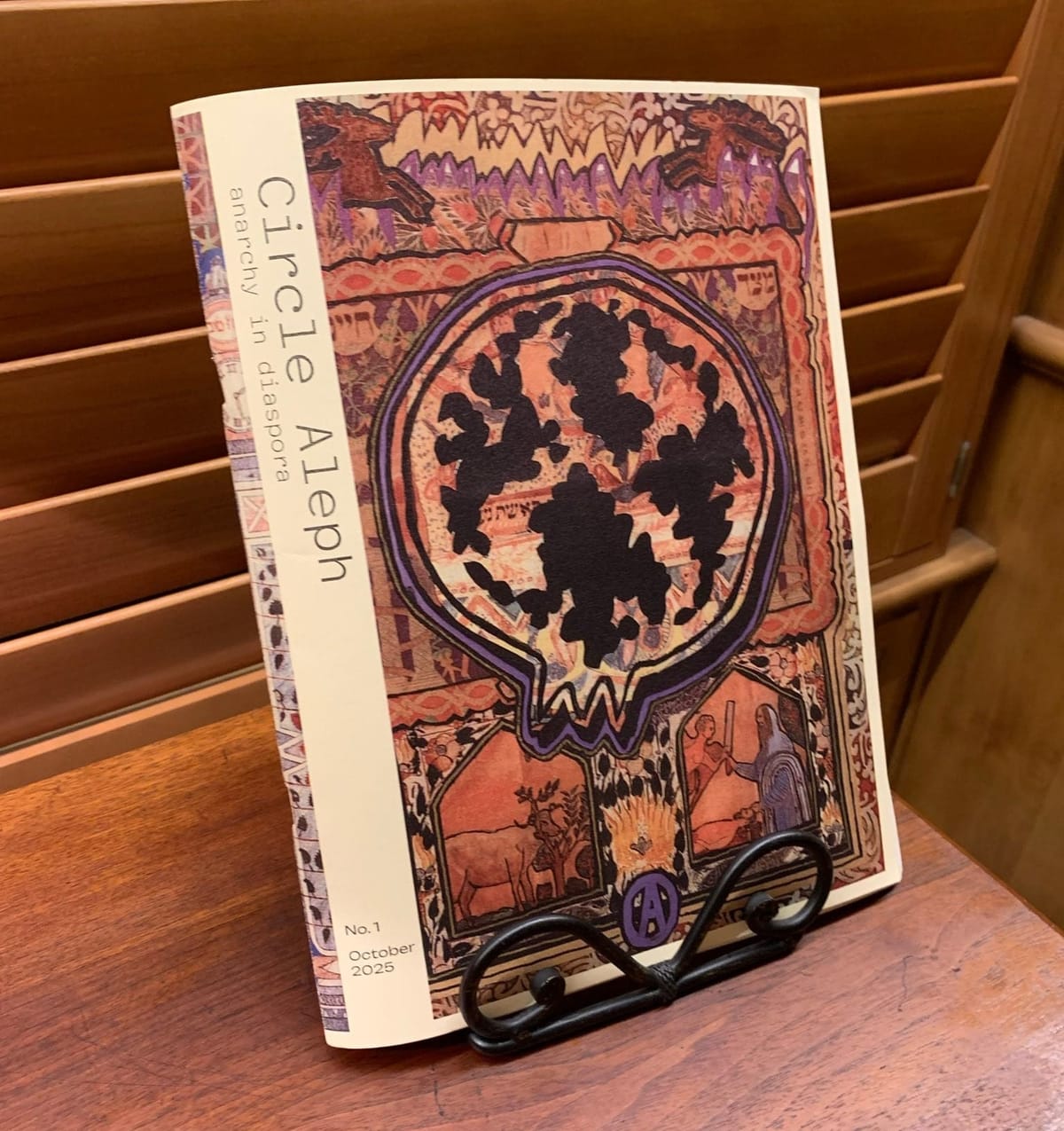
We’re huge fans of co-publishing, which we did last year with Vashti and Elia Ayoub’s Hauntologies podcast. We also love to kibitz with our comrades, sometimes in public! Our editor Malka Leah did so last month in an interview with Circle Aleph, a zine aiming to rekindle the Jewish anarchist literary tradition. Circle Aleph is decidedly print-only and free (“anarchists love free things”), available at radical spaces across the world. You may also request PDFs for at-home printing and distribution (they are not intended for reading on a computer, but they can be requested via email at circlealeph@proton.me). Its editors say the magazine fills a space that they feel has been left vacant on the Jewish Left — a vision that reimagines Jewishness outside of statist terms, rather than folding to false promises of safety by the same powerful people and institutions that work against us. We discuss the importance of print publishing in a digital world, Jewish anarchism’s reclamation of religion, the importance of rejecting nostalgia, and much more.
We hope you enjoy this conversation, which has been edited for clarity. Please click here to learn more about how to get a copy of Circle Aleph and support their work.
Malka Leah (ML), Der Spekter: It's been really cool to see a lot of new, small Jewish publications emerging in the past few years. Can you tell me a little bit about the history of Circle Aleph? Where do you see yourselves in this new ecosystem of Jewish media? And why did you think, specifically, a Jewish anarchist publication was necessary?
Nico, Circle Aleph: There was this sense that I had that I just kept on running into Jewish people in anarchist spaces. And it always sort of was odd to me that there's not a lot of explicitly Jewish anarchist projects. And we got to talking together and we just wanted to address that issue, not only to fill that void, but also to explore why that void existed. Why were there not very many Jewish anarchist publications? And is there some sort of relationship between Judaism and anarchism that we can explore? Can anarchism be an outgrowth of Judaism, or are these two totally separate things that we're bringing together?
Raquel, Circle Aleph: I think also for me, the specificity of not only a leftist Jewish publication or a radical Jewish publication but one that's truly a Jewish anarchist publication, both its center and its periphery, was really important, because in the last few years, especially, there have been a fair amount of radical Jewish things, but not a lot of specifically Jewish anarchist publications or other work.
Nico: To address the part of the question about where we see ourselves in the ecosystem of Jewish media, I think for me, that's a hard question to answer, because you look at this whole gamut of different types of Jewish media. You have religious publications, you have these older newspapers or news organizations like the Forward or Jewish Currents. And I think that what they're trying to address is very different from what we're trying to address. For example, these publications are moving away from having print editions, whereas that's something that we're very actively committed towards. And I think that is an outgrowth of our history as both a Jewish but also an anarchist publication. We are sort of ensconced more so within the anarchist publishing world, and we're approaching that from a Jewish angle.
There's a certain level to which conversation moves so quickly these days on social media, in the digital world, where things can be accessed instantaneously, and there's a certain level of constant back and forth. When you look at Jewish Currents and Tablet Magazine, those publications are really tapped into the social media world and the discussions that happen in the news on a day-to-day basis. I didn't want to become the anarchist version of Jewish Currents.
ML: You mentioned a little earlier that there was a whole tradition of radical Jewish publications before, and I'm curious if you had discovered any specifically Jewish anarchist publications that you took inspiration from, or if there were any either solely Jewish or solely anarchist publications in particular that you were thinking of when you decided to create Circle Aleph?
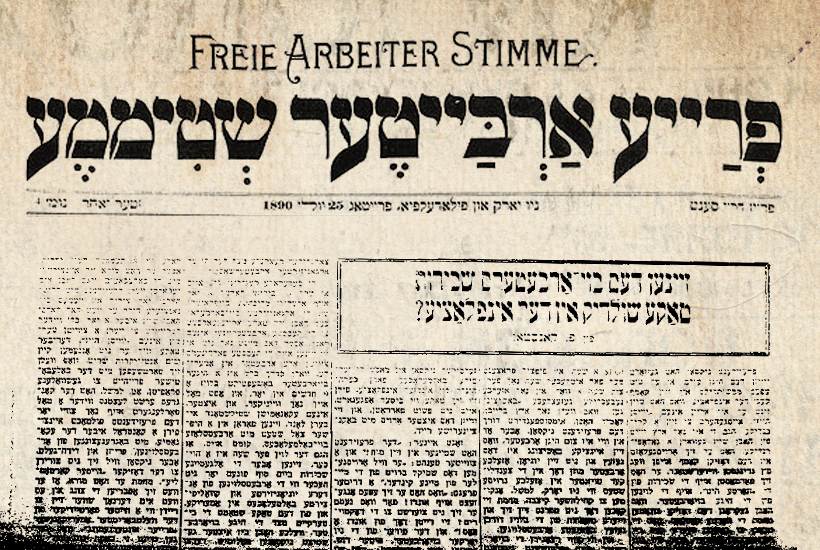
Raquel: One of the longest-running Jewish anarchist publications is called “Fraye Arbeter Shtime.” It ran for, I think, over 40 years, if not much more [ed. note: it was 87 years!], and that was a Yiddish paper in the U.S. Publications like Black Seed and other anarchist media, especially print-only stuff that has later been digitized, have been really interesting to me as a material object, and also in the ways that it allows more organic networks of distribution to happen.
Shmuli, Circle Aleph: I was personally inspired by a print-only anarchist publication, Tinderbox, which is seasonal. You don't know when it's going to come around until you see it. They don't have an online presence, nothing posted on the Anarchist Library website or anything. So I like the idea of that, offline only. And then there's Jewish zines that inspired me, on Jewish Zine Archive, that touch on a bunch of different topics relating to Judaism and anarchism or radical politics. And they'll do different zines for different holidays and touch on that, and those were really inspirational as sort of a piece of literature to have around and draw inspiration from.
Raquel: What I really like about being print-only is that it forces people to make real connections with each other in the places that they're in. They might have to talk to someone to get a copy or go to a physical place where they might find people who think similarly to them and really build in-person, hyperlocal connections like this. That's just not something that you can do if people can just Google you to find a copy.
"The trap of nostalgia is a fear of doing things our own way, a fear of having power to define for ourselves what life ought to be. I think any movement of liberation has to reject nostalgia, because we have to believe, if we want to have control over our lives, that we can do something that's different from the past."
ML: For Der Spekter, we are definitely digital forward, but we were very surprised at the response when we did a physical one-year anniversary magazine last year, just how many people wanted one. And then we did a little meetup event in New York, and a lot of people came up and asked if there was a print edition or if we were thinking of going that way. I'm a journalist in my professional life, so to hear that from people is honestly shocking; it makes me feel optimistic that people still want to access media in that way.
Raquel: People are super tired of looking at their computers and feeling like they have to read everything at once as soon as it gets in their inbox or comes on their feed. I've heard from several people, just being able to sit with the copy on their coffee table and read one article every few days when they're drinking their coffee or something like that has been a really nice way for people to engage with it.
ML: Could you talk a little bit about the history of Jewish anarchism — did it ever overlap with Bundism? I’ve studied a bit of Chinese history, and many Chinese communists came to communism originally through anarchism. So I was curious if there was a similar historical relationship there with Jewish anarchists as well.
Raquel: Jewish anarchism started existing at the same time anarchism became a named ideology. The need to resist oppression, especially in Central and Eastern Europe, drove people towards radical ideology in order to survive and thrive, with or without spirituality, or often replacing spirituality in some cases. In Eastern Europe, Jewish anarchists organized as such, and not with Jewish communist friends; there were enough radical Jews to have that specificity in their organizations and social lives as well.
Nico: If I had to summarize, I would say that the relationship between the Bund and Jewish anarchists very much mirrored the relationship between anarchists and other socialists more generally in that there were a lot of points of overlap and ways in which they worked together, but at the same time, also conflicts. And you can see that in the Russian Empire and its successor states, Poland, Ukraine, Latvia, Lithuania, etc., there were all these dialogues between Bundists and socialist revolutionaries and anarchists and Bolsheviks, and they had moments in which they worked together, and they had moments in which they fought. I think that the Bund was kind of the more radical edge of the Marxist movement in Eastern Europe. And at the same time, there was this commitment to internationalism and this commitment to transcending these national boundaries that I think a lot of other socialists didn't necessarily adhere to. You can see that in World War One, the German Social Democratic Party voted for war credits. But I think that the Bund, because of the position they had as Jews and socialists, they had a different perspective. And I think Jewish anarchists also shared that perspective of not clinging to narrow nationality and instead trying to embrace a broader movement that can bring people together.
ML: Where do you see Jewish anarchism fitting into the broader spectrum of the Jewish left today, but maybe also within the spectrum of anarchism in the US? You mentioned that there hasn't been much of a scene in a long time; do you see that starting to change?
Shmuli: One of the pieces in issue one (of Circle Aleph) talked about this a little bit, but looking at the history of Jewish anarchists, initially many of them were very anti-religion. They were coming from a place where they saw the society and the religion of their upbringing as authority, and they were rejecting it and rejecting society by rejecting religion. They had Yom Kippur balls, where they would eat ham in front of the synagogue on Yom Kippur as a mockery of religion. Now, looking at the scene, it's almost the opposite, where it's more spiritual, kind of reclaiming religion rather than rejecting it, of rejecting the things they don't want and sort of making it their own, which is a nice change, and that's kind of the direction I’ve seen it going in the past 10 years or so.
Raquel: There’s been a real revival of spirituality within anarchism in general. And I think this is in part due to the prominence and importance of movements like the #NoDAPL protests, where spirituality and religion are at the forefront of the struggle, as well as Black radical traditions that don't necessarily have any conflict with religion. And so I think that allows people to look at their own ancestral or adopted traditions, not just of politics, but also of religion and spirituality, which don't necessarily always go together.
I think we're in a really interesting moment where you can really be a Jew and an anarchist; those things aren't in conflict. And in fact, we all really noticed, in our individual scenes, in anarchist organizing projects that we were in, when we asked, up to 70% or 80% of the people who we were working with were Jews, but we weren't organized as such. And so that was a really interesting realization, at least for me.
Within anarchism, more broadly, there are more individual groups based on heritage that have worked on their own development for a while, but also within the mainstream of anarchism in the US in general, Jews have always played a really big part without necessarily writing about Jewishness or the Jewish experience. Jewish anarchists have always been part of what anarchism is in the country that we're in.
Nico: One thing that I think, regretfully, is an ever-present elephant that we always have to address is the centrality of antisemitism in organizing on the right. And even though I think that it would be a mistake for antisemitism to define us as Jewish anarchists, it is important to talk about, for antifascism as a tradition within anarchism, how we relate to that as Jews. We play an important role in terms of combating antisemitism, combating fascism, analyzing these trends on the right, and providing our perspective on it. I think it's really valuable, because there's a lot that gets missed sometimes with certain non-Jewish perspectives on antisemitism. Not that you have to be Jewish to oppose antisemitism, but unfortunately, antisemitism plays a major role in politics.
ML: I'm curious to know if, historically, Jewish anarchists were completely secular, completely against religion. And as you said, that seems to be changing today, and it's actually something that I find limiting about Bundism. I feel that religious community is one of the strongest ways these days to build community, even stronger than politics, because so much of our secular culture has been lost, and it's great that people are trying to rebuild that, but I think we also have to start with the structures that we already have access to. The Bundists felt that these religious structures were fundamentally hierarchical and oppressive, and that's changed a lot today. Jewish Currents had talked about this because they've also started bringing religion back into their pages, and that's been controversial. Historically, is there a similar tradition among Jewish anarchists? And how do you feel about how that's moving and changing?
Shmuli: There definitely were religious anarchist Jews in the early 1900s at the origin of this movement. There’s a really good book by Hayyim Rothman, “Portraits of Anarcho-Judaism,” and it discusses the anarchist minyan [and] touches on different rabbis who have anarchist perspectives or how anarchism was found in their Judaism or their Judaism was reinforced by their anarchism. Being Jews, we're always questioning everything, we're always supposed to be asking questions, and that overlaps really well with anarchism and their questioning of authority and questioning of rules and laws and how they can limit you.
Raquel: Something that’s happening with Jewish anarchism religiously right now is the idea of alternative or self-made orthodoxies. Most religious Jewish anarchists, I would say, aren't really doing a traditional orthodoxy. But one thing anarchists especially have a really good handle on is creating a strong set of rules for themselves and then sticking to that. So it's not necessarily as individual as that might make it sound, or as isolated. But I think Jewish anarchists are creating their own ways to be religious, rather than the same exact religion as was so oppressive to some Jewish anarchists in the past. And I think that's really important; being anarchists allows us to be religious Jews, rather than the other way around.
ML: Where do you see Jewish anarchism placed in the Jewish Left, or on the left more broadly?
Nico: I know for myself, personally, and I don't want to speak for all of the other editors or all of our writers or the people who contribute, but my idea of [what] Jewish anarchism should be in relation to the broader Jewish Left is not necessarily going to IfNotNow and saying, “We don't like how you're doing this; you need to organize an anarchist way.” I don't see us as doing that. I think there are Jewish anarchists out there who definitely try that kind of approach. For me, we are trying to completely change what it means to be Jewish.
Anarchism is such a radical project that if anarchism is going to have an input on what Judaism ought to be, then it's going to radically change what Judaism looks like in the future. And so, to get more specific about this, when it comes to anti-Zionism, I think there's a certain perspective or strategy that a lot of Jewish leftists adopt, which is to emphasize this moral force or to accept some level of responsibility for the actions of the United States or for Israel. It's not as if Israel has nothing to do with Judaism or that we have no power over how the United States exists in the world as people who live in the United States. But what I would say is that when we reinforce our role as citizens and we adopt a strategy of trying to get governments to change their policies and adopt a policy more in line with our vision for the world — this sort of international law, [a] utopian dream of world peace — the anarchist critique would be that we don't need to even need to approach things that way. We need to approach things from the perspective of, we need to completely, radically dismantle the state through direct action. The way in which a lot of those on the Jewish left view power is often not really so different than the way that those on the Jewish right do, which is an appeal to other people who have power to protect us or to change the way they're doing things, rather than an attempt to create Jewish power that isn't just reinforcing certain hierarchies. Hopefully what we can provide to people is just a completely different way of being Jewish, instead of just an anarchist flavor of Jewish leftism.
"Being Jews, we're always questioning everything, we're always supposed to be asking questions, and that overlaps really well with anarchism and their questioning of authority and questioning of rules and laws and how they can limit you."
ML: Do you have some writings in the first issue that cover this? I’d be very interested in reading more about that.
Raquel: It's a throughline in a lot of different pieces. I'm not totally sure that's the topic of one of the pieces, because that's partially the baseline that we're working from: that the contributors to the magazine share that political sensibility that the state will never work in our interests and we shouldn't try to get it to.
Nico: It’s maybe also a point of disagreement that we have with some of the people who write for the magazine. The essence of the magazine, or the ethic of the magazine, is that it's a submission-based project, so we don't tell people what to write. We don't assign people to say certain things. We don't have permanent columnists. We don't have editorial meetings where we go over what sort of things we want to publish. We don't really tell people “no” unless it's so far outside the bounds of what we consider to be Jewish anarchism that we cannot print it. So what you'll see when you read Circle Aleph Issue One is actually some disagreement within the pages about what Jewish anarchism means and how we relate to the broader Jewish Left. Because I can say that there's definitely people who write for Circle Aleph who do see themselves as Jewish leftists who happen to be anarchists as well, and they just want to bring in that anarchist approach to what I think we could call this movement, whatever that might mean. It means so many different things. I think it's still incredibly diverse, even though there are a lot of points of commonality.
ML: I was really excited to see the callout for submissions for the next issue on the topic of spiral time. That’s something that I’ve always found fascinating, this idea that Jewish time is different. I just read the book “Zakhor,” about Jewish memory and Jewish history and how the idea of Jewish history itself is so new. So I'm very interested in seeing what people will submit. But can you talk a little bit about why you chose that topic and how it relates to anarchism?
Shmuli: It was in one of our earlier meetings, where we were pitching themes, and I recently read the book [The Jewish Anarchist Movement in America by Joseph Cohen]. In that book and other books about anarchists in the early 1900s, you see all them working on these projects, these different publications, newspapers, raising money for legal support or social centers or printing equipment. We've been doing the same thing for over 100 years, and rather than getting discouraged by it and thinking, “Nothing's changed; we're always still raising bail for the homies and fixing broken printers,” it's like, “Yeah, this is what we do, this is who we are.” We should see our ancestors and how they did things and build off of that and be inspired by that fact. That was one thing I took away from the spiral time pitch.
Nico: This is permeating the ether of leftist thought, but a sort of critique of capitalism and time — or maybe not even capitalism, but just even civilization generally. You see this in the Soviet Union, but this focus on growth, on progress, this progression towards the gradual accumulation of capital in the future, to keep moving forward, to keep building, until what? Until it all collapses, until every aspect of life is monetized? Who knows.
What I find attractive about the spiral time idea is this notion that there is a certain rhythm and regularity. It's not to suggest that nothing changes. That's the spiral of spiral time. It's not purely cyclical, but it's not linear, either. So there is a notion that there are core aspects of life that we hold dear, and it's these gatherings we do together, the things we do as Jewish anarchists, the things we do as Jews, and we can change those things. But there's also a continuity there.
Something we really want to emphasize is moving beyond nostalgia. And this could be a really interesting point of conversation with Bundists and anarchists, and also between Circle Aleph and Der Spekter. For Jewish anarchists, there's a tendency to say, “Oh wow, look at Emma Goldman, look at Alexander Berkman. So cool, I wish we could do all the same things they did.” And there is a certain degree to which this nostalgia is limiting. I think that it kind of is the same for Bundists, I'm sure. There are so many amazing successes and cool things that they did, but also, at the same time, it's a different historical situation. The trap of nostalgia is a fear of doing things our own way, a fear of having power to define for ourselves what life ought to be. I think any movement of liberation has to reject nostalgia, because we have to believe, if we want to have control over our lives, that we can do something that's different from the past. We have the capacity, we have the intelligence, we have the confidence to really define ourselves. And so that for me was really what I found interesting and a great point of contact between Judaism and anarchism.
Raquel: I can read a little bit of writing that we did for an in-person event on the topic:
“The question is, what is spiral time? Well, it's the theme of our second issue. A lot of the work that we've been doing in the curation of Jewish anarchist art and writing is the process of tending to what's coming to us right now, in our moment in the sun. In our first issue, we noticed several prominent themes: grief; both connection and disconnection from the past; visiting but not dwelling in our histories; and a joy that can only come from success in doing things our way, together. To be Jewish is to dwell in story just as much as we dwell in the world that is manifest in front of us. Whether the stories are from Torah and Talmud, our mother’s youths, or from teachers we find for ourselves, we communicate by handing stories back and forth, with a twist or a little remark tacked on the end to make our own relation to these stories clear. The spiral is the shape of the network of stories we hand between each other. The origin points glint away into nothing, and the story is handed down until it becomes the seed of another. Along the way, there is change in the characters, the setting, the language, the audience. Again and again, when we come back around to tell the story, we find there's some parts forgotten and we have to make up something to fill the gap, or there's just something else to say than last time.”
ML: What can people see in the first issue, and where can they get it?
Nico: In the pages of the first issue, we really tried to have not only diversity in terms of thought and what people believe, but also in terms of format. There's poetry, there are excerpts/scenes of plays. There's your traditional political essays, there's satire, many sorts of visual art, including paintings. There's actually a link to some Yiddish techno music, which is really awesome, and the person behind it is really, really cool [ed. note: Shoutout to Chaia!]. And so when people get a copy of it, we hope they check everything out.
Shmuli: And if they hate it, they should respond to it and tell us why they hated it.
Nico: Yeah, call for haters.
And for the second issue, we wanted to expand. We wanted recipes, erotica, videos, ASMR, we wanted to be as radically expansive in terms of what we can include as possible. And I think this was really a plea to think outside the box and differently in terms of how we approach Jewish anarchism.
As for where you can get it, we have shipped out copies of the first issue to anarchist bookstores, radical and leftist bookstores, and info shops all over the world. But we've also been taking requests for people to get individual copies if they don't live in a place with an info shop. And in the future, we're hoping to really radically expand our distribution and just really push to get it in as many different places as possible, but with the emphasis on it being an in-person experience.
Raquel: We're working on a distribution partnership in Europe; it’s not finalized yet, but it's something that we are aware of and are working on. What's really ideal for us is if people are willing to print out as many copies as they want for them and their friends and then read it, talk about it, and respond to it together.