The Socialist Uprising in Austria
A translation of the writing of Henryk Ehrlich in honor of the anniversary of the Austrian Civil War.

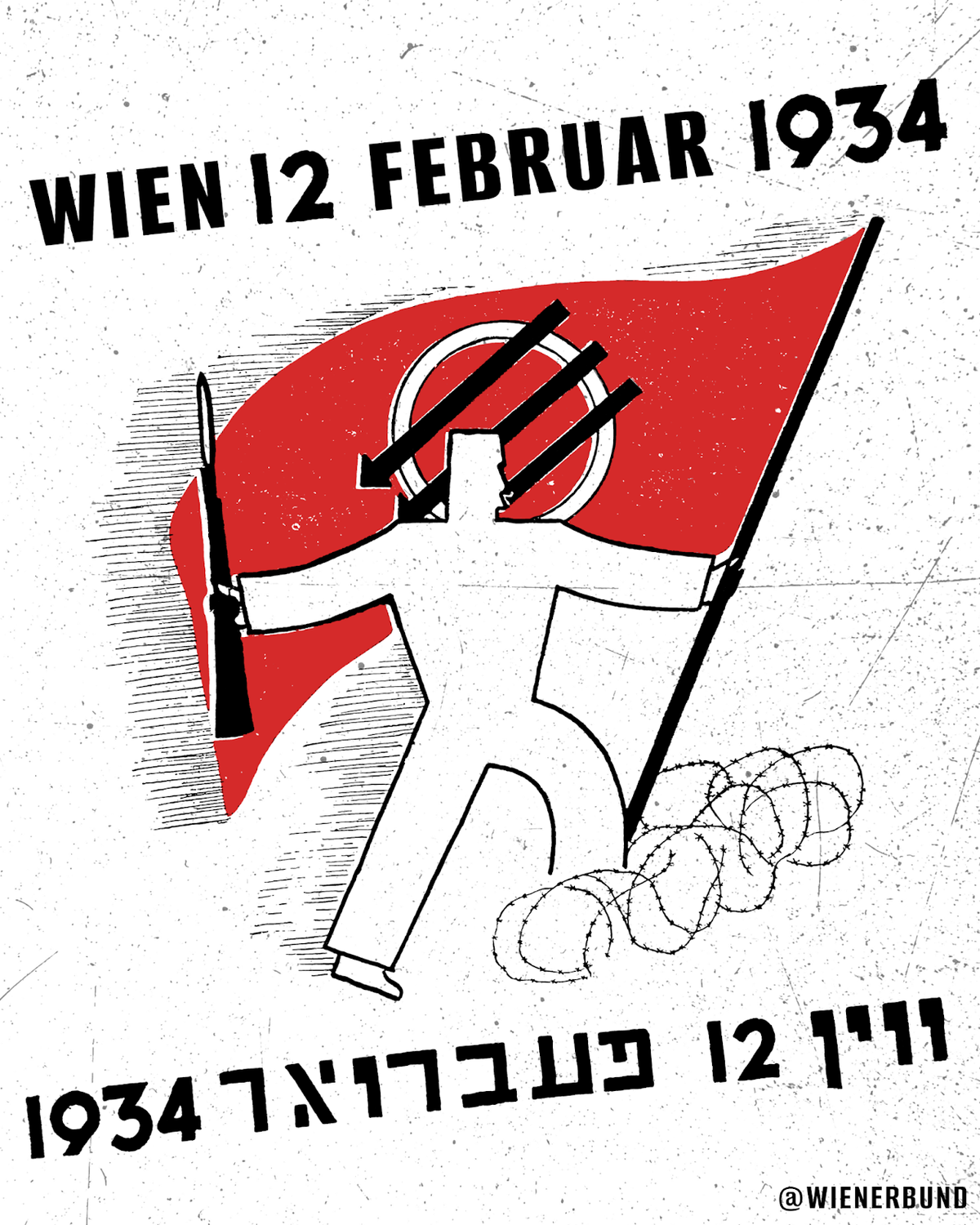
February 12, 1934 was a big day in the history of the European left. In France, the socialists ordered a general strike against a recent attempt by the far-right to seize power (many of these same far-right and fascist forces would later go on to collaborate with the Nazis during World War II).
In Austria, a short civil war began when thousands of workers, organised primarily around the paramilitary organisations of the Social Democrats, attempted to resist the usurpation of power by an increasingly fascistic dictatorial government. While each led to wildly different outcomes, they both acted as a wake-up call for socialist movements around the world, still largely shell-shocked by Hitler’s rise to power, demonstrating that active resistance to fascism was possible.
Henryk Erlich, editor of the chief Bundist newspaper Folkscajtung, wrote an article in the immediate aftermath of these events. “The Socialist Uprising in Austria” was considered important enough to be included as one of the selected writings in the Alter-Erlich Memorial Book — originally published in Yiddish in 1951, and translated into English by Samuel Portnoy in 1990. However, Portnoy translated some, though not all, of the articles included in the original Yiddish version, and “The Socialist Uprising in Austria” was not one of them. Given the recent anniversary of the February Uprising in Austria, I asked my father, Barry Smerin, a renowned Yiddish translator, to help bring it back into the public consciousness.
Given the state of the labor movement today, great pompous slogans about the working class rising up and bringing the economy to a standstill may sound a bit delusional and LARPy to us (that being said, recent uprisings in Minneapolis and other American cities are certainly inspirational). But, to anyone who doubts Erlich’s perspective on what was going on in Paris, one only need to look at the New York Times report on the strike above the fold on the front page for confirmation. On the other hand, while the situation in Austria was not as spectacular as may be gleaned from his article, this can largely be explained by the limited information that was reaching Warsaw in February 1934. In an age of instant global communication, social media, and 24/7 news coverage, it’s worth reminding ourselves that until very recently, information took time to travel.
As the Vienna Chapter of the International Jewish Labour Bund mentioned in its commemoration post, a 67-year old Bundist actually fought on the barricades in Vienna in February 1934. But the full history of the relationship between the Bund and the Austrian Social Democrats runs far deeper, and could be the subject of an entire book. A book that, unfortunately, has not yet been written. For now, let’s start with some articles!
The Socialist Uprising in Austria
Folkscajtung, February, 1934
Henryk Erlich
- Paris and Vienna
As we write these lines, the first news of the general strike which the socialist trade unions and the French Socialist Party called for yesterday has already reached Warsaw.
For all intents and purposes, life in Paris came to a complete halt. The trams, buses, taxis and underground trains were all on strike. Newspapers did not appear. The only paper which did get published - with the help of fascist strike-breakers - was the monarcho-fascist Action Française, but the striking workers prevented its distribution.
As well as the factories and workshops, the strike covered the post, telegraph, telephone and radio services. Paris was cut off from the outside world.
This first show of force by the French proletariat, and its determination to fight a corrupt capitalist society’s attempt to defend its right to theft and corruption with the help of fascist dictatorship, was exemplary – a brilliant manifestation of strength!
**
However, while tensely awaiting news from Paris, we suddenly received the first telegram from Vienna about the spontaneous outbreak of a strike in the Austrian capital and the bloody events in Linz. The fact that it has proved impossible to get through to the editorial office of Vienna’s Arbeiter-Zeitung by telegraph shows that the events are still ongoing.
“The Twelfth Hour has struck in Austria,” we reported a few days ago. Today’s telegrams confirm that judgement in full. We have been reading the news of little Austria and its large, impeccably organised proletariat with bated breath. Convinced that conditions are ripe for a fascist upheaval in Austria, the fascistic Heimwehr troops launched their final assault on the Austrian proletariat.
And with heart in mouth, every conscious proletarian asked himself:
“Is the German tragedy about to be repeated in Austria? In Red Vienna too, will the fascist gangs be able to establish their rule without resistance from the workers’ masses?”
So the first feeling which news of the events in Linz and Vienna will arouse in each of our readers will doubtless be one of immense relief: No, the Austrian workers will not let themselves be strangled. They will bitterly resist the fascist gangs!
As this issue goes to print, the streets of Linz are the scene of bloody clashes between workers and troops. The Viennese workers have also come out to fight, and little Dollfuss’s government is threatening them with bloody repression. This is no time for evaluations. At this fateful moment, we wish only to send the heroically fighting Austrian proletariat our heartfelt greetings on behalf of the Jewish workers of Poland and assure them of our warmest fraternal solidarity!
- Help the heroic Austrian proletariat!
The battle has been raging for two days and nights: on one side, the fascistified state police, gendarmerie, and troops, together with the armed gangs of the fascistic Heimwehr.
For years now, the Austrian counter-revolution has been building, “cleansing” and strengthening its repressive apparatus. The armed forces now fighting the Austrian working class with the latest instruments of war are an army of hired soldiers, a solid instrument in the hands of the Austrian counter-revolution.
Against them, on the other side of the barricades, stands Austria’s socialist proletariat. In the bitter armed conflict now raging outside every worker’s home, in every street and on every patch of ground - in the life-and-death struggle that will determine the fate of the Austrian proletariat for years to come and have colossal importance for the whole international workers’ movement – the socialist proletariat stands alone.
And that is the source of its decidedly organised character. On the basis of the first telegrams from Vienna, we reported the “spontaneous outbreak” of a strike in that city. But only a few hours later it was clear that it was an organised strike which had been decided in advance. At exactly the same time, a few minutes before noon, representatives of the Social Democratic Party (representatives of the Social Democratic factory councils, according to another account) appeared in the administrative offices of all Vienna’s factories and announced the SDP’s decision to come out on a general strike at 12 noon. And not only the strike in Vienna was an organised response to the bloody battles in Linz; beyond doubt, the armed uprising in Linz was also the response to a directive from the Party leadership not to allow any further confiscations of accumulated weaponry.
The heroic, exemplary struggle of the Austrian workers has now been raging for two days and two nights.
In this exceptionally hard battle, the Austrian proletariat deserves the active support of the whole international workers’ movement. The Central Committee of the Bund in Poland has addressed a demand to the Bureau of the Socialist International that, in response to the events in Austria, it immediately declare a powerful international proletarian action. The international proletariat must not watch the heroic struggle of the Austrian working class passively. Help must be provided, and the sooner the better!
- We shall not forget!
We have just received from Prague the shattering news that the first members of the Republican Defence League tried by court martial in Vienna yesterday were condemned to death. As we write these lines, the sentence has probably already been carried out! Yet another crime has been added to the endless list of bloody atrocities committed by international fascism! One more item has been entered in the horrendous account which the working class will settle with fascism at the time of the inevitable, merciless reckoning. In the pantheon of proletarian immortals who will be forever remembered with admiration, loyalty, enthusiasm and love by every conscious proletarian, one of the most distinguished places will be taken by the eight Viennese proletarians whom the fascists tore by force from the fighting ranks at the moment when, with incomparable heroism and weapons in hand, they were defending the honour of the Austrian and international proletariat.
What is the meaning of Austrian fascism’s latest shameful atrocity? In its official communiqués, the Dollfuss government endeavours to give the world the impression that the resistance of the Austrian proletariat is broken, that the government has gained control of the situation throughout the country. If that were true, little Dollfuss’s shameful act would be a normal manifestation of the filthy bloodlust which victorious counter-revolution always displays towards vanquished workers’ masses.
But we don’t believe the Dollfuss communiqués! The Austrian fascists feel ashamed vis-à-vis their European allies. Through their bloody class justice, they are trying to terrorise the heroic Austrian proletariat and break its wonderful unparalleled resistance.
The events in Austria have shocked workers’ masses throughout the world to the very depths. The working-class districts of Warsaw – both Jewish and Polish – are on the boil, seething with rage. The workers thirstily gulp down every drop of news from Austria. Workers’ meetings are packed to the full, all hearts bursting with desire for action. That’s what it’s like here in Poland, and, according to reports from comrades in Prague, the same is true of the workers of Czechoslovakia, and, without the slightest doubt, throughout the world.
Let us bow our heads in respect, love and loyalty to those who have fallen in our holy struggle. But precisely because of those martyrs, let us remember the living, who are defending their freedom and our common socialist ideal with such bitter determination!