Bikherdik B-tch: "Followers of the Trail: Working-Class Jewish Radicals in America"
David Leviatin's oral history of Jewish labor activists, paired with DJ Chaia's tunes, remind us of the great wisdom found in old political milieus.


Welcome to the first installment of “Bikherdik B–tch,” my new book review series for Der Spekter that will span a variety of genres and offer personal musings, critical take-aways, and hopefully a sense of what radical thought can be gained through every selection. As my main love and expertise as a journalist is in music, every book will be paired with a recommended album or piece of music along with an explanation of how they are complementary.
“And the cops were standing there, the state troopers, and they didn't do anything,” said an old Jewish man named Harry. It was the 1980s and he was speaking to a young first-time oral historian named David Leviatin who would go on to write the book “Followers of the Trail: Jewish Working Class Radicals in America.”
Harry was describing his experience with homebred American fascism in the post-war 1940s to Leviatin. Harry was one of many members of Followers of the Trail, a camp barely upstate in Westchester County, New York made by and for the conscious Jewish working class. The incident he described is notorious to Jewish-American radicals of a certain era, referred to as the “Peekskill riots.”
The incident revolved around a 1949 concert given by African-American communist internationalist singer and activist Paul Robeson (hear him sing the Yiddish partisan anthem “Zog nit keynmol”). The concert was organized through a variety of radical Jewish camps in the area, and was reportedly attended by 20,000 people including the likes of Pete Seeger and Woody Guthrie. With the great attention it got from leftists at the time, the event was also heavily counterprotested by local fascists. This was just four years after the United States defeated a Nazi regime famous for referring to the world of Black and Jewish musicianship as Entartete Musik (“Degenerate music”).
Despite heavy protective presence for this much-anticipated concert, Harry describes a fascist ambush resulting in smashed car windows and the aforementioned cops who just “stood there.” Many of the antisemitic, anti-Black fascists in question were known to be fresh-out-of-the-war members of local VFWs and the American Legion.
This is just one piece of one person's story in Leviatin's book “Followers of the Trail: Jewish Working Class Radicals in America.” Told through oral histories of the members of a radical leftist Jewish camp, the book follows their lives as working-class immigrants in three sections: “Europe,” “America,” and “A Shtetl on a Hill.”
“Followers of the Trail” holds great wisdom and relevancy for our times — not because every account was agreeable, or even interesting — but because it painted a concrete image of a social and political milieu that is once again becoming familiar. Reading first-hand accounts of pogroms, fascist attacks, police complicity and more rings incredibly relevant in the wake of my own eyewitness accounts of state violence and fascist threats in Minneapolis during Operation Metro Surge. At the same time, reading concrete accounts of strikes, labor organizing, communal life and leftist political radicalization will feel aspirational to many of us at this moment in history.
Harry's account is given unabashedly and forces the present-day reader to acknowledge multiple levels of nuance as he gets radicalized to the left, self-identifying as a communist, but eventually spends the last years of his life with Zionist ideals. Harry himself was born in 1902 in the Jewish ghetto in the center of a small town called Kańczuga where he lived out his childhood before immigrating to the US.
The enchanting magic of oral history is that it is often an untapped wellspring — an enormous opportunity to freshly theorize and understand humanity.
Kańczuga was initially a town mixed between Hasidic Jews and ethnic Poles under the Austro-Hungarian monarchy. Here, Harry was sent to compulsory government school where he was beaten for speaking Yiddish, then witnessed violence and looting from local Poles and invading Russians during World War I before being liberated anew by German and Austrian armies. After he moved to the United States, the same town would be occupied during World War II, eventually being holocausted by the Germans who one generation earlier had liberated it.
In America, Harry would become radicalized while working as a glazier. He ended up doing work with a few labor organizing groups, and also involved himself in racial solidarity work. Then Harry would join a camp organized by working-class communist Jews called “Followers of the Trail.” When describing what attracted him to communist ideals, he states:
The ideas of communism attracted me first of all because I had a worker’s background and I felt that the worker was being exploited … The main attraction was the idea of equality of people — that everyone is alike, Jews, black people, Indians — there is one human being. This was the main attraction. I remember as a boy I was pointed out as a Jew, that the Jew was different.
Reading about this radical working-class summer getaway and the era of strong unions can feel intoxicating — accounts of heckling scabs and cooperative land ownership abound. Harry and many others in the group also lived through the communitarian boom in America that peaked around the 1960s (for more on this, read some reviews of “The Upswing” by Robert Putnam). How do we learn from these radical accounts of the past and return to them?
This book can also be a starting point for trying to understand and undo the current Zionist consensus which smothers much of Jewish life. Why did value-driven egalitarian communists like Harry turn to the State of Israel which has committed apartheid, genocide, war crimes, etc? The answers are there, laid out directly or indirectly and in context for anyone brave enough to listen to an old man speak his truth (tough sell, I know).
The enchanting magic of oral history is that it is often an untapped wellspring — an enormous opportunity to freshly theorize and understand humanity. Much energy in leftist spaces is lost arguing about “theory and praxis.” The political education or re-education of the self and the masses are both hard to approach under the boot of capitalism as time and money are captured more and more by a crumbling society. Folks simply don't have the capacity to read theory or get in the streets and practice mutual aid. What is one to do?
An answer I often give to people, which “Followers of the Trail” is a prime example of, is to read and engage with oral history. What is an oral history of a human's lifetime if not an account of praxis — of things done and experienced? And when you read each account in all its nuance, the brain naturally synthesizes, looking for takeaways. Voila. You've theorized based on praxis, even if someone else's account of it.
While some in the Jewish leftist movement of today have red diaper baby familial ties to bind them to the Bund, anti-Zionism and other ideals, many in the current cohort of young people don't. The Zionist consensus in much of the Jewish world and polarized state of intergenerational discourse makes benefitting from the wisdom and accounts of our elders in real life even harder.
For a Jewish audience, a book like “Followers of the Trail” can help bridge these gaps by providing a more nuanced understanding of their histories and communities, as much as (and perhaps even more than) a book like Studs Terkel’s classic compendium “Working” — which catalogs accounts from a truly diverse group of people from all walks of life in 1970s Chicago — can do for a general audience. Consuming them is an extension of conventional wisdom — talk to strangers, remain curious, honor your elders.
Album pairing — “Yiddish Electronic” by DJ Chaia
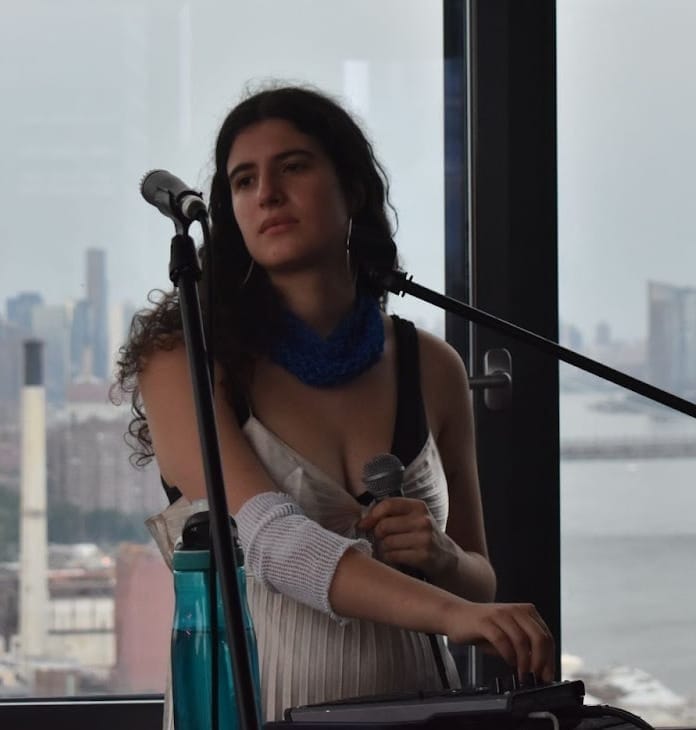
While I could recommend Paul Robeson's many great albums, which include many radical folk songs, there was one album that came to mind to share in tandem with this book: “Yiddish Electronic” by DJ Chaia. In particular, I highly recommend the track “Borough Park” which includes samples of Chaia's own grandmother describing the liberated social milieu she grew up in.
Having interviewed Chaia before, it's no mystery to me that Chaia's music is all about the revitalization of these old political milieus. This is sorely needed as the rotting mainstream of Jewish-American culture today is bereft with kitsch and rubbish — from “not your bubbies’ ____” to the perennial and false implication that all Yiddish culture died with the Holocaust and is being raised from the dead like some kind of frankenshteyns golem. By mixing and engaging with the Black liberatory history of techno music and archival samples of the Yiddish past, “Yiddish Electronic” reflects the reality of our organizing as Jews. While our Yiddish ancestors can inspire our sense of identity in activism today, the organizing we do was most recently trailblazed by and must continue to center and be led by BIPOC folks.