Bundism Today, Part 3: Doikayt
A guide to national cultural autonomy and organising in your local Jewish community

This is part 3 in the author's Bundism Today series. Please read the Introduction, Part 1 (Bundist organizing principles), and Part 2 (Yiddishkeit) on our website.
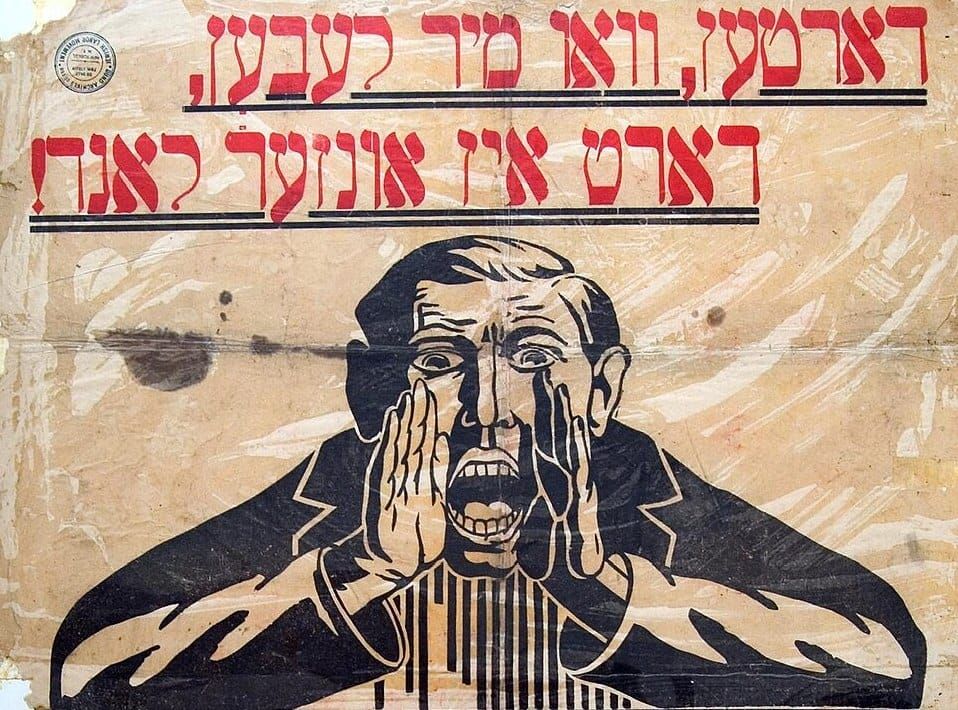
“Wherever we live, that’s our homeland.”
Chances are, if you’ve heard about the Bund, you’ve heard this sentence, too. It succinctly characterizes the Bund’s ideological belief in geographic belonging and attachment.
The 1917 Ukrainian general election poster, from which the slogan was taken (along with the symbol that younger generations have taken to calling ‘Bundy’), was not used by Bundists in any general context. Likewise, the word doikayt (or “here-ness” in Yiddish) was not used by the Bund in the interwar period, nor did it solely “belong” to the Bund when it emerged. It's certainly no panacea magically providing all answers to the future of local Jewish communal life, nor does its sloganeering necessarily provide a sufficient response to Zionism.
Beyond labels and slogans like these lie nuances, complications, and diverse understandings. Where do we live, anyway? Do we live in countries, cities, neighbourhoods, communities, buildings, apartments? If we establish communal institutions to make decisions for Jews broadly, how do we govern them? And how do we engage with pre-existing institutions that claim to do so?
To answer these questions, I want to start by breaking down some general Jewish concepts of ‘hereness’ from a global and historical standpoint, before looking at Bundist perspectives in more localised Jewish communal life. If an arbitrary distinction is to be made, one could make it between a “high” doikayt that looks at abstract ideas of autonomy at a state or global level; and a “low” doikayt, which focuses on forms of organising in community.
Self-Determination: A Dirty Word?
Let’s start off with a relatively simple and hopefully non-controversial statement: from a progressive perspective, every national or ethnic community should have the right to exist in safety and to flourish culturally. With the rise of modern ethnic nationalism in the last 200 years, it has become increasingly common to argue that broad national communities should not be placed under the domination of a minority ruling class, whether as a result of foreign conquest or due to some kind of “native” caste system.
This progressive belief underlied the modern idea of national self-determination. This is often understood in a European context, where it first pertained to so-called "civilised" nations, and later in a more global context, as racist ideas of stewarding “inferior people” to civilisation were challenged by anti-colonial movements. These movements led to the majority of African and Asian countries successfully gaining political independence, even if neo-colonialism still persists in the global economy today.
But even in some cases that might seem clear-cut, the hard reality is that humans are not cleanly divided into national groups, neatly tucked behind state borders. Some groups don't identify with the community they are designated members of. Some groups have internal sub-divisions. Some groups move around a lot. Many groups will never form a demographic majority anywhere. While Kurds, for example, form a demographic majority in some areas of the Middle East, the city with the largest population of Kurds in the world is Istanbul. If a Kurdish state were to be established, what would happen to them? Would they be at risk of losing their rights as citizens and being ethnically cleansed, as happened in the same city with the Greeks?
Geographical areas themselves might be predominantly inhabited by several groups, at which point none form an absolute majority at a local level. What if the groups disagree about the boundaries? Sure, if you zoom in or out enough, you might be able to draw "national territorial divisions," but good luck doing that without pissing off a lot of people—even for a short moment before people start moving again. What if particular national or ethnic minorities in a land are only minorities today as a result of past colonialism, ethnic cleansing, or genocide? Are they just expected to move on without any acknowledgement or restitution, or do they nevertheless maintain some sort of claim to the land?
The only way to enforce a system of nation-based political boundaries long-term is through various forms of state violence, ranging from soft coercion to outright crimes against humanity.
There are a few ways in which one can respond to this reality from a progressive perspective. You may simply believe a world of cleanly delineated ethnostates is an inevitability, with high walls, large armies, and ministries of culture and education on a mission to enforce the correct view of national identity. You may offer some critiques of the more draconian policies, but resign yourself to the overarching framework.
If this is the world we resign ourselves to, of kill-or-be-killed, then possession of a state for the Jews makes sense, and especially so in the aftermath of the Holocaust. Even if it effectively internalises the logic of the medieval ghetto and expands it to a nuclear-armed militaristic state, many Jews who may wish that Israel shouldn’t have to exist may nevertheless deem it a necessity.
But if we are to imagine a better world and work towards it, there is no particular reason as to why self-determination within the nation-state must be seen as an inherently superior form of self-determination — or indeed, the only form of self-determination. Such may be the lessons taken from the terrible catastrophes of the twentieth century — the rise of modern nationalisms, the collapse of multinational monarchies, persecution and mass murder of minorities, the "fixing" of national boundaries that accepted “population exchanges” (what we call ethnic cleansing today), and the disastrous failure of self-described “socialist” multinational states such as the Soviet Union or Yugoslavia.
The world we live in today is different from that of the 1940s. We are connected digitally in ways that would be almost incomprehensible 30 years ago. More economically developed countries are demographically reliant on migrant workforces. Supranational political unions, leading among them the EU, have shown the possibilities of greater freedom of travel and residence (at least for citizens of member states). Even if climate change and military conflicts do not force millions (or billions) of people to move to other countries, this will not change the fact that ethnostates are constructs that do not exist “naturally,” and can only be maintained with political violence. The ongoing global rise of the far right means that the question of collective self-determination for minority groups will remain relevant in the coming decades, for Jews and everyone else. We, however, can start by asking ourselves this: what specific political demands can be made to realise the principle of Jewish self-determination in the diaspora in line with a Bundist worldview?
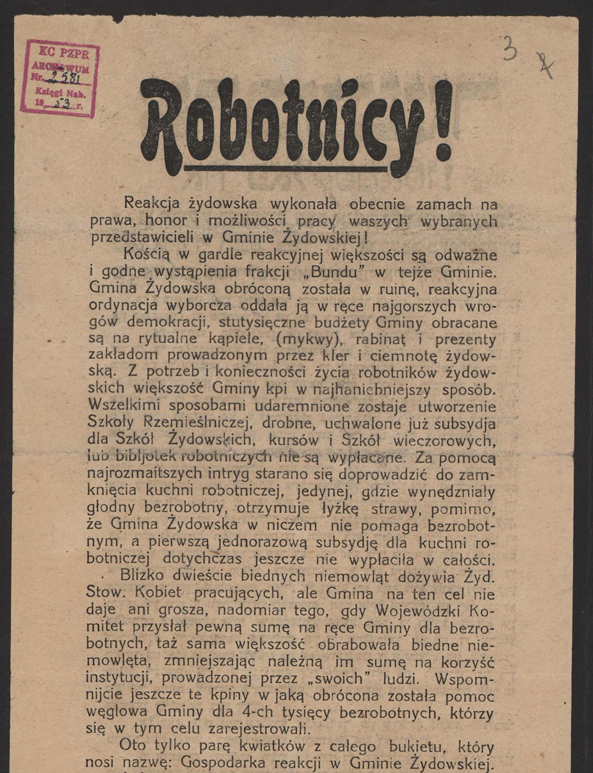

Interwar Lublin Bund statement condemning the actions of the Kehillah Leadership in Polish (left) and Yiddish (right) (Polish State Archives)
National Cultural Autonomy
130 years ago, Bundists and other Eastern European socialists organised in a reality dominated by multinational autocratic monarchies, such as the Russian, Ottoman, and Austro-Hungarian Empires. However, the “National Question,” as it came to be known, was not the immediate priority following the movement’s founding. While freedom from antisemitic discrimination and violence was never questioned among the revolutionary socialist left, institutional demands to support cultural and communal fulfilment for the Jewish national masses were not unanimously agreed upon. Many Bundists during this time would describe themselves as “neutralists,” seeking a middle path of “neither assimilationism nor nationalism.” These discussions began in earnest starting from the Bund’s Fourth Congress in 1901, crystallising in the aftermath of the 1905 Russian Revolution. They took place within the context of the broader Russian revolutionary movement (with strong polemics made against Lenin and the Bolsheviks in particular) as well as the rising philosophies of Austro-Marxism and the various Zionist movements.
What came out of these discussions began to be articulated by Bundists as a policy of “National Cultural Autonomy” — institutional self-determination for minority diasporic Jewish communities. The Bund always believed that only in a socialist society would it be possible for NCA to be fully implemented. But when Bundists began to be elected into Jewish community councils in interwar Poland, they tried transforming them by pushing for general reforms and specific policies based on the principles of NCA. Their approach can be broadly summarised in the following way:
1. Jewish NCA should not be limited to a specific geographic administrative subdivision of a country. Similar models of NCA may be adopted by other nationalities in the same country. Whether Jewish communities in any particular country may wish to adopt a NCA framework is dependent upon local factors.
2. Individual participation in (Jewish) NCA institutions should be voluntary and based on self-identification. The Bundists did not refuse the right for individuals to assimilate, nor did they intend on using Jewish religious law as the sole means of identifying someone as Jewish.
3. The NCA institutions should either receive funding from the government or be able to raise financial levies on their own members. In either case, some sort of institutional relationship with the government should be maintained.
4. The NCA institutional leadership should be elected democratically by the membership base. The Bundists recognised that they would not be the only political organisation competing for power in the Jewish NCA institutions, were they to be established in their ideal form in the near to mid-future. Ultimately, only the victory of socialism would allow for NCA to be fully implemented.
5. The primary task of the Jewish NCA institutions should be to foster cultural and educational development in the language of the Jewish working people. For the Bundists, this was, of course, Yiddish.
6. As for other tasks, there are reports of Bundists using their position of power in existing Jewish communal institutions to socioeconomically benefit Jewish working people (such as by trying to decommodify Kosher certification). However, given that the Bund categorically rejected the idea of creating a ‘united Jewish political voice’ with non-socialist Jewish parties, they did not envisage Jewish NCA institutions as a means of doing so.
There are a few conclusions that can be drawn from this outline. Firstly, while Bundists believed in the state existing as an institution even under socialism, NCA as a policy is not incompatible with a libertarian socialist or even an anarchist framework.
Another aspect worth mentioning is how timelessly the principles can potentially be adapted to Jewish communities around the world today. Admittedly, the Bund never believed that every Jewish community had to adopt NCA as a policy in every country. Until the Holocaust, it generally viewed itself as a movement rooted in the specific context of Eastern Europe, not a global organisation with universalist principles. The idea of a global Jewish nation, or even a global Jewish working class, was seen as hypothetically possible, but too abstract and unrooted in local material conditions as things stood at the time.
There is much more that could be said on this issue. It is an open question whether the geographical Bundist approach limited the potential strength of the movement, and whether the globalised approach that came in the 1950s was done out of sheer necessity and too late to make a meaningful difference. But the bottom line is that if Bundist (or Jewish autonomist-socialist-diasporist) movements emerge around the world, they may face different contexts whether they are Ashkenazi or Sephardi, Brazilian or Belgian, sparse or dense. Given that the world, including the Jewish world, is more interconnected than ever before — in a way that historical Bundists could never have imagined — it would be foolish to not cooperate on a deep level, including on the belief in NCA.
Lastly, anyone who objectively looks at the general state of existing Jewish communal institutions today will see how far they are from the ideals of Bundist NCA. For a simple rundown:
- Many communal institutions have no mechanisms to democratically elect their leadership or influence policy decisions, or the democratic mechanisms are so bad that they are not worth considering as up to any reasonable standard.
- In some communities, the idea of publicly criticising the leadership is considered taboo, which creates an oppressive climate that is not only harmful to meaningful debate, but also fosters corruption, nepotism, and exploitation.
- Many Jewish communities in a single area are only religious congregations of a particular denomination. That may be their right, but it’s also our right to criticise them if their leadership claims to speak on behalf of the Jewish community while refusing to provide an inclusive space for certain Jews from actively participating in Jewish communal life.
- Many Jewish cultural or communal organisations needlessly duplicate each other's work without cooperating. This may sound surprising coming from a Bundist, but while divides on important things are important and should not be swept under the rug, divides on stupid things … are stupid. Especially when resources are already limited, as in many small communities. Don’t get me started on Poland.
Participation
All of this criticism of mainstream Jewish communal institutions begs the question: Why should we try and transform these institutions in the first place? Is it not better to try and build new Jewish communities and communal institutions from scratch? How can Bundists and other Jewish leftists be expected to enter into such spaces, when so many have felt uncomfortable or shunned in them or have never been able to join in the first place? By entering into the same spaces as racist or right-wing Zionists, are we not legitimising such views in some way?
It is an extremely personal decision to individually participate in any space or organisation — particularly so for individuals who have experienced harassment, ostracisation, or even threats because of their views or protected characteristics. However, the situation is a little bit different when discussing political movement strategy. Apart from some highly authoritarian sects, it is perfectly possible to believe that an organisation should engage with another organisation, without forcing all membership to participate against their will. And vice versa — a political group may not deem another organisation worth officially engaging with, but wouldn’t penalise individual members for doing so.
If there is a model for institutional Jewish self-determination that is worth fighting for today — one that equally encompasses Jews all over the world, one that doesn’t require an ethnostate constantly perpetuating racist policies towards Palestinians and failing to return on its promise of “safety” for its Jewish citizens — then that model will be based on democratically-elected, accountable, and interconnected local Jewish communal councils. While in some communities this may mean establishing new institutions entirely, the only way in which we can move forward is through deep engagement and understanding with existing local Jewish communities and the actually existing Jewish communal institutions that claim to represent them. The point is not to become friends with those whose views we find horrific, nor to hide our views to make ourselves more likeable. Quite the opposite — we should be in the room to challenge homophobia, Islamophobia, anti-Palestinianism, and all other forms of bigotry. If such people are given space without being adequately challenged, as in many Jewish communities, our non-participation increases the reach and legitimacy of those tendencies, not the other way around.
This is by no means a zero-sum game. Deep engagement does not forbid the creation of Bundist or leftist cultural organisations, spaces, collectives, or communal spaces and events. The Polish Bund recognised in 1924 that the system of Jewish community elections was unfair, since it denied women and certain working-class Jews the right to vote. While obviously arguing for universal suffrage, it still chose to participate in a bad system, seeing it as another site of political struggle.
If the Bund can offer any inspiration today, it is in this matter. Ever since it adopted its policy of NCA in the early 1900s, it was only natural that its focus would turn towards already existing Jewish communal institutions, rather than trying to create new ones from scratch. In 1908, Vladimir Medem spoke about the “Kehillas” (Jewish religious councils serving as de-facto forms of communal self-government), arguing that "no matter how horrific these institutions are, they nevertheless remain organs of self-government, and the road to autonomous self-government leads through these institutions” and called for “a kehilla more democratic, enriched by new tasks and freed of old ones. It should become a bridge [between them], and our future political activity should focus on it."
Engaging with the Kehillas by no means meant downplaying their problems. In interwar Poland, the Bund’s 1924 Kehilla election programme argued for ridding them “of all rubbish, darkness and terrible superstitions, inherited from the rules of clericalism which have lasted for entire generations” and that until the aim of secular Jewish community councils was reached, the Bund had to make sure that the Kehillas did not act against the interests of the Jewish masses. Four years later, the Bund continued to argue that the structure of the Kehillas constituted a precursor to NCA, and that the Bund must struggle for the gradual transformation of congregational councils into secular self-governing bodies. While the Bund leadership initially wished to boycott the 1936 Polish Kehilla elections, under pressure from its membership, it changed course. The results exceeded expectations, and the Bund became undoubtedly the largest Jewish political movement in Poland.
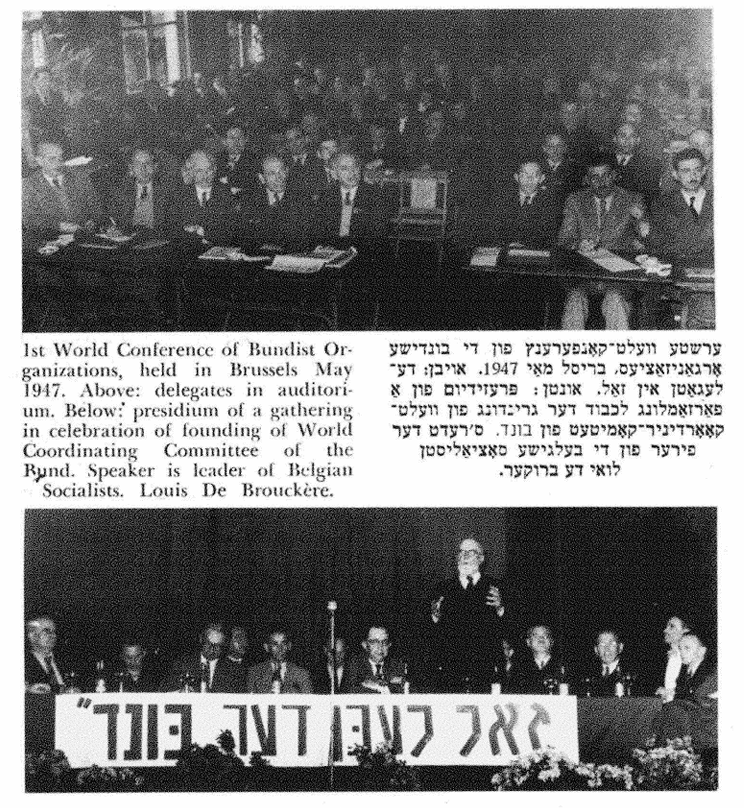
The Kehilla elections were not the only arena in which the Bund could flex its electoral muscle. It performed extremely well in the 1938 Polish municipal elections. (In Latvia, the Bund had a member of Parliament). But following the Nazi genocide, electoral politics for explicitly Jewish political organisations became largely impractical. If there remained any political arena for Bundists to test their strength, it would be Jewish communal institutions. In 1947, for example, during the first World Conference of the International Jewish Labor Bund in Brussels, the following resolution was adopted:
The BUND members should attempt to transform the general Jewish bodies formed in some countries during the years of war (e.g. in France, Poland, et al.) into truly democratic institutions, representatives of which would be chosen by the Jewish inhabitants of the respective countries themselves. Where no such institutions exist, the BUND organization should consider it its duty to lead the fight for the establishment of a Jewish autonomous body democratically elected by the Jewish people.
Within the framework of these autonomous Jewish councils, the BUND is to assert its stand concerning all matters affecting Jewish life in general, resist all forces of Jewish reaction and assimilation, and struggle for the cause of a progressive, secular Jewish culture.
And again in 1955, at the third World Bund conference in Montreal:
The Third World Conference of the BUND expresses satisfaction at the progress made by various BUND organizations toward becoming important and influential factors in Jewish communal life in their respective countries. In addition to building their own auxiliary organizations, the BUND movement in a number of countries has participated in establishing and expanding those general Jewish organizations that play a constructive role in Jewish communal life.
Whenever feasible BUND organizations should support the efforts to establish central Jewish communal organizations (Kehillas) on a secular and democratic foundation. The Third World Conference of the BUND deplores the fact that many Jewish communal bodies are still dominated by bureaucratic and undemocratic leaders. The conference urges that the democratic base of these bodies be broadened to provide for true democratic representation.
Like fellow Bundists a generation earlier, the Bundists of the 1950s were under no illusion that this participation would be idyllic:
Within these general Jewish organizations, as among Jews generally, we strive for our socialist ideals, for secular Jewish culture, for the dignity and rights of Yiddish. We resist Zionist and assimilationist ideologies as well as clericalism among Jews. We are strongly opposed to the Zionist negation of the possibility of Jewish life in the countries of our residence and to the drive toward Hebraization of the Jewish people.
The Bundist vision is clear. The form of Jewish NCA that would best fulfil the ideal of Jewish diasporist self-determination would be institutions operating over specific geographical areas (municipal, regional, national) with specific departments and committees to implement and control the decisions of democratically elected Community Councils. This institution would be able to maintain relations with municipal, regional or national governments, as well as with the wide range of different Jewish communal institutions.
A Path to Victory
Once we accept that for Bundists, mainstream Jewish communities are one of our sites of political struggle, with the ultimate goal of NCA, what should be our strategy? Whether secular or religious, there are many kinds of institutions that strive to build Jewish community, or whose leadership claims to represent the Jewish community of a given area.
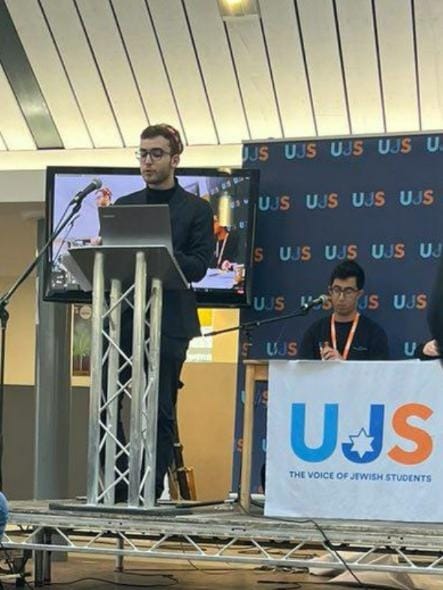
Once you decide on an institution to be involved in, what do you do once you enter the building? Well, much of what I discuss in this section is based on my personal experiences, particularly in Jewish student organisations. They have some unique quirks of their own, such as usually not being particularly worried about halakhic status (such as whether or not you have a Jewish mother). Much of what I believe about them also fits into a framework regarding non-student institutions, adapting historical Bundist values and practices to our times.
As a start, you need to get rid of one particular thought that may be lingering inside your mind: entering mainstream Jewish spaces is not “infiltrating” them. We have every right to be involved in community spaces that claim to represent us. We are not placing ourselves behind enemy lines. Hiding your political views is also not the point — there have been plenty of self-described left-wing Jews (some Zionist, some not) who tried to moderate their public stances in order to gain a position of power within a communal institution, only to find themselves without any allies once in power and unable to do anything beyond the most incremental of progress.
The best-case scenario is that you do this work together with your fellow Bundists or “Bund-curious" people. You don’t have to make friends, but being friendly can go a long way. From the perspective of others, it will become much harder to call someone a self-hating Jew once they’ve had a few polite conversations with you, as opposed to exclusively online interactions.
In every community, there will be plenty of small ways to contribute that are fairly non-controversial: an extra pair of hands to clean up after a Shabbes dinner, an additional volunteer to help the seniors, someone to help write the newsletter. Be patient. You won’t notice these opportunities immediately. Maybe you won’t be trusted right away, especially if your politics are already known. There’s also nothing wrong with stepping back for a little, or just taking the opportunity of a community Shabbes dinner to hang out with your friends — you are not a professional revolutionary. But over time, you’ll start noticing lots of things that could be done better. Simple ways to build a better, locally-rooted community.
From a Bundist perspective, there are endless ways in which you can help nurture Jewish culture, like organising a Yiddish event, a communal library (or helping the existing one), or a cooking class. Unless you intend to do crude political propaganda, the majority of the community will likely support such work in principle and gain respect towards you.
You should constantly be on the lookout for any discussion of socio-economic issues. Not every opinion will be a good one, but there’s a good chance that people will talk about their job, their house, their cost of living, and so on. For obvious reasons, there is a special place reserved for us regarding Jewish labor organising. Be careful, especially regarding working conditions in the institution you might be in at the moment. Over time you will start noticing possibilities of organising Jews around such specific issues (a Jewish caucus within the wider environmentalist movement, perhaps), or ways of making them relevant within the Jewish communities (e.g removing meat from community meals as a contribution to animal liberation). Making Jewish communal institutions economically inclusive goes hand in hand in making Jewish communities more inclusive for members of marginalised communities — trans Jews, Jews of colour, patrilineal Jews and so on.
The most touchy matter is usually going to be Israel-Palestine. If you are actively involved in the community in at least some of the aforementioned ways, your reputation will already make such discussions easier for you. In my personal experience, the best way to go about these discussions in a casual environment is to not initiate them. While this may not be the most satisfying answer, being labeled the person who can’t shut up about Palestine will just make people less likely to listen to you — even people who might agree with you.
Conversely, you should always be ready for the subject to come up at any point. These are your chances to present your alternative perspective. You let right-wingers know that they will be challenged — if you argue effectively, they might have second thoughts about publicly spewing hatred in the future. You will also hopefully embolden more timid progressive voices who are afraid of being the first ones to speak out.
In an optimistic scenario, you have managed to set up a Bundist group that is actively involved in the local Jewish community, and is not just a bunch of Jewish outcasts that nobody in the community knows or respects. People in the community know about the Bund, and they recognise you and others as members or sympathisers. What comes next?
How are decisions within the communal institution made? Usually, there will be some kind of decision-making group, board, or council. They might do a lot of work, but there’s also a good chance that they are not very well organised. Even nominally democratically elected communal leaderships may not be very democratic in practice.
If you have already been able to organise some kind of event within the community, you may have gotten the green light from a board member — maybe they are a friend, or they just respect you enough to not get in your way. The goal, however, should not be to rely on such interpersonal relationships. The goal is for the communal institution to have a regularly democratically elected communal leadership, with systematic forms of accountability and feedback from the general membership.
The struggle for a truly democratic system will take time, but even before that can be accomplished, Bundists should organise to gain representation in community leadership. The point in this, as the 1924 platform stated, is to make sure that the Kehillas did not act against the interests of the majority of the Jewish community. As the Bund, we should not aim to shape a unified view of the whole community (our coalition partners should be other non-Jewish leftist movements) not anymore than any ethnic, national or religious group should be expected to have “one view.” Rather, we should make the point that there are different perspectives within centralised local Jewish communal institutions — even if we represent a minority view within them.
And yes, in the beginning, we will be a minority. But we will be a loud, organised minority, impossible to ignore by our communal leadership or the outside world. The fact that we would support democratisation of institutions while not confident of winning elections would show the sincerity of our convictions. We are not aiming to make these “apolitical” spaces “political” — they were always “political,” and often internally divided around extremely petty issues. What we support is in the interest of the vast majority of Jewish people, and many of our policies will be individually supported by the majority of Jewish people, even if they were not to identify as Bundists.
From the local Jewish Community Centre to the international Jewish student body, factors might differ depending on the size of the institution, but this is the only real path towards a modern form of Bundist National Cultural Autonomy in diaspora and the Bund becoming, as it was in 1930s Poland, the most powerful political movement in the Jewish community.
Ultimately, a pan-European or pan-American (dare I say, global?) network of Jewish communal institutions with democratically-elected and accountable leaderships, with organic connections to cultural and educational institutions, with voluntary yet engaged grassroots membership, would have every right to describe itself as a vibrant living institutional basis for Jewish diasporic self-determination.
But let’s come back to Earth for a minute.
Schooling
Apart from institutions that claim to represent the Jewish community, there are also Jewish institutions that provide some form of communal service — kosher restaurants, libraries, burial associations, etc. Although Bundists would historically have a lot to say about all of them, there is one particular institution that I would like to focus on, particularly since the majority of those of us interested in Bundist organising today are on the younger side — something that will hopefully not always be the case.
The school is one of the most crucial institutions for communal life in general, but even more so for Jewish communities. Its values and methods are always influenced by political factors. It will, in turn, influence entire new generations in their outlook on the world.
The old Bund took education extremely seriously, being the dominant force behind the Central Yiddish School Organisation (TSYSHO) in interwar Poland, although other political forces had a minority presence, including Poalei Zion-Left. TSYSHO’s educational vision was clearly secular, focusing on practical sciences and literature, using progressive teaching methods, embedding a spirit of confidence in the children, with Yiddish as their unashamed mother tongue. To see the level of pride that Jewish children were supposed to feel for their schools, it is sufficient to watch the documentary “Mir Kumen On” about the most memorable institution run by TSYSHO, the Medem Sanatorium.
The TSYSHO framework stood in stark contrast with the traditional Jewish religious schools for boys (the Beys Yaakov school system for Orthodox girls was in its infancy in the 1920s). Bundists perceived them to be completely antiquated, staffed by unqualified and often abusive teachers, with a singular emphasis of repeatedly memorising religious texts, in cramped rooms that provided a challenging learning experience. The more modern Zionist schools, in which Hebrew was the language of instruction, were also strongly criticised by the Bund.
Yet whatever one may say about mainstream Zionist or Orthodox Jewish day schools in their past or present forms, you have to give them credit for one thing: they exist.
To put it kindly, the Jewish left has in recent years made little constructive criticism of the Jewish institutional system, let alone made any meaningful attempts to create significant institutional alternatives. Sure, there was some discussion generated by the documentary “Israelism,” released in 2023. But while its premise that mainstream Jewish day schools generally do a very bad job teaching the reality about modern-day Israel is largely unassailable from a progressive perspective, the only implied “solution” to the status quo offered by the film is to engage in social activism as an adult. There is no attention given to the idea of reforming existing schools or setting up new ones. The only way, it seems to be, is to walk away.
The best example of this one-dimensional focus comes when “Israelism” fails to interrogate the implication of a sentence uttered by Abe Foxman. During a sit-down interview, the ADL Director Emeritus stated that if he had 100 million dollars to “change the future of American Jews,” he “would make trips to Israel available to any Jewish kid who wanted to go.” The crude anti-Zionist perspective only focuses on the brainwashing nature of this demand, but does not follow up by asking where that kind of money should go instead. Given the exorbitant costs of many Jewish day schools in America, it’s quite likely that many left-leaning Zionist parents could be swayed by a demand to redirect funds going to Israeli propaganda trips into cheaper tuition for their children.
Some leftists might argue that Jewish day schools, alongside other schools based on ethnic or religious divides, are a sign of unnecessary separatism and potentially discriminatory, and that a better solution would be to integrate (assimilate?) Jewish pupils alongside their peers into a single public education system. While this may be unlikely to accomplish on a societal level, as support within the community for separate Jewish day schools remains rather high, the strength of such voices on the left could at least provide opposition towards organised action in this regard.
I would argue that Jewish day schools can educate their pupils in a rich cultural and communal atmosphere without isolating Jewish children from their non-Jewish peers. To this demand, Bundists should add demands of financial accessibility, rooting in local culture and geography, thorough religious and secular education (not just teaching a particular type of Judaism and ignoring all other types), the right to learn Jewish languages other than only Hebrew, and active anti-racist education, particularly about Palestine. Local circumstances can determine whether these can be best advanced within existing teaching institutions, or by the creation of new Jewish day schools with Bundist influence — this will largely depend on the size of the Jewish community and the strength of the Bund. Practical work with teachers and parents will hopefully diminish the largely defeatist mindset that currently exists on the Jewish left in this regard.
Existing Jewish communal institutions, regardless of the politics espoused by their leader, should form an integral part of Bundist organising efforts. A positive vision for non-nationalist self-determination can be easily articulated, rooted in and adapted from historical examples, for today’s diasporic communities. But there exists another crucial aspect of what ‘hereness’ means, one that we must absolutely not ignore — the actual physical environment in which Jews live. More on that next time.