Feygele
In “Children of the People,” Baruch Charney Vladeck tells the stories of Bundist revolutionaries, many of them women

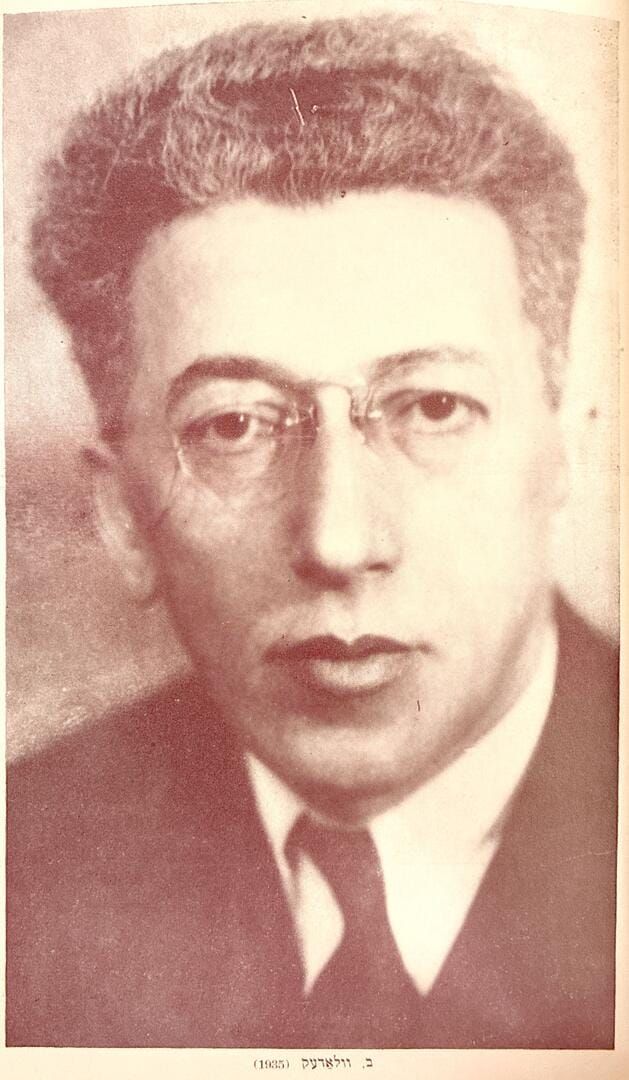
Few remember Borekh Charney Vladeck (né Borekh Nakhman Tsharni) (1886–1938) — Bundist revolutionary, socialist politician, and organizer — for his literary output. This is not a knock on his literary accomplishments; there’s simply so much else to remember him for, including, according to Molly Crabapple, helping to create the socialist political legacy in New York City that paved the way for Mayor Zohran Mamdani. Yet Borekh Vladeck was very much a writer, in addition to his now more well-known accomplishments in politics and as business manager of the storied socialist Yiddish newspaper “Der Forverts.” I was reminded of this when paging through the edited volume, “B. Vladek in lebn un shafn” (B.C. Vladeck, His Life and Works) (1935), in which I first encountered “Feygele,” the nonfiction story — really a vignette — translated below.
Within “B. Vladeck in lebn un shafn,” “Feygele” is included in a collection of short non-fiction prose pieces entitled “Kinder fun folk” (Children of the People), a title that moved me. (A note: while the word “feygele,” meaning literally “little bird,” is perhaps better known now in the U.S. as a (now reclaimed) derogatory term for queer or feminine men, here it is simply the diminutive form of the Yiddish name Feyge; the derogatory use of “feygele” probably postdates this story by twenty years.) The pieces that make up “Kinder fun folk” were first published in the New York Yiddish periodical “Di Tsukunft” (The Future) between 1909–1913; “Feygele” appeared at the latter end, in 1913. The figures in these stories include many new and seasoned revolutionaries, but also the people who love, care for, and seek to protect the revolutionaries: an old woman who becomes adopted by a band of young Bundists seeking a meeting place; a young man, arrested for petty theft, who reconnects with his brother the political prisoner for the space of just one tantalizingly short day, before the brother is shipped off to Siberia; a child whose family lives close to the prison in which Vladeck and his comrades are imprisoned, and who befriends the lonely men there against her parents’ wishes.
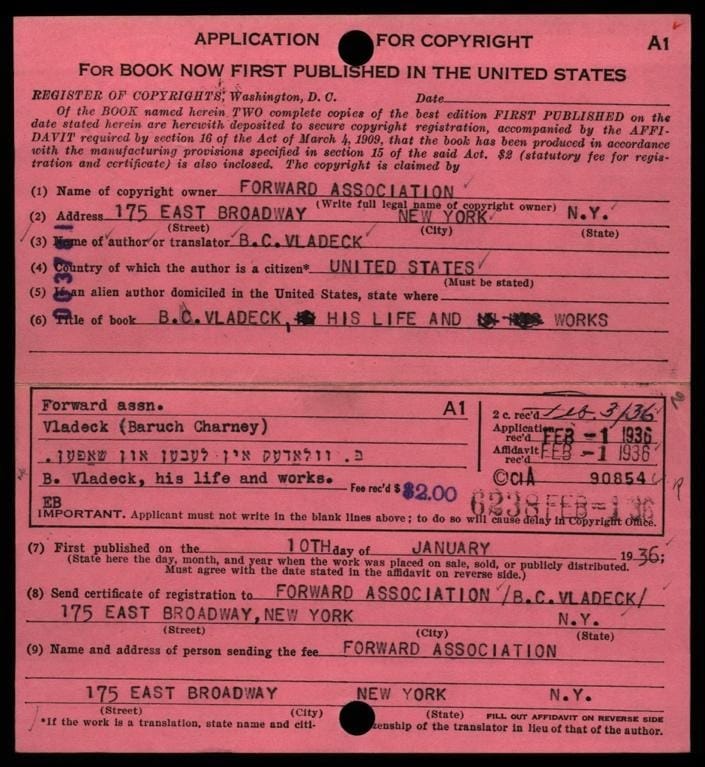
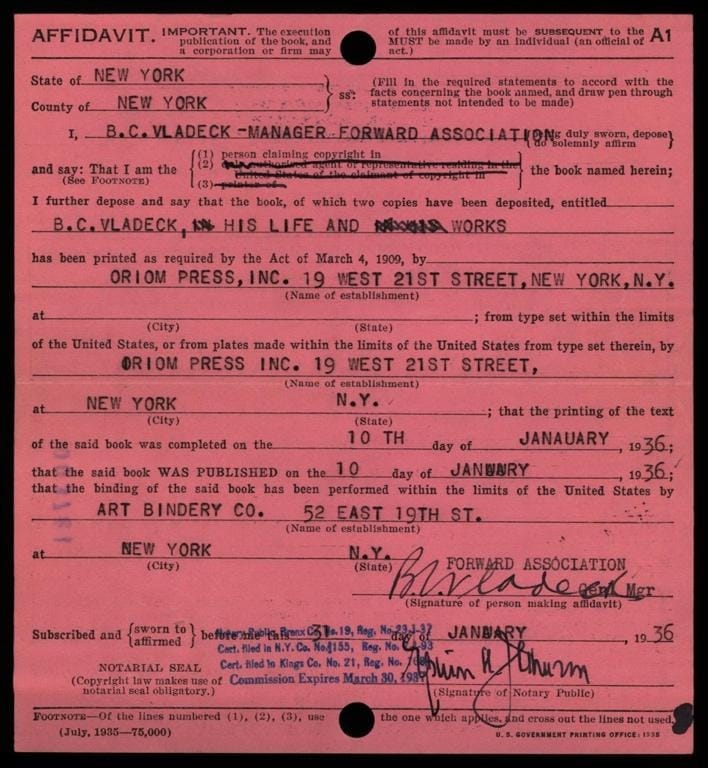
Copyright application for the publication of “B. Vladeck in lebn un shafn”
These are stories of people who have survived the collapse of a major workers’ movement — the failed Russian revolution of 1905 — and, often, been destroyed by it. Vladeck, who was not fully destroyed (I think here of a phrase his younger brother, the writer and memoirist Daniel Charney, often returned to: to be burnt and burnt and never fully burnt up), remains witness, his presence registered only as a light touch in these almost journalistic vignettes. Many of the Bundist figures who appear in the collection are women — thrilling given the still-dominant narrative that women, and certainly Yiddish-speaking Jewish women in Eastern Europe, were not living dangerous or political lives in this time. There is true pathos to their fates — madness for Feygele, and the implication, if not outright indication, of sexual violence; death for others — but also a clear heroism and respect in Vladeck’s portrayal of them.
These figures are “children of the people” in the sense that Israelites, in the Bible, are “children of Israel” (beney Yisroel). It’s a fitting blend of religious and secular language for a figure like Vladeck, who grew up in an impoverished Lubavitch Hasidic family in Dukor (Dukora, in modern-day Belarus) and became known as a brilliant yeshiva student before going on to achieve prominence in the Bund in Minsk and elsewhere. In a time in which leftist Jewish activists are often disowned by Jewish institutions and leaders, I found his assertion of these radical young people and their loved ones belonging to the “folk” to be very beautiful indeed.
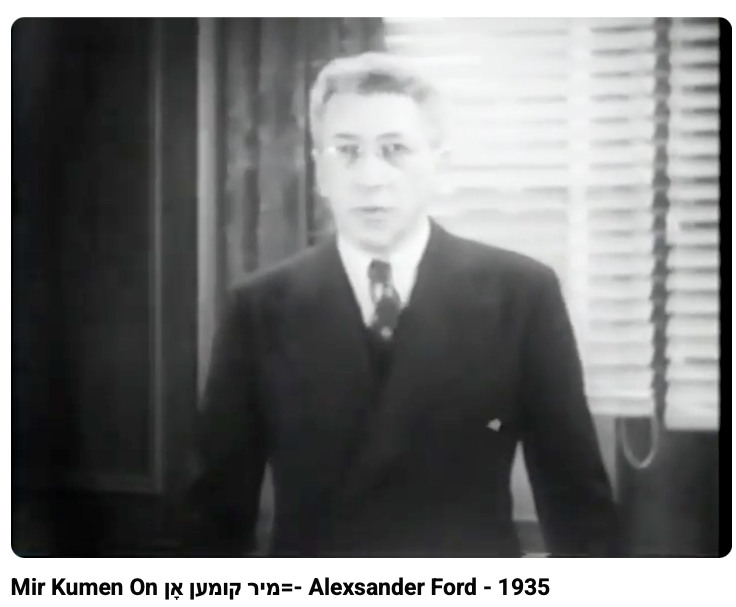
For more on Vladeck (though by no means an exhaustive list): See Jonas Franklin’s 1972 dissertation on Vladeck, “The Early Life and Career of B. Charney Vladeck”; Ephim Yeshurin’s 1936 edited collection, “B. Vladek in der opshatsung fun zayne fraynd” (literally, “B. Vladeck in the Estime of His Friends”; registered in English as “B.C. Vladeck: 50 Years of Life and Labor”) — note that the final 50 pages are in English; Melech Epstein’s “Profiles of Eleven” (1987); and Michael Casper’s YIVO lecture on Vladeck’s work on public housing. For a rare clip of Vladeck speaking (in English) only a few years before his death, check out frames 6:18 to 10:14 of the 1935 film about the Medem Sanatorium, “Mir kumen on” (Children Must Laugh).
“Feygele” by Borekh Charney Vladeck
From “Kinder fun folk,” published in “B. Vladek in lebn un shafn” (B.C. Vladeck: His Life and Work) (1935)
Translated by Jacqueline Nekhe Krass
“Feygele,” we called her; even Ezriel, the cold, tall, gloomy representative of the “Committee,” called her that, she was so childish and so lively, like the bird she was named for. And everyone knew that Feygele always accomplished what she set out to do, and that Feygele was someone you could trust with even the most important duties.
Must I add that she was also very young and very beautiful? When Feygele came to a meeting, everyone smiled, and there was never a lack of volunteers for work.
So you can imagine that when Feygele quit the Bund and became a Socialist Revolutionary*, the whole city, it seemed, went around as though in mourning, and the Socialist Revolutionaries teased us, and Feygele stopped smiling at Bundists and went by as though she were a great big bomb and the smallest movement could set her off.
Later Feygele became a “Maximalist,” an extremist in the Socialist Revolutionary Party, and it wasn’t long before we learned she’d been implicated in a key terrorist act.
Through clandestine but reliable sources we heard that Feygele was one of the most active Maximalists and that she laughed very, very rarely.
And so a year went by, and they arrested Feygele and sent her far, far into Siberia, into the distant countryside of Narimski Kray, and from there she ran away. On the way from Siberia to Paris she stopped for a day in her home city, in Minsk, and there, in a small, narrow little room in a far-flung suburb, she spent an hour with me in nervous conversation.
“You say you don’t recognize me, I’ve grown so old and sad? It’s nothing, I just need to rest a little, that’s all. It all went quite well, and the running — what a delight! How quickly the Yakut drove his horses! And the thick tundra flew by like in a panorama, but Taganka Prison broke me.”
Feygele fixed her eyes a couple times at the door, then quickly drew them back, but the more she spoke, the more often, I noticed, she threw her eyes at the door with a half-hidden terror.
“It was all right there, and the waiting for the prisoner procession to Siberia almost didn’t bother me. But that natshalnik, the warden, was a scoundrel. Give me my shawl, pozhalesta, it’s cold in here. Yes, normally the natshalnik just came to Pavierka and then went away. The first days he was even very polite and went so far as to permit me a svidanie, to say goodbye to some acquaintances, but he was a scoundrel and — ”
Here Feygele coughed a little, and it seemed to me that she coughed more than she needed, in order to break up the story she was telling.
I asked her to proceed.
“Well, as you know, in Taganka the light in your room stays burning all night. Waking up in the middle of the night once by chance — a hard bed it was! — and looking, not willingly, toward the door, I spied in the glazak, the peephole, a little human eye. Nu, you think it impressed me, being watched? No! I’m used to it, and it wouldn’t have bothered me the slightest bit, except that it was a man’s eye. A great wide-open eye, with a strange, frightful look. . . I got very worked up, pulled the blanket back over my head, wept, and, listen, I fell sound asleep until the next morning’s call for boiling water.
“But a strange thing — the following night I couldn’t so much as close an eye. I lay and waited. I tried to convince myself that it had been the regular female warden and that I had just imagined that someone besides the natshalnik could have looked in, but I couldn’t sleep a wink. The whole day after that I had a headache, and as soon as they locked my room that night, I threw myself onto the bed like a block of wood and fell asleep until late at night. I awoke with a shiver. The same great, wide-open eye was pressed up against the peephole, and as quickly as I could get on my feet, I heard a voice, low as though it came from a thousand mouths:
“‘And you, young lady, you ought to get undressed — not good to sleep in your things.’
“These words were accompanied by a departing titter of laughter.
“After that I slept no more, not that night and not the nights afterward.
“As soon as it got dark and the prison was quiet, I would lie on the bed with my eyes to the door and listen. I knew the footsteps of the female warden well, and they did not frighten me; on the contrary, they actually made me feel better. But once, on the fourth or fifth night, I heard the sound of the great door that leads to the corridor below me opening with great difficulty, and then everything went quiet again. Ten or fifteen minutes later I heard quiet steps. Yes, quiet, very quiet, so quiet that no ear besides my own could pick them up. I heard how the steps approached and then fell silent at the door to my cell. Ha? No, it wasn’t terror I felt, but my entire being lit up, and my eyes were as if riveted to the peephole. Soon the little cover on the other side of the door rose a bit, and the same great wide-open eye fitted itself against the window. It doesn’t matter, I can talk about it. I get worked up, it’s true, but that happens all the same whether I think or speak about it.
“This went on for two weeks. That’s what’s aged me, all that time not sleeping.
“The last night was absolute foolishness on my part. I didn’t know that they were coming to take us to the prisoners’ procession, to Siberia, and when I saw an eye in the peephole and heard the great, heavy padlock open, I fainted and was put up in hospital for four weeks until the next procession came through.
“As you can see, Feygele’s had some ‘bad luck,’ but as soon as I skip over the border, I’ll finally be able to get some rest, and then you’ll see how Feygele will again sing and dance.”
Now it’s three years that she’s been in the madhouse and the doctors say she suffers from persecution mania. I visited her several times in the institution, and she was always outwardly very friendly to me and inwardly very cold. And asking with an artificial smile about mutual acquaintances, her eyes stayed fastened to the door.
*While Bundists and Socialist Revolutionaries (SRs) were both socialist and anti-tsarist, the Socialist Revolutionary Party, est. in 1905–6, was not Jewish, among other differences, and its Jewish members did not believe in the need for a specifically Jewish party like the Bund. The Socialist Revolutionary Party was known for carrying out political assassinations and terrorist acts; Lenin was wounded by a member of the party in 1918.