Let’s Talk: an interview with Eli Haligua of Avlaremoz
A Jewish media outlet aiming to break the political silence of Turkey’s Jewish community has become a leftist voice for Turkish Jews around the world

In December 2025, I visited Istanbul and Izmir, two cities I had been dreaming of visiting ever since I became interested in my family genealogy. My grandfather’s family, on my father’s side, came to the United States from Thessaloniki, Greece, but had probably resided in Bitola (now in North Macedonia). All my father had known was that his grandparents had come from Turkey (the entire region would have been under Ottoman rule at the time they emigrated), that they spoke many languages, and that they fed him delicacies like stuffed grape leaves and boyoz, the latter of which is now an iconic pastry in Izmir, brought there by Sephardic Jews. But my upbringing in America, like that of many others, was decidedly Ashkenazi.
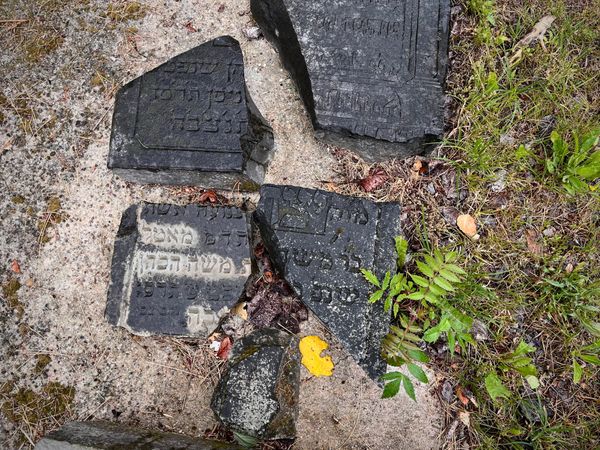
Many of Izmir’s synagogues still remain, but many stood destitute without community members to fill them — tens of thousands having left for Israel after 1948 — and plans to restore them frozen due to a lack of funds from both government and international sources. There was also a reluctance from the local community to do anything publicly Jewish in light of rising Israel-fueled antisemitism in the country. The synagogues in operation had layers of security so thick that it was almost impossible to get inside without knowing a community member personally. I was lucky enough to have been connected with some young Turkish Jews in Istanbul who had been living abroad but would be visiting their families for the holiday. At one of the synagogues, we celebrated Hanukkah with the musical stylings of an Ottoman-style choir.
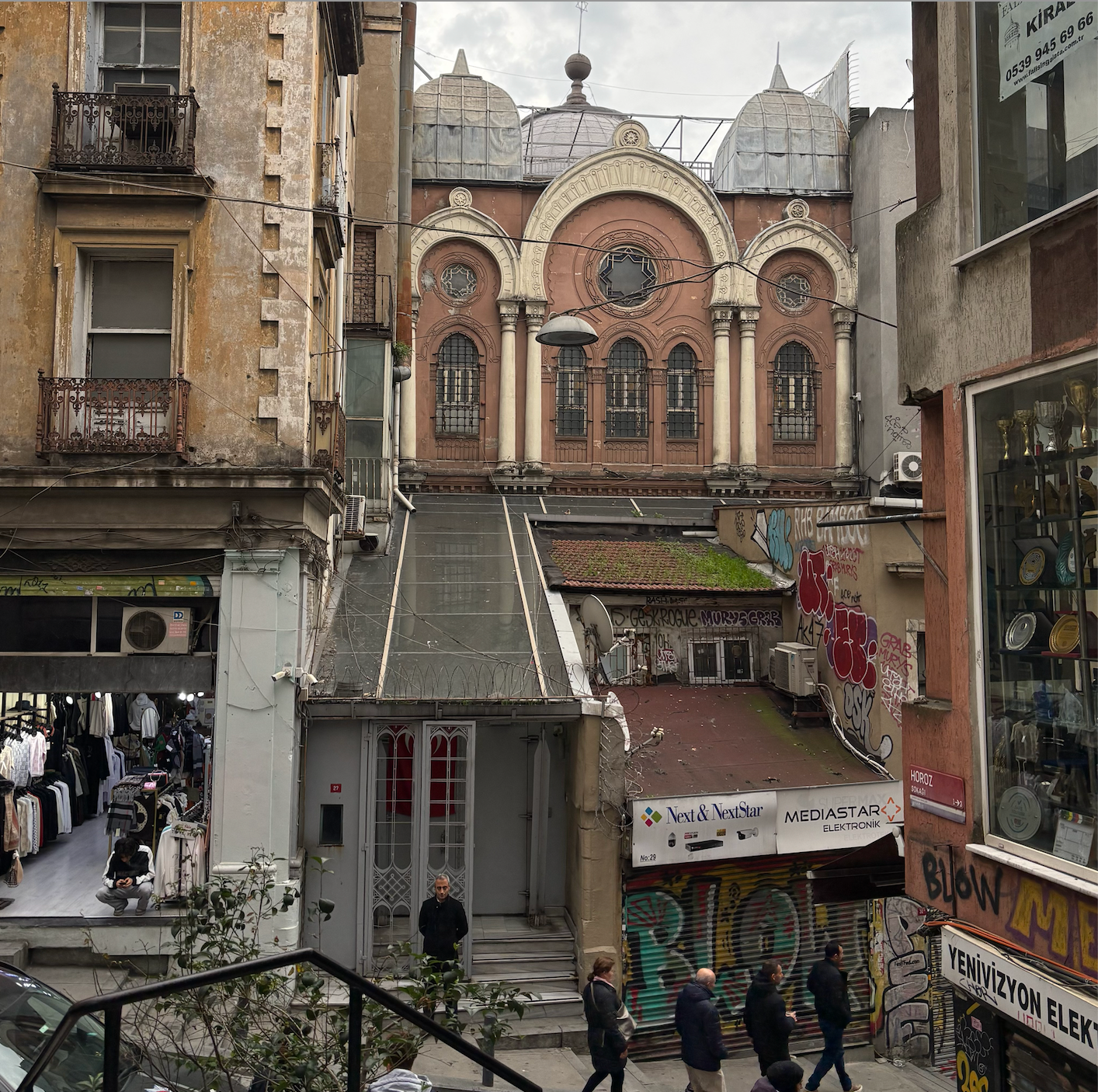
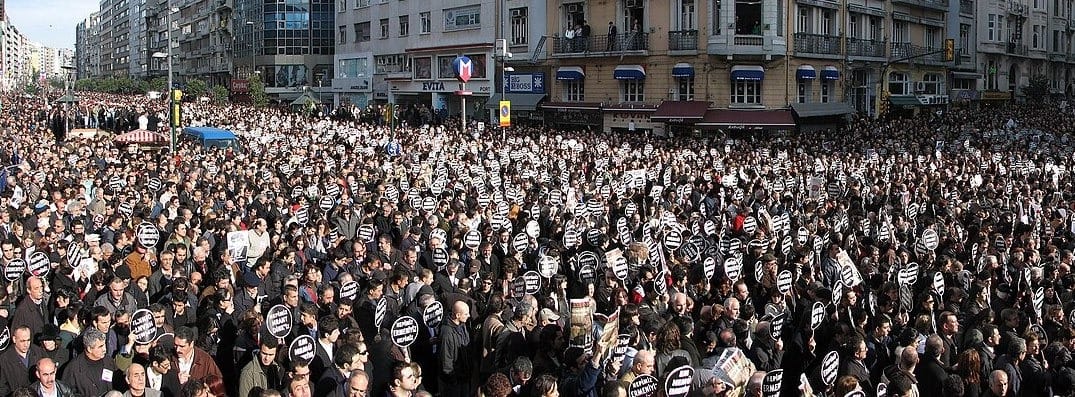
One of Istanbul’s synagogues, Neve Shalom, had been the subject of two terrorist attacks — in 1986, which killed 22 people, and again in 2003 in bombings that also targeted Bet Israel Synagogue. That same day we celebrated Hanukkah at one of the city’s oldest synagogues in Balat, demonstrators gathered outside Neve Shalom Synagogue across the city ostensibly protesting an individual member of the Jewish community who had made pro-Israel comments on social media. But as Avlaremoz reported, the mob instead verbally attacked a tour group that had gathered outside the synagogue and shouted that they could not “‘celebrate the occupation of Jerusalem,’ linking the Jewish religious holiday of Hanukkah with Israel's occupation policies.” In the face of antisemitic attacks much of the community has chosen insularity and silence, kayades.
But in 2016, a group of young progressive Jews started a new publication, Avlaremoz. In Ladino, it means “let’s talk”: about antisemitism, about Israel, about everything. Though most of its contributors are now living outside of Turkey, it still actively publishes about Turkish Jewish affairs and history from a left-wing, anti-Zionist perspective in Turkish (and occasionally English) and recently celebrated its 10th anniversary. I spoke with its founding editor, Eli Haligua, at the end of March. Give Avlaremoz a follow on their website, Instagram, Facebook, and Bluesky.
— Malka Leah, editor
This conversation has been edited for length and clarity.
Malka: Can you start by introducing yourself and how you started Avlaremoz?
Eli: My name is Eli Haligua and I am one of the founders of Avlaremoz. I’ve been publicly organizing since 2005. I was an activist against climate change, and then in the anti-war movement. I was working on an independent radio station, and the main topics were environmentalism and anti-war, culture, human rights, that kind of stuff. I wasn't part of Jewish community at that time. I was born into a Jewish community, my parents are Jewish, and we were living in a Jewish neighborhood. The Jewish Association was one street above us and in summertime we were going to an island where mainly Jewish people were going for the summer. So I was pretty much inside of the Jewish community. But then I started to slowly get away from it during my adolescence, I started to drink and smoke. So we had a couple of friends, and then we were kind of a subgroup in Jewish community. But after university, our relationship was gone, so I had no connection with Jewish community.
After the Gezi uprising [a 2013 sit-in by environmental activists to protest the demolition of Gezi Park in Istanbul, which grew into broader nationwide anti-authoritarian protests], we saw some Jewish names that were arrested or were involved in the demonstrations. So it was the first time for the Jewish community, except me, or three or five other people, who were involved in Turkish politics, as Jewish people. So it was interesting for us, and I started to talk about with my socialist friends, how could we make Jewish people organize around a platform or a website?
And before that, in 2008 or something, I don’t remember the exact date, we published a petition in the newspaper, we were saying that we were against Israel’s aggressive policies and occupation. And it was a huge thing in the Jewish community because they started to blame us. But it was a kind of first movement of Avlaremoz.
And in the meantime, Gezi happened, and then Camp Armen happened. Camp Armen was a summer camp for orphans who were staying there because their their parents were killed during the [Armenian] genocide. And then this Camp Armen was sold and started to be destroyed by a public-private company. So people started to go there and try to protect it. And in this Camp Armen protection, there were Jewish people as well, which was really interesting, and maybe a [turning] point for Avlaremoz. We went to Camp Armen and met a couple of people there, and one Jewish person also wrote an article about it [from the perspective of] her Jewish identity. So and then conversations started, and officially, we started to talk about [how] Avlaremoz would be a good idea.
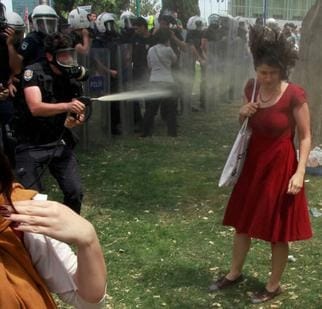
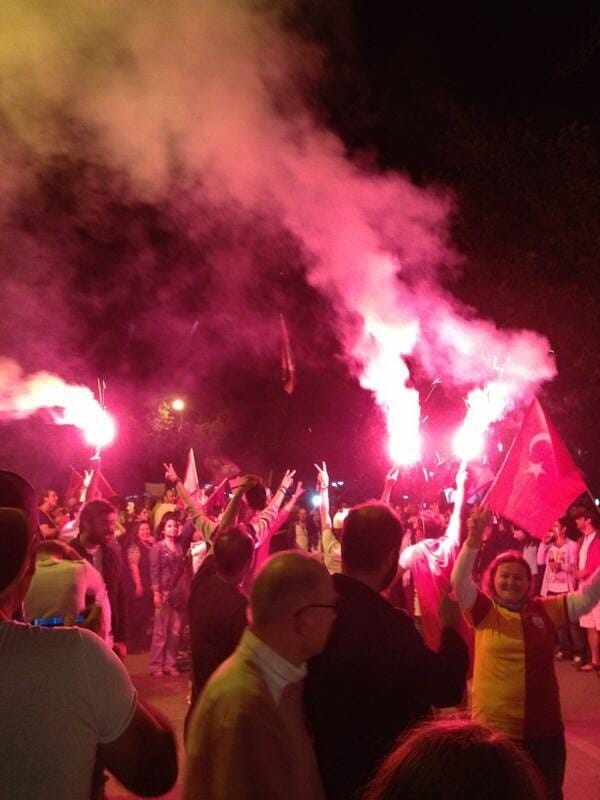
Left: Turkish academic and activist Ceyda Sungur attacked by police officers at Gezi Park during the 2013 uprisings. Right: The protests which started at Gezi Park spread across the country in nationwide protests against Recep Tayyip Erdoğan’s authoritarian politics.
At the time, there was also only one [Jewish] newspaper in Turkey called Şalom. And these people who we met in Camp Armen weren't really political. They were against antisemitism. They were not feeling good about how it was going with Armenian people, about the stereotypes and everything. And also they weren't really happy with Şalom, because Şalom wasn't really talking about antisemitism. And also, there was so much censorship in the newspaper. They weren't free to talk. They were always cutting the words if they would like to write something about the main politics of Turkey. And politically, they were more on the pro-Israel side. And I was anti-Zionist at that time.
But our main topic is not Israel or Zionism. The main thing is, as a Jewish community, we don't talk. It is a desert. There's no ideas, no different voices, nothing at all. Let's publish, and then we can discuss Israel on this platform. We don't need to agree on this, but let's discuss it, and then make Jewish people write, think and talk. So Avlaremoz actually means talk [in Ladino]. Let's talk. And also Jewish people in Turkey don't talk about politics at all. They chose to be invisible. And most of the Turkish Jewish community is Sephardic, and they were saying kayades, which means silence. They chose to be silent.
So it was against this idea, as well as a new generation who wanted to talk about Turkish antisemitic policies, what happened in the past. We wanted to talk about how it was in Turkey, and also in the present, how it's going in Turkey [now].
Malka: It sounds like there was never — at least, while you were organizing there — there was not a “Jewish left.” It was just Jewish communities, and then people who were maybe involved in socialist organizing or left organizing, who happened to be Jewish. Historically, in Turkey, were there any kind of organized left Jewish movements that had disappeared by this time?
Eli: There wasn't a Jewish left movement in Turkey, but there were leftist Jewish [individuals], a couple of people who were part of the socialist movement, but I would say two historical figures maybe, and maybe three feminist women who were involved. They were Jewish, and they were older than me — 70s, 80s. As I said, the Turkish Jewish community mainly doesn't do any politics.
But if I jump to today, we tried to make an anti-Zionist network around the world with Turkish Jewish people, or Turkish-rooted Jewish people. And I realized that there are more people than I know who are more on the left side. I think it's a little bit different than in the U.S., because the U.S. Jewish population is much, much bigger than the Turkish Jewish population [eds. note: the Jewish community in Turkey is estimated to be around 14,300 people]. And also historically, I think, U.S. Jewish people were coming from Eastern Europe. They know the socialist movement arguments and everything, but Turkish Jewish people are not really coming from a socialist background at all. They were doing trade, they were shop owners or factory owners. So we can’t talk about these kinds of roots for Turkish Jewish people as connected to socialism or communism.
But Avlaremoz didn't start as a socialist or left organization. Because the left organizations used to support Jewish people against Turkish nationalism and against antisemitism, and since me and a couple of the co-founders of Avlaremoz had close connections to the left-wing environment in Turkey, they were kind of natural allies of Avlaremoz, and they supported us.
Malka: You mentioned a little earlier that one of the ways you had met some people who became involved was through organizing in solidarity with Armenians.
Eli: Even they weren’t socialists, for example. They just kind of went there to support Armenian people because of the human right minority solidarity, but not from a socialist perspective.
Malka: Yes, I see. I guess I'm curious if there has been any trend, historically or more recently, of Jews working with the other minorities in Turkey, rather than just organizing as Jews.
Eli: Armenian people have a socialist background, Greek people have a socialist background, because their relation with the land in Turkey is a little bit different than Jewish people. Jewish people are one of the oldest immigrant communities of Turkey, of course, they lived there for generations and generations, but they were not like Armenian or Greek people with the land. Because of that, I think it's a different relation. Historically, I think Jewish people tried to be loyal to the government. Armenian people and Greek people were more connected to socialist movements, so they had some other problems with the Turkish government. So they have completely different backgrounds, I would say.
Malka: Can you give us a sense of what the ecosystem is like today inside Turkey for Jews who are still there — are there any anti-Zionist Jewish networks that are organizing in some way?
Eli: Avlaremoz became an anti-Zionist publication after October 7. All [the Zionist] people left Avlaremoz [after October 7] because some of the people were criticizing Israel. [Since] they went, this became just an anti-Zionist platform, because there were no other Zionist perspectives there anymore.
Avlaremoz’s main writers and editors are living abroad, not in Turkey. I mentioned an anti-Zionist Turkish people's Google Group. But most of the people are living abroad, not in Turkey. I know some people who are anti-Zionist and live in Turkey, but they are not organized. They are not amplifying their voices. They're not vocal about Israel, but they feel anti-Zionist. After one article that I wrote criticizing Israel, someone wrote me a message, she was living in Spain, and she mentioned that she was on the subway, and she was reading the article, and she became emotional because she sees that some people think like her, but she wasn't vocalizing personally. So Turkey and Turkish Jewish people, as a community, suppress voices a lot. Jewish people criticize Turkey a lot, but they learn from Turkey a lot as well, unfortunately. As long as there is a different voice, they just try to suppress or cancel them with smear campaigns. It's not really different in the U.S., as you can see, people lose their jobs in the U.S. as well. But in the U.S., I think Zionists have way more force than Turkey. On the other hand, in Turkey, they blame us for trying to take advantage of being in opposition to Israel, because Turkey is anti-Zionist as a country. They say we try to be part of the government so we will benefit from these ideas or we will be protected. Some of the Facebook groups comment that we were funded by Qatar or Hamas.
There are no young [Jewish] people anymore in Turkey. This is the result of antisemitism. All of the youth just left the country. In the weekly newspaper Şalom, my father was saying that every week they [publish] news about how many people died and how many people were born. And there is no birth news. There's always death news in the newspaper, because the population lives there. They are dying because they're 80 years old, 90 years old, but there's no young generation. Of course, there are births, but really relatively less.
I think the only anti-Zionist voices are coming through Avlaremoz. And to be honest, our voice is not so strong because Avlaremoz is a volunteer-based organization, and we all live around the world and we have other professional lives. So we try to continue, and we are not getting money from Qatar, so we can employ 10 people to create a product. We try to make it, but I think it's kind of effective, because so many people hate us in Jewish community.
“Every hardship that causes young people to want to leave the country is a Jewish problem. We cannot ignore this when discussing the future and shrinking of our community. Freedom of expression is also a Jewish problem. Jews also need freedom of expression. Youth unemployment is a Jewish problem. LGBT+ rights are a Jewish problem. Domestic violence is a Jewish problem. Anything that deeply affects any Jew is our problem as a Jewish community.” — from a 2021 Avlaremoz article by Nesi Altaras
Malka: I did want to ask about how there's no young people left, because that was also my impression when I was there. I visited Izmir and Istanbul, and I was lucky to meet some people, but all of them were just visiting their families because it was Christmastime and people were on holiday. To be honest, it kind of made me think about me being here in Taiwan. I came here for a reason originally, but at a certain point it does feel like I'm just avoiding going back. And also thinking about the values I’ve developed working with Der Spekter, of the Jewish Labor Bund, of doikayt and wanting to make an impact where you are, and being really rooted in whatever you consider to be your homeland. And I don't really consider Taiwan my homeland. That's what I think about when I think about going back. And so I guess I just wonder how you think about all this, and also, would you consider Avlaremoz to be maybe a diaspora publication in a way, more for people to maintain this connection to home if they can't be there physically?
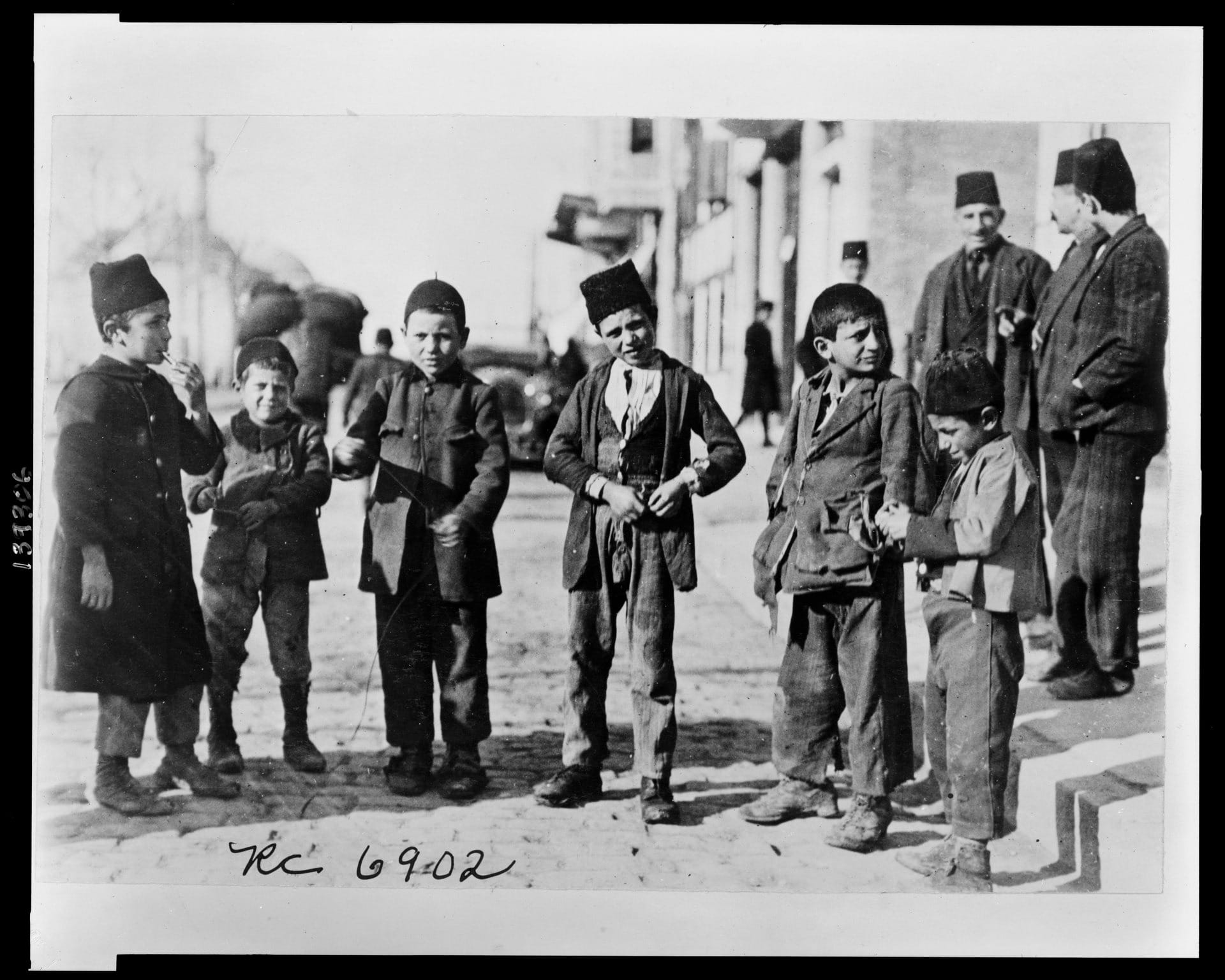
Eli: You’re right, and we are talking about similar things. Avlaremoz became kind of a Turkish Jewish diaspora thing, because we are all living abroad in different countries. But I think we didn't reflect on it a lot because the people who are contributing to Avlaremoz, we are not talking about Canadian Jewish people a lot. I did an interview for Independent Jewish Voices when I first came here, an anti-Zionist Jewish organization in Canada. I did an interview with them and introduced them to Turkish politics. Because my aim with this stuff was because in Turkish Jewish society, there's [not] really different organizations, different ideas. We are not bringing what we see here, we are experiencing here. So the main topic for Avlaremoz now is, I think Israel, but specifically, settler violence, pogroms, as a Jewish state doing genocide. We are talking about pogroms in Turkey against Jewish people, or how Jewish people [lost their] buildings and homes and economic freedom, or how they didn't let them speak their language. Or the Holocaust, how Nazi Germany did genocide against Jewish people. We were trying to keep this perspective: we were sheep as a Jewish people. Now we became the wolf. It's important in Turkey, we suffered from pogroms and antisemitism or settler violence, Turkish people's violence against Jewish people, but now we are doing the same thing to Palestinian people.
Malka: So kind of using this history as a way to speak to the community in Turkey and convince them of your view.
Eli: The main idea of Avlaremoz is talking to the main society, with Muslim society, and talking about antisemitism and how these Jewish people who used to live in Turkey since 1492 and how they were affected. Try to show them Jewish doesn't mean Zionist and Israel. We try to always talk to the main public. And also we were aiming to talk to the Jewish community all the time: kayades is not good. We need to speak against antisemitism or Israel. Because of that, nobody liked us, in a way. Some of the people, pro-Palestinian people, were attacking us: ‘Oh, you are talking against Turkish people. You hate Turkish people.’ They were blaming us. And also Jewish people were hating us. But I think your point was correct. We are trying to talk to the people and try to create empathy. So try to say, this is the fact. And it's clear, obviously clear. But if they don't want to see, they don't see. So unfortunately, now [it’s been] 10 years, to be honest, I will say that they don't see. They see what they want to see. We can't really change people's minds or ideas. They can still believe that we are founded by Qatar. Academic people love us, though, because there's so many resources about Jewish history in Turkey, and also how we are looking at Israel and Palestine is unique because we are putting a Jewish lens there. It’s interesting for them, because we are the only Jewish community or people who is against this genocide. So it's also interesting for the Turkish public.
Kayades is 400 years of culture, so it's really hard to change it. Only the young generation would change it, but now the young generation doesn’t live in Turkey. So because of that, for me, Jewish community of Turkey is a dying community. So maybe in 100 years time, we won't talk about any Jewry in Turkey.
Malka: I did also want to ask you about antisemitism in Turkey. Anti-Zionism and antisemitism very often go hand in hand there, it seems. In North America, I think that's also becoming more the overall trend as well. A couple years ago, maybe it was more possible to separate them. But now it's really gotten out of control with Epstein and everything. So in Avlaremoz, when trying to educate the public, how do you approach that issue and make that differentiation?
Eli: We try to say that, of course, anti-Zionism and antisemitism are not the same thing. But also we try to say that the antisemites and Zionists are kind of finding each other at the same place, that this equivalence works for both of them. And I think, intentionally, they try to blur this idea, because Netanyahu is doing the same. Viktor Orban is antisemitic, but [Netanyahu] can hang with him; Trump, he is an antisemite, but they are hand in hand together. Israel benefits from this equivalence. Some of our contributors who left Avlaremoz were doing the same thing, and they were saying that, for example, anti-Israel opinions were antisemitism. I don't think they're stupid. They are intentionally doing it. So at Avlaremoz we are trying to make a point that Israel also benefits from this.