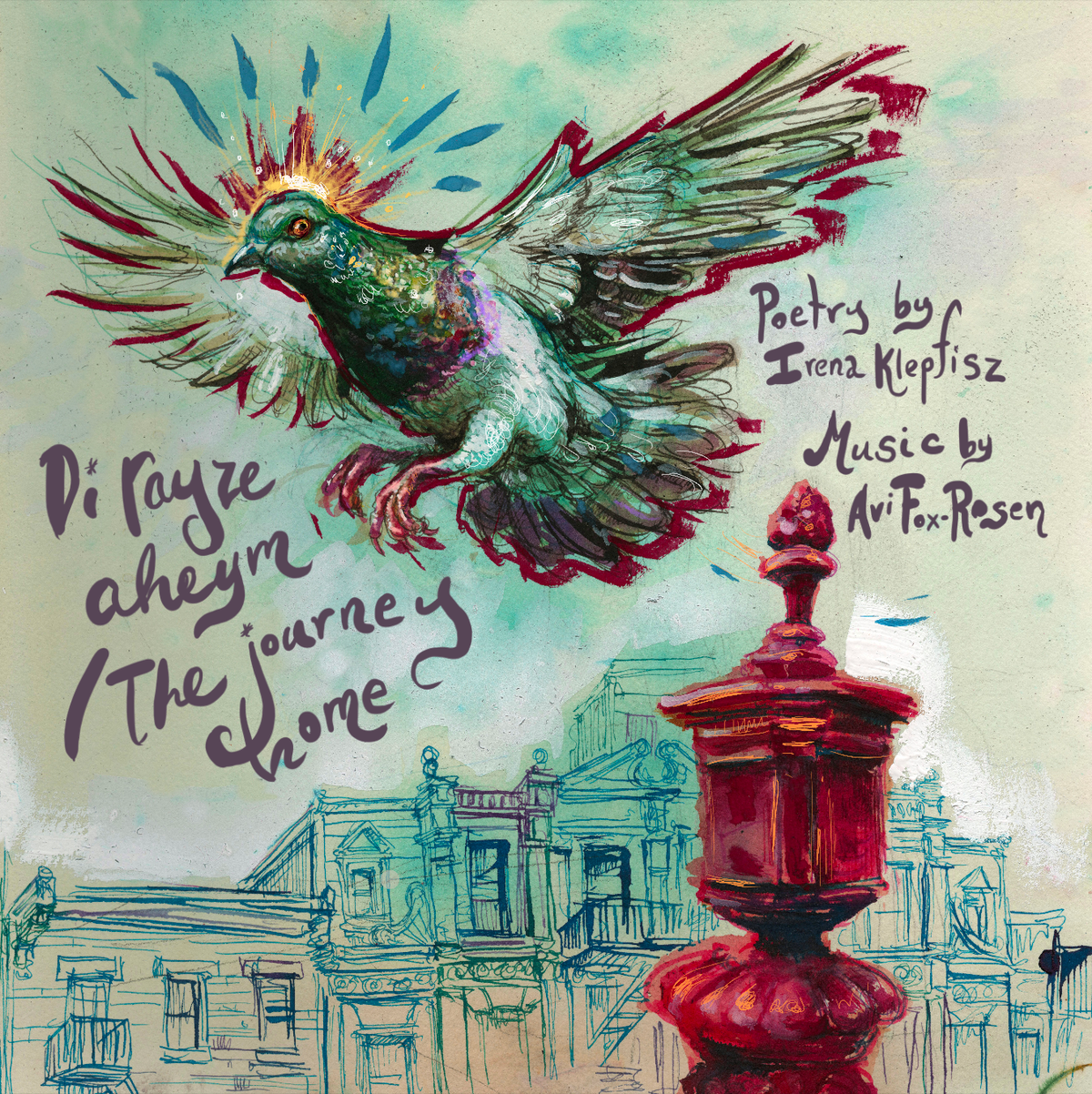
Di rayze aheym/The journey home: on making new music with an iconic poem and poet
Here we must live. We must fight for our culture. We must create the queer resplendent inclusive Yiddishland we want alongside our partners in liberation.

Growing up in Los Angeles in the 1980s and 90s, I was spoiled at synagogue by elders with accents — Holocaust survivors who were delighted to see Jewish children running around the sanctuary. All my grandparents were refugees of "the war." Remnants of Yiddish were present in foods: aykikhl, or mandelbrot, cookies procured from Diamond’s bakery. And in certain prayer related words: daven (to pray), bentsch licht (blessing the candles). And of course insults. Yiddish was acknowledged, but other than these nuggets, it was rarely spoken, and certainly not taught.
At the same time, Los Angeles was being ravaged by AIDS. I remember when my mother's study partner from graduate school died of the disease, and when the children of a family in my elementary school were orphaned by it. My father bicycled from San Francisco to Los Angeles for the California AIDS ride. But I didn't give it much thought. This was just the world I lived in.
I came out as bisexual in my 20s, after moving to New York. At first I mistakenly thought my queer identity was at odds with my Jewishness.
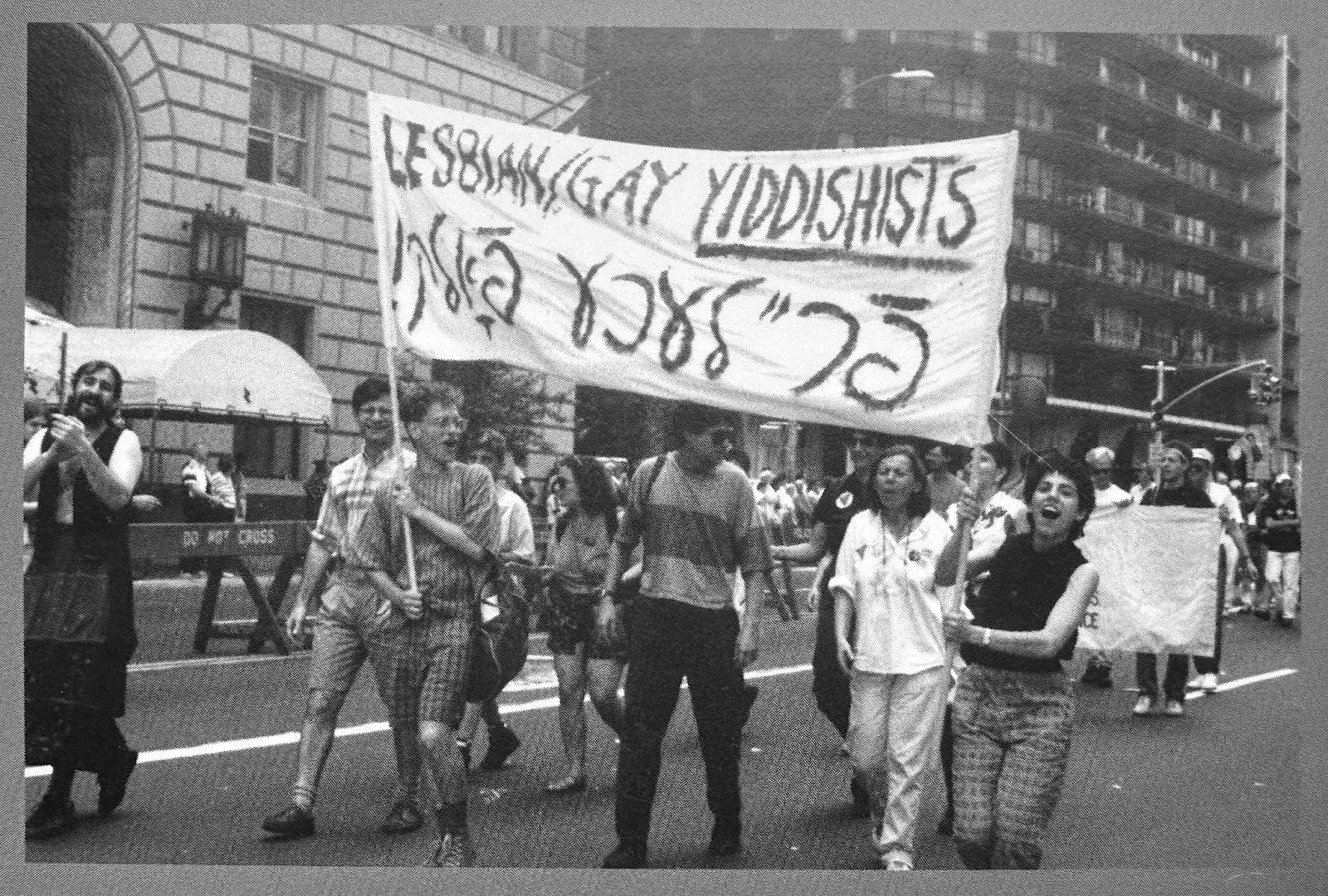
But I discovered New York's Yiddish and klezmer community, one shaped by linguists and activists, musicians and artists, queers and allies. And I was encouraged, and sometimes employed, by the musicians I admired in the generation ahead of me: Creative movers and shapers like Jenny Romaine, Adrienne Cooper, and many of the founding members of the Klezmatics.
I learned from them that Yiddish is contemporary and vibrant, and that there is pride both in queerness and diaspora. And in this world, Irena Klepfisz is a true gadol, a giant. Standing at about 5 feet in stature.
Irena is a trailblazing lesbian poet, with a body of work that explores feminism, queerness, diaspora, alienation and connection, and doikayt (hereness). She’s a child Holocaust survivor born in the Warsaw Ghetto in 1941 who emigrated to the U.S. in the mid 1940s after surviving the war with her mother Rose. Irena has written extensively about her experience in both poetry and prose. (For prose, I recommend “Oyf keyver oves: Poland, 1983” published in her book of essays “Dreams of an Insomniac.” For poetry, there is of course “Di rayze aheym,” and also “Searching for my Father’s Body,” and the collection “periods of stress.”) She came out shortly after the Stonewall uprising of 1969, and her work (both written and personal) has been about integrating the pieces of her identity that she had been told were distinct. Integrating Yiddish language and yiddishkayt with queer experience and feminism. Integrating roots in the Bund and Poland with an adulthood in New York’s activist coalitions, art circles, and later academia.
I came to Irena’s work in late 2024 with an agenda. I wanted to uphold her personal and artistic example, and create new music based on hers.
In December 2024 and January 2025, I hunkered down with her books. Her poem “Di rayze aheym/The journey home” struck me. The poem is structured into nine distinct sections and is bilingual — in English and Yiddish. The poem employs short phrases, and creative use of white space in the formatting of the text that can suggest silence, or movement, or tension and release.
When I first read “Di rayze aheym," I projected myself into her words. I was reckoning with what it means to be a Jew and a descendant of Holocaust survivors after October 7, 2023. I was coming to terms with the failures of Zionism, and with growing militancy of the mainstream Jewish community. By my sense Israel was exploiting the story of our Holocaust to justify another genocide. With these things in the forefront of my mind, I understood the poem as refuting this distorted narrative, and offering me hope and resolve to be do, "here." To be a part of a rich coalition of diasporic people struggling together to build a home.
Irena told me later that she wrote the piece after returning from a trip to Poland that she took with her mother Rose in 1983. That year marked the 40th anniversary of the Warsaw Ghetto Uprising and it was Irena's first and her mother's only post-war visit to Poland. After the trip, Rose returned to her home in the Bronx and Irena to the home she shared with her partner Judy in upstate New York.
Irena had truly flown over the oceans: to visit the cemeteries, physically encounter the place of her birth, and observe the occasion where her father, Michał Klepfisz, (a Bundist, chemist and bomb builder, and lead organizer of the uprising) died fighting.
I wanted to set this work, but I did not want to approach Irena empty handed. I composed the first two sections, “Der fentster” and “Vider a mol,” and recorded demos at home with just my voice and guitar. My child Izzy became my recording engineer on these demos. In late January 2025, I emailed Irena the demos and waited through two weeks of my own anxious fantasies that she would inevitably take offence to me appropriating her work. Luckily, she responded with enthusiasm and generosity, and put me in touch with her publisher. I composed the remaining sections through the spring and organized a fundraiser in June, with significant help from my artist coach and logistical weightlifter Sarah Chandler, to bring a community of supporters to the project.
From my first reading of “Di rayze aheym,” I noticed musicality in her short phrases, where silence and space are built into the text. Irena employs a strategy where Yiddish is translated into English, and then becomes a part of the vernacular of the poem. Irena is teaching us simultaneously in the richness of her experience she puts on the page, and in her Yiddish translations. Once translated, she uses these Yiddish words again in the poem, “zi flit,” “vider a mol,” and doesn't need to translate them again, because she has already welcomed us to her Yiddishland.
I had thought to underscore Irena's recorded readings at one point, but her recitation is wonderful and complete.
This poem records how Irena could survive a genocide, and then integrate this fractured history into her adult understanding of herself. By moving through so much pain she arrives at her resolution to make a home — to live.
And here we are, in another terrifying moment in America. In Palestine and Israel. In Iran. In Ukraine. The particulars are very different from the Nazism of her childhood. But our work is clear.
Here we must live. We must fight for our culture. We must create the queer resplendent inclusive Yiddishland we want alongside our partners in liberation.
Do muz zi lebn. Here she must live.
I hope this music brings you joy.
I hope this music makes you feel.
If this is your first introduction to Irena's work, I hope you will keep reading her poetry and prose.
If you've known her work for decades, I hope this music feels like a fitting tribute.
Di rayze aheym/The journey home is out on Borscht Beat, the wonderful Yiddish indie record label based in Brooklyn.
Listen at https://borschtbeat.bandcamp.com/ and on all major streaming services.