Himl un erd veln undz oyshern!: A Review of “Yiddish Revolutionaries” in Manchester
From the Pale of Settlement to the streets of East London, Yoyvl's homage to the Jewish working class past and present shows the power of culture as an organising tool
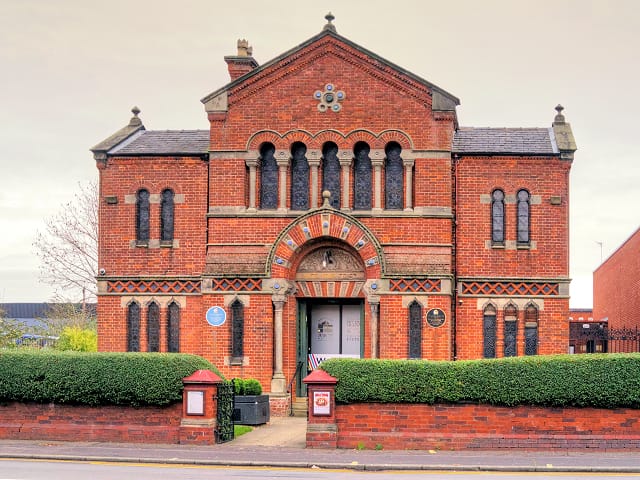
Manchester’s Jewish Museum is not the first place you would expect to see a show like “Yiddish Revolutionaries,” despite the working-class history of its neighborhood, Cheetham Hill. Once a vibrant North Manchester working class district, it served as a centre for Jewish life (working class and otherwise) from the 1850s until the 1950s. Post-war suburbanisation meant many of the now upwardly-mobile Jewish, Irish, and British workers moved northwards to the leafy exurbs of Whitfield, Crumpsall, and Prestwich (where most Jewish Institutions in Manchester now base themselves) as Cheetham Hill endured rapid deindustrialisation throughout the 1960s and 70s. It now sits in stark contrast to the neoliberal “rentier city” that has become Manchester’s City Centre some 15 minutes walk away.
I sat down to enjoy my third performance of “Yiddish Revolutionaries” this March in the hall of the museum, formerly a synagogue built in 1874 to serve the Sephardi community that closed in the 1970s after the exodus of its membership to the suburbs. In a place, and with an audience, that was quite different from where I had seen it the first two times, I felt trepidation and preemptive embarrassment. Nervously looking around, I was sure it would cause a stir for its fearless tying together of Yiddish working class movements of the past and the Palestinian liberation movements of our present.
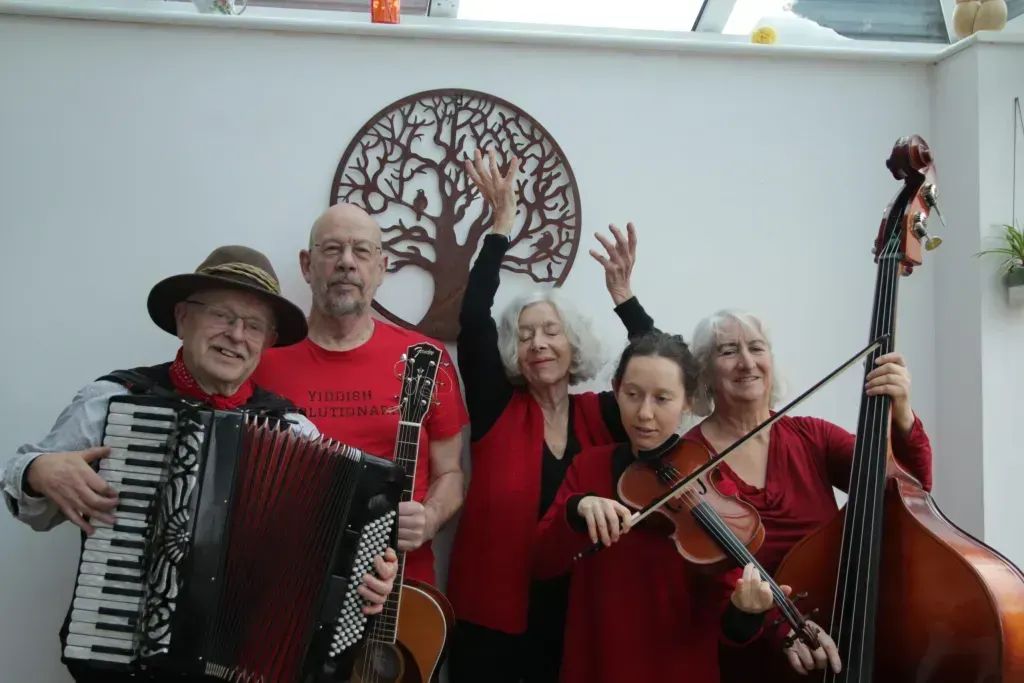
“Yiddish Revolutionaries” itself is a show by the klezmer band “Yoyvl” (in English “jubilee” or “celebration”). “The Company,” as they refer to themselves, is made up of lead vocalist and guitarist Phil Tomlinson, violinist and soprano Maya Brown, accordionist Adrian Dobson, double-bassist and researcher Sue Cooper, and narrator and dance leader (yes, really!) Judy Sherwood. Let’s cut to the chase, the show is absolutely cracking: a superb mix of prose, poetry, song, and tunes that takes you on a journey from the barricades of the Pale of Settlement to those on the streets of East London. Born out of the discourse around antisemitism on the left and place of Jews in the socialist movement during the Corbyn years, “Yiddish Revolutionaries” seeks to ground the ordinary history of Jewish workers in the words of those who lived it, and in so doing, links those experiences to our current moment. This is in part facilitated through the use of a slideshow presentation behind the performers throughout the show alternating between lyrics in English and transliterated Yiddish, and historical photographs alongside contemporary snapshots (a Jewish soup kitchen next to a modern foodbank, garment sweatshop workers throughout the centuries, a shot of The Battle of Cable Street next to an anti-fascist demonstration from earlier in the year).
By the time of this showing at the Manchester Jewish Museum, not only had I already seen the production two other times, but I had deliberately staged one of those editions myself. I had first come across “Yiddish Revolutionaries” by chance on Facebook, and seized upon what stood at the nexus of a few interests of mine (traditional music, radical history, and Bundism) like a hawk. I made an effort to introduce myself to the performers and formed a comradeship with them that has allowed us to work on a few projects together. Having seen the show in February 2024, I organised a truncated 45-minute version at an International Workers’ Day celebration at Manchester’s own People’s History Museum that same year. The work had jumped out to me then not only for its content, but for its ability to engage non-Jewish socialists, and unaffiliated Jews with socialist inclinations.
Yiddish Revolutionaries at the People's History Museum, 2024. Credit: Manchester Radical Tradition
To me, it is an active embodiment of yiddishkayt, doikayt, and socialism: perhaps in a way the original founders of the Kultur Lige would recognise. Reactions to both of these previous performances were interesting in and of themselves: unaffiliated progressives became temporary converts to Bundism, young Jewish musicians had a burning urge to learn klezmer and its associated dances, and lively debates broke out over the show’s comparison between the Lodz General Strike and the First Intifada, along with Hirsh Lekert’s attempted assassination of a Tsarist governor (the show both tells the story of the shooting, and performs a 1921 Ballad recounting it). Dancing is a major part of these performances, undertaken within the klezmer interludes by the ever-spritely Sherwood, leading audience members into long lines around the seats and stage.
The show begins with one of its numerous klezmer interludes. It starts off with a slow, methodical hora as the tension gently builds and people settle in. This then barges headlong into an upbeat freylekh that almost universally gets the audience clapping. The first half of the show, which I am going to call “yiddishkayt”, focuses on history readers of Der Spekter may be familiar with: the conditions of industrial workers in the Pale of Settlement, the formation of The Jewish Labour Bund, and the Lodz insurrection of 1905, told through the songs “In Zaltzikan Yam,” “Barridakn,” and “Arbetsloze Marsh.” This is then followed by the aforementioned story of Hirsh Lekert, “The schlemiel who missed!”. It was particularly interesting to see this history presented in this venue.
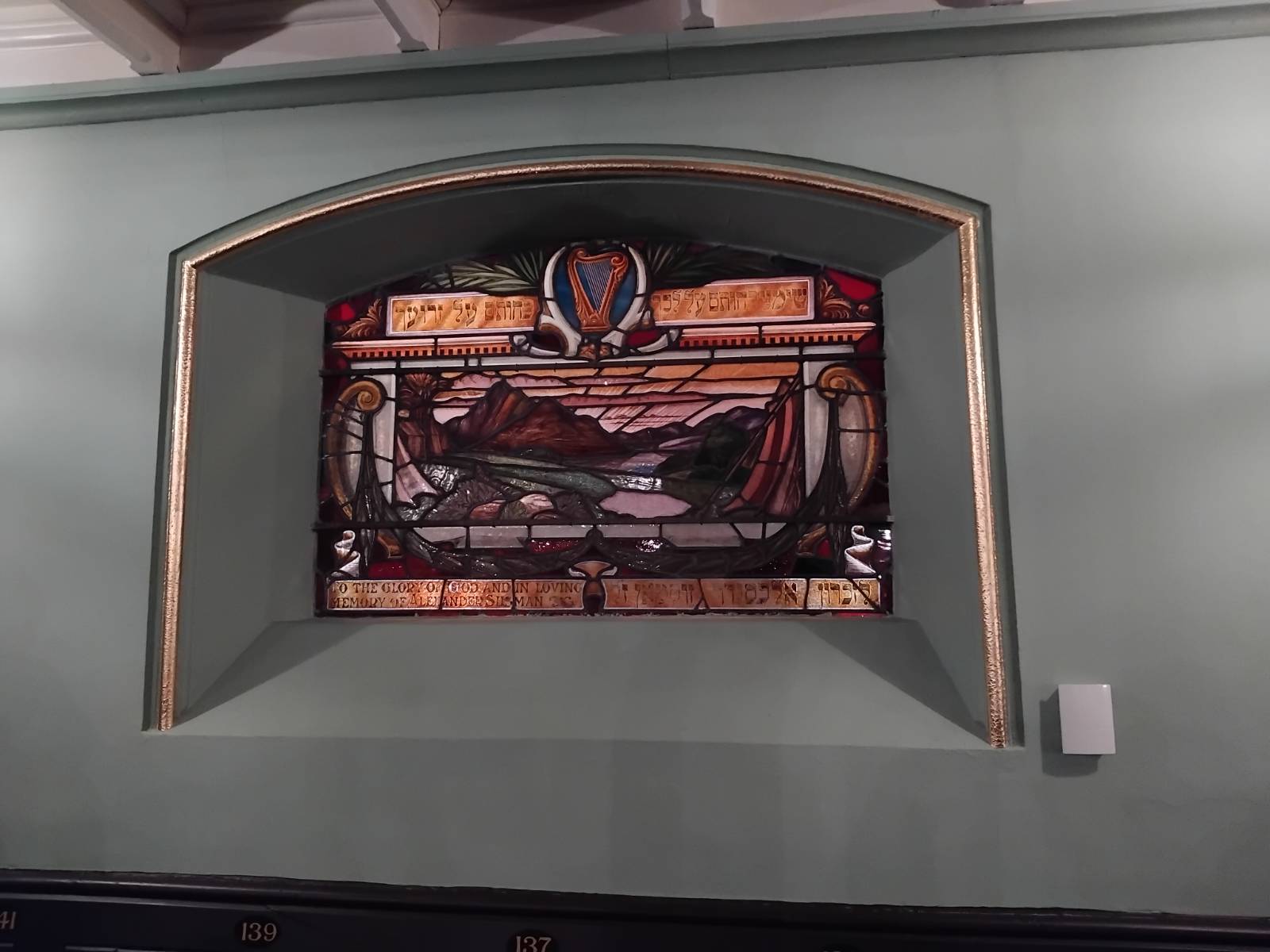
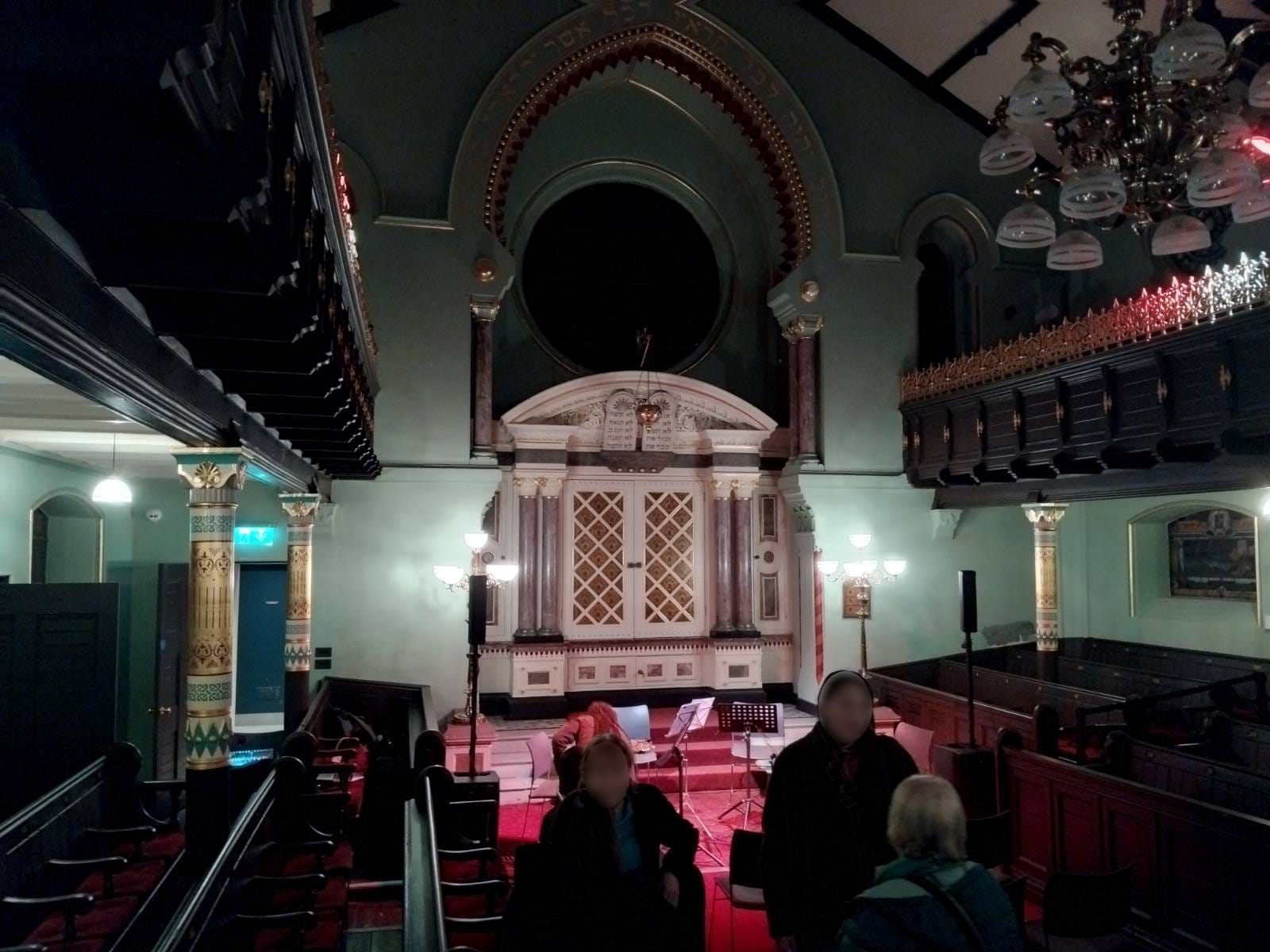
The Spanish and Portuguese Syngogue was converted into a museum for the Jewish community in 1984 and has served this function ever since. The hall itself is resplendent with stained glass windows of Britannic heraldry and Hebrew script (the one opposite me held an Irish Harp and Song of Songs 8:6). Laid out in the then modern auditorium style popularised by the Reform Movement, the space had an intimate feel despite its lack of a dance floor. With the majority of its patrons coming from the well-off parts of south Bury (along with the growing Haredi wards of Kersal and Broughton Park in Salford), I was worried how this crowd would react to what I knew would come in the later parts of the show.
This half ends with a lively rendition of “Di shvue,” or “the oath,” the Yiddish anthem of the Jewish Labour Bund. In the first performance I had seen, this song had been so popular that the band repeated its two handpicked verses to allow people to fully savour the moment. I would later joke to Phil Tomlinson that it was probably the first time “Di shvue” had been sung by such a large crowd since the war, and that he could reform the Bund then and there.
While not as impressive as the first time I saw the production in South Manchester, there was a zeal in which the crowd at the Manchester Jewish Museum took to singing “Di Shvue” which took me by surprise. Being here, rather than in a socialist institution like the People’s History Museum or a community centre in Manchester’s “Lefty” South, I had expected a more conservative audience. In the crowd of some 50 to 60 people, the demographic was predominantly older, with some multigenerational groups. You could easily clock those under 30 in the audience: there were at least a dozen. However despite the talk of revolution, assassination, and communists, I had yet to see anyone walk out or with a dour face.
In the interval, a lady who was seated in front of me (in her latter years though full of life) turned around to me and said, full of surprise, “well you know the songs!” I admitted to her that it was the third time I had seen this show. She was surprised that she hadn’t been aware of the previous performance at the People’s History Museum. To my relief, this meant her politics were of a vaguely socialist persuasion. It was in this interval that there was a buzzing energy in the synagogue and outside in the added museum space. People were discussing family histories. They recognised old friends and acquaintances. Some noticed each other from across the room and said hello. A few, myself included, went up to the band to have a natter. It is a testament to the quality of the show that it has this ability to draw stories out of people and build connections between strangers in an audience.
The name I would give to the second half would be “doikayt” (the term itself had flashed up on screen early in the first half with an explanation for the audience). It focused on the British Jewish experience, including hot-off-the-press research about Manchester resulting from this production being at the museum and thus having access to its archives. The first two songs (“Mayn ruhe plats,” and “Dray shvester”) focused on the conditions of Jewish immigrants as workers. The images juxtaposed Victorian Jewish seamstresses with those working in sweatshops in Britain today. The attention of the show then shifted towards the Battle of Cable Street (1936), and one of its lesser known cousins; the Battle of Belle Vue (1934), which occurred in the titular working-class district immediately southwest of Central Manchester. The latter, like the former, had been a successful counterprotest to block Oswald Mosley and his British Union of Fascists from conducting political activities. I would later find out that many of the pictures belong to Sue Cooper’s father, who had been on the barricades in Cable Street. In honour of those who had stood on those days, the Communist Anthem “Der internatsional” was sung with a surprising amount of gusto from the audience. It was almost certainly the first time it had been sung in the old Spanish and Portuguese synagogue and perhaps the first time it had been sung in a shul in England.
The show then moved on to some very local history: the Kinder Trespass of 1932. This was an act of civil disobedience undertaken by young workers from Lancashire and Sheffield against the closure of public right of way by aristocrats that led to Britain’s first national parks (albeit a decade and a half after the fact), led by Young Communist and British working class Jew Benny Rothman. Here, “Yiddish Revolutionaries” introduced another first: the performance of the anthem of the Trespass, “The Manchester Rambler,” in Yiddish. Recently translated by Yiddishist Annie Cohen, the song declares in its original English version by legendary Salfordian singer, songwriter, folklorist, and communist Ewan MacColl that “sooner than part from the mountains, I think I would rather be dead!”. MacColl tells a fictionalised account of an encounter with a game keeper warding off hikers, along with proclamations of love for the countryside to the point of a man skipping his own wedding to hike. A comrade and friend of Rothman, he was at the Trespass in 1932, although unlike Rothman he had managed to escape without arrest (it is worth noting that all of the six arrested and charged were Jewish). The song was a hit with the crowd, many of whom would have known the original, but Yoyvl threw in another twist: Usually sung with five or six verses, this version had only three in Yiddish, adding in minor-flipped variations of the melody, and playing them with the raw intensity of a klezmer by Maya Brown in what was the best act of musicianship of the night. Cooper then recounted her capital-C Communist parentage along with the titbit that her father’s own photos had been in circulation during the presentation, a revelation met with gasps from the audience.
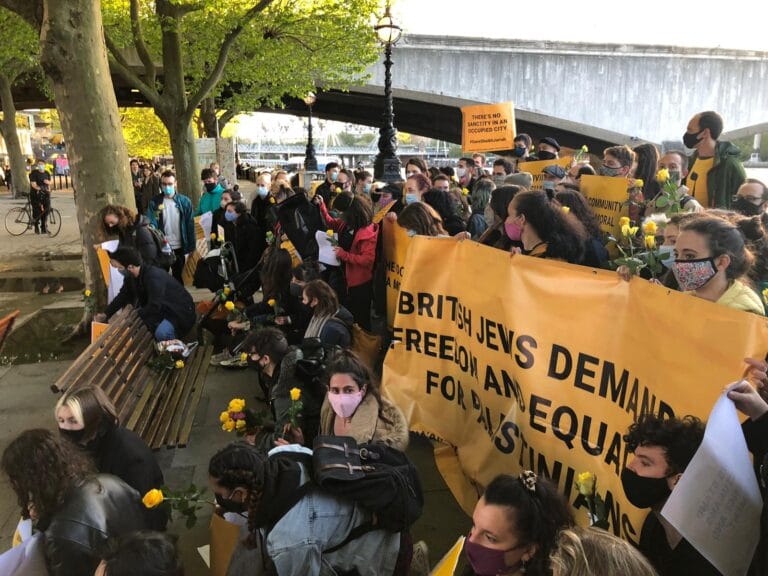
Throughout the evening, an older man was sat next to me. In a flat cap of yesteryear, he was enjoying much of the show. He had turned to me to watch me join in on the choruses of “Di shvue” and “Der internasional” and appeared to approve. He nodded his head in beat with the klezmer interludes in amusement. I think he was enjoying his evening, until the penultimate instrumental section, following the song “Der yokh” (a Yiddish translation of the Catalan anti-Franco song “L'estaca”), when a number of organisations of the Jewish left, Yiddishist, socialist, and notably pro-Palestinian and/or anti-Zionist, appeared on screen. His demeanor changed rapidly. He turned away from the projected screen and put his hands on his knees. As people clapped, he turned around to me and all but shouted “SHIT.” He did not clap for the rest of the show, and left promptly as a group of 5 danced in the small centre of the former synagogue. I wonder if we had lost a new khaver, or if an old khaver had been reminded why he fell out of the movement. I would later found out a complaint was made to the board of the museum, and an attendee would be interviewed in The Jewish Telegraph around their displeasure with the production. This platforming of organisations of the contemporary Jewish left is a fundamental part of the show, a way of tying history into the present day. Comparing Jewish workers to activists in keffiyahs may have been a ballsy move in the venue and local area we were in, and a few people may have felt alienated by the end. But I do not think this is merely an issue around Zionism or Palestinian solidarity within the Jewish community but speaks to a greater issue on the British left: its inability to relate the struggles of days gone past to struggles of today.
Exhibition of historical class struggle is an activity I personally undertake. What had drawn me to Yoyvl and their work was seeing a Jewish reflection of my own activity regarding British and Irish traditional culture and its connections to the labour movement. Yet in a historically industrial and radical city like Manchester, there is a strange sense of simultaneous acceptance of this history and its place, yet a rejection of its modern incarnation. To go to a former mining district and sing songs about imparting physical violence to strike breakers is welcomed, yet attempting to organise contemporary workers into unions (without such violence one would hope) within said community is often met with disdain. It is not a new observation that the radical struggles of the past are co-opted into acceptable history by future generations, but it can be difficult when the connections between historical struggles and contemporary ones are rejected despite their direct links. It is even harder when the work today is cutting edge and so sorely needed. Once again I find a mirror between my own work and that of Yoyvl’s, and perhaps a limitation of this kind of political activity through culture. The past is a foreign country, they say, and through a lack of cultural transmission between generations and the decay of the institutions of organised labour, we have become our own sort of diaspora to the historical workers’ movement. What we do is obviously related but separate enough to be disregarded by the “mother country,” by the working class, Jewish or not.
Despite all of this, it is still the conversations that are had in these kinds of spaces that make them both so useful and so valuable. During a collection of photographs displayed on the screen during a klezmer interlude, another woman in front of me gasped as a picture of “The Manchester Jews’ School” on Derby Street (spitting distance away) from the turn of the century appeared on the screen. I asked her at the end why she had gasped, she replied simply: “my father taught there”. She then regaled me of his work as a tailor, and the fact that he was constantly fired for unionising his workplace. “He was never out of work for four days though: he was too good of a worker!”. He had taken up teaching after the war, during a period of small deindustrialisation in Britain, that saw the death of most textile and raw metal industries. “There was terrible poverty” back then, she said, “kids were sewn into their clothes in the winter.” She was politically active, pointing to herself on the screen when a picture of a group of Na’amodniks appeared. It is moments like these that make the entire enterprise worth it: working class history, platformed not through dry academic presentations or aesthetic larping, but through cultural immersion. Folk music, such as klezmer, is known as “people’s music” in many languages. It came from the working class and the peasant class before them. It is the voice of the masses telling stories that aristocratic composers or culture industry juggernauts never could.
So what can be learnt from a somewhat contentious evening of radical music? I believe the inherent power of shows like “Yiddish Revolutionaries” is the ability to assemble likeminded people into a room. Most people do not want to engage in the dry (and sometimes futile) work of organisation building, nor the endless branch meetings of established groups. A show like this can engage in political, cultural, and historical education in a deep and meaningful way while bringing in new people, and organising the already politicised. While the Jewish Museum, as a mainstream apolitical institution, is probably not the best place to try and get people signed up to a new Bund, one way of establishing such an organisation in an area is staging productions like these and collaring everyone before they leave to at least get on a mailing list. On a more serious note, popular histories require spaces like these: for people to discover and rediscover their own heritage and be able to express them, even if only to the person next to them. Such work is fundamentally in opposition to the historical narrative imposed by the ruling class and helps build a sense of solidarity within communities and classes.
I am not a hippie, I do not believe that if everyone sings a song of peace it will end war. However, culture is both a great tool for organising, and a fundamental act of heritage preservation in a time when the world is becoming ever more grey and overcome with AI slop. Also, who doesn’t like having a klezmer dance after having belted out “Di shvue"?
“Yiddish Revolutionaries” has no known future productions. Yoyvl and its associated members are involved with various projects. We would recommend you visit Phil Tomlinson’s website for news about any related upcoming work: https://philtomlinson.co.uk/