Why We Should Build Our Own Institutional Spaces - A Response to Bundism Today, Part 3: Doikayt
The beauty of doikayt as a guiding principle in our organizing is that the local context is essential to decision making.

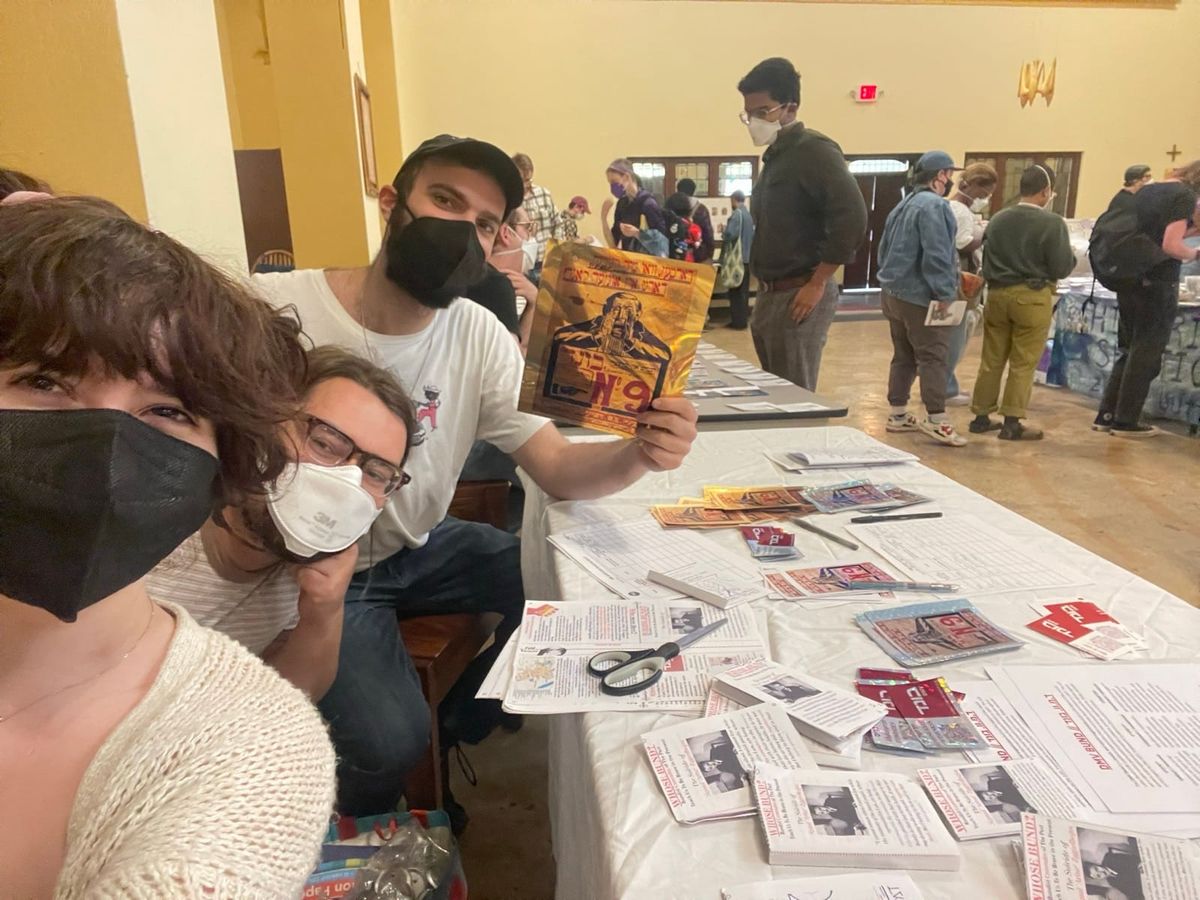
Molly Crabapple’s recent hit book Here Where We Live is Our Country: The Story of the Jewish Bund has driven significant interest in a renewed Bundist politics. As new Jewish diasporist organizations emerge throughout the world, including through the International Jewish Labor Bund (IJLB), it is essential that we ask the question: “Where do we fit into our local context?”
Organizers with the DMV Bund — the chapter spanning Washington, D.C., Maryland, and Virginia — have asked ourselves this question since our establishment in Summer 2024. Last year, I wrote in a local dispatch that the lefty Jewish scene in the D.C. area is crowded and therefore it is important to avoid redundancy with the other organizations that already exist in the area.
Zach Mojsze, organizer and delegate representative of the Vienna Chapter of the IJLB, discusses the importance of this question in his recent piece Bundism Today, Part 3: Doikayt, in which he argues in favor of participation in existing Jewish institutions. His analysis of these institutions rings so true to the DC area that I would believe he was talking about DC specifically if I didn’t know otherwise.
To summarize his argument, Mojsze points particularly to the troubling lack of institutional democracy, the oppressive climate that discourages public criticism of the leadership which in turn “fosters corruption, nepotism, and exploitation,” fails to provide an exclusive space to all Jews, and the problem of redundancy among organizations that nevertheless fail to cooperate with one another.
He goes on to argue that organizing within existing spaces that claim to speak for us is necessary as we move forward. While, strategically, this may make sense within the local context Mojsze is organizing in, it is not the case for everyone. The beauty of doikayt as a guiding principle in our organizing is that the local context is essential to decision making. In the D.C. area, existing local Jewish institutions (excluding national organizations with local offices in D.C.) lack democratic structures; it isn’t worth the energy or time to integrate ourselves into those local institutions. Asking people to work with Zionists within the structures of these spaces would not be fair and, in some instances, would be putting people in harm's way. To create the world we want to live in, we need to build our own institutions.
As Arielle Angel wrote in her piece for Jewish Currents, “The development of such spaces will make us stronger political partners, from the vantage of both strategy and sustainability.” This is how we gain power; by building our own institutions to organize Jewish workers, pulling them from the normative Zionist institutions that exist today and toward a Jewishness rooted in class solidarity.
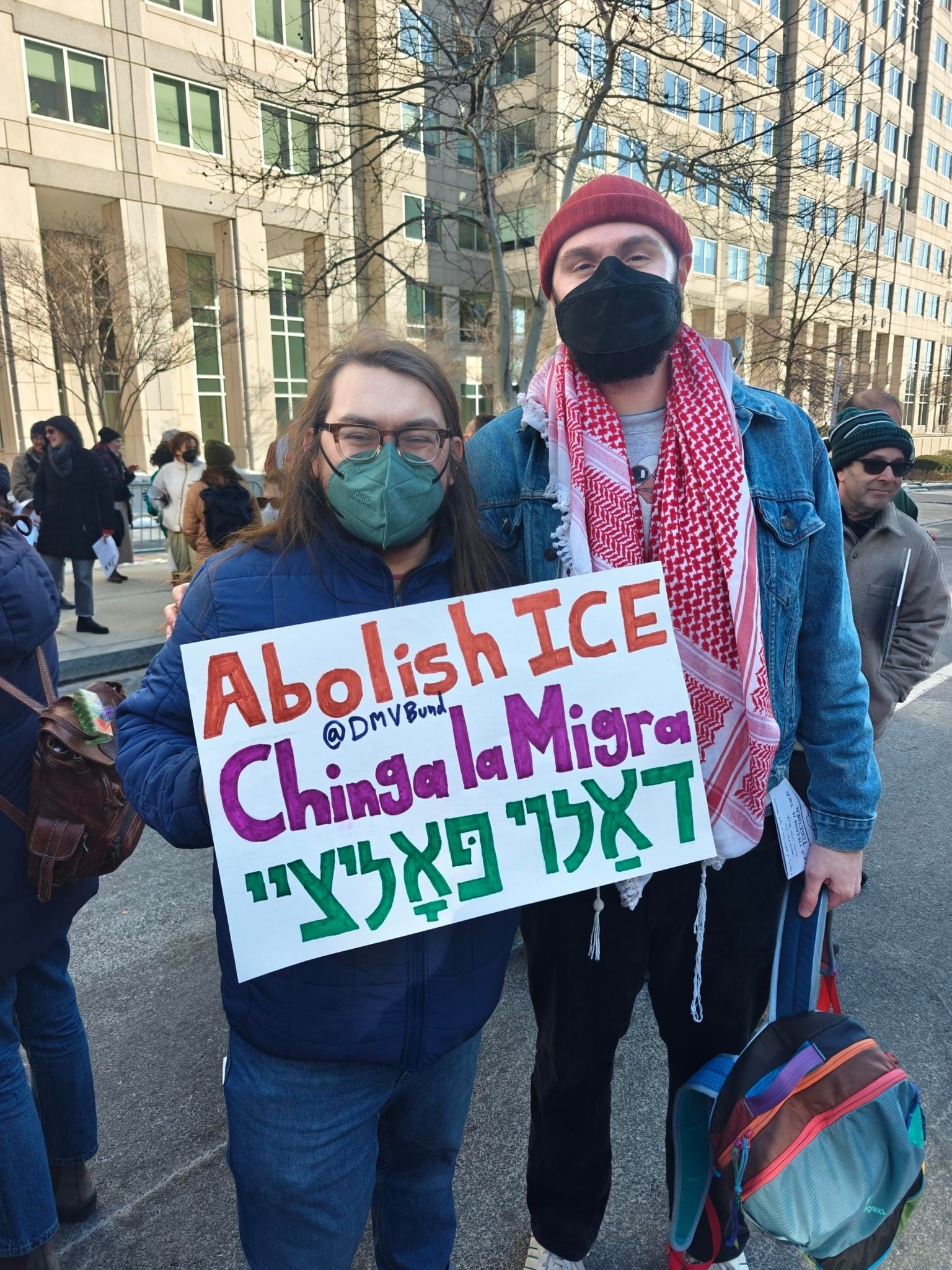
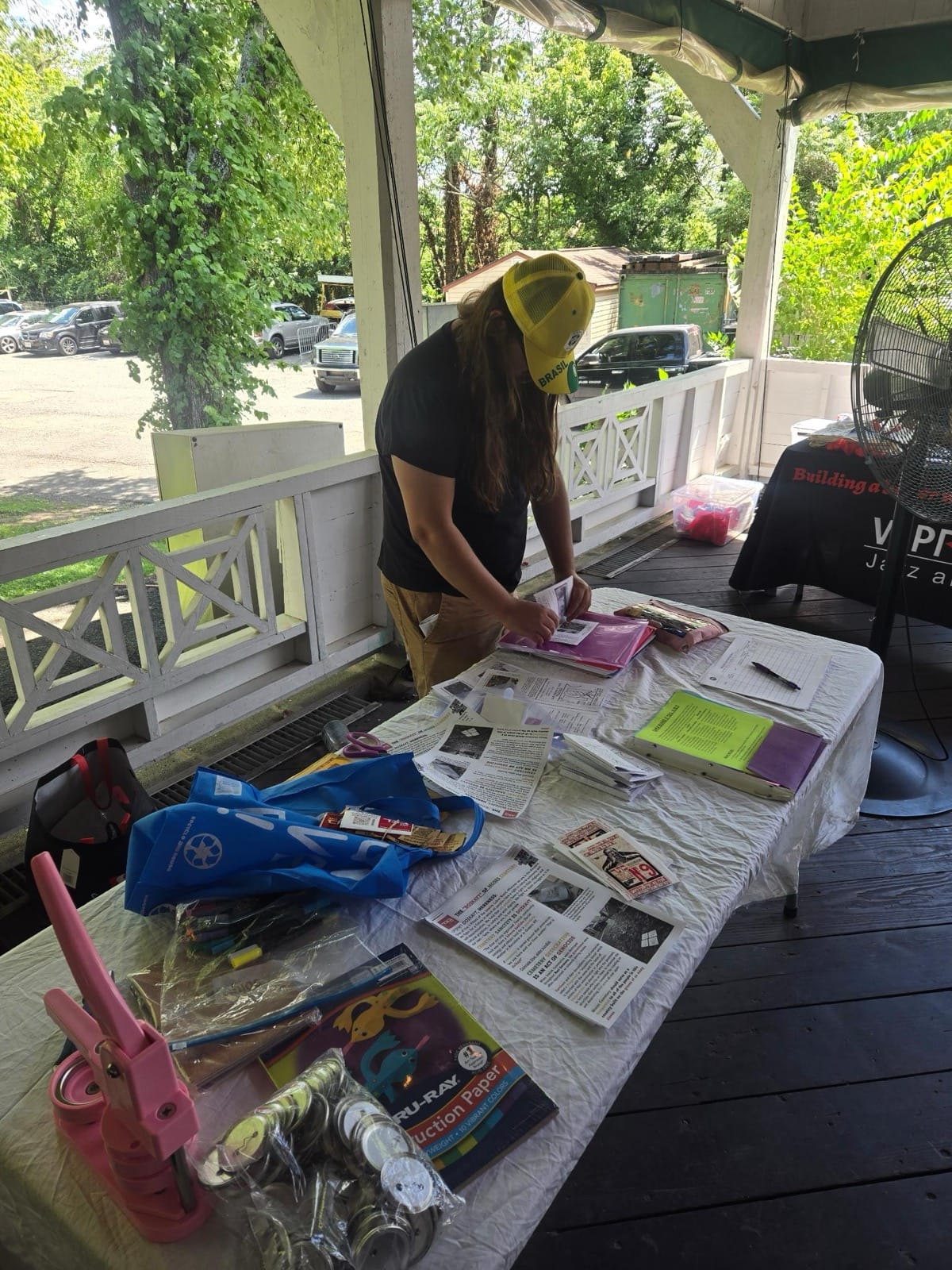
Left: The author and another Bund member, Eli, at a Jews Against ICE rally. Right: Tabling at a Bethesda African Cemetery Coalition Juneteenth event. Photos courtesy Max Ewart.
The Local Landscape
The landscape of Jewish institutional spaces in the D.C. area is dominated by two factions: local advocacy organizations and the loosely woven network of local synagogues.
The Jewish Community Relations Council of Greater Washington (JCRC) and the Jewish Federation of Greater Washington dominate the advocacy space for the local Jewish community. Local politicians lean on these organizations when they are courting the Jewish population for a vote or need assistance on acts of antisemitism (real or perceived). These institutions are ingrained in Jewish life in the area and are deeply rooted in Zionism, making them a particularly useful tool for those who stand against the liberation of Palestinian people.
These organizations do not operate within a democratic structure. They are your typical non-profit, board-run organizations that, while they have a process to apply to become a board member, the decision about who gets added to the board is made by the board. To operate within these organizations with a goal of shifting them towards anti-Zionism would take an inordinate amount of time and patience. For example, the Jewish Federation of Greater Washington has become less democratic in recent years. Taken straight from the governance page on their website:
A community like ours—bold, diverse, ever evolving—deserves a leadership model that reflects who we are and where we’re going. That’s why, over the past two years, we’ve approached this work with deep intention: reimagining our governance model to reflect our values, our community and our future. This change is the result of careful listening, learning, and collaboration across our leadership and community, rooted in where we’ve been and designed for where we’re headed.
Here’s what’s new:
* A smaller, sharper Board of Directors, focused on Federation’s strength and strategy
* A new Community Leadership Council: a powerhouse group of 70–90 leaders, connectors, and changemakers bringing the voice of the community to the table
* A renewed commitment to data-informed decision-making, gathering broad community insight, analyzing what we learn, and acting with clarity and purpose
In a vacuum, this does not seem particularly anti-democratic. A Community Leadership Council (CLC) with 90 people and an open call to become a member, what a process! Dig a bit deeper with the power of the Wayback Machine, you can see that many members of the formerly larger board have simply shifted over to the CLC. Earlier in July, I reached out to the designated email about the process to join the CLC and, to this point, have still not heard back from them.
Synagogues in the DC area land all over the spectrum of support for the State of Israel. The vast majority would call themselves Zionist, while a handful would likely be considered by most to be non-Zionist, though their congregations are likely predominantly and aggressively anti-Zionist. I am lucky enough to be a member of the New Synagogue Project, but other spaces including the Interfaith Families Project, Kehillat Sankofa, which serves black Jews, and Baltimore’s Hinenu have good reputations as well. While there are organizations that do work directly in synagogues to de-radicalize congregants and potentially shift synagogues to the left, the synagogues themselves and those in charge tend to be aggressively Zionist at worst and normatively Zionist at best.
To this, I can only speak of my own experience. Shortly after October 7, 2023, and the rapid and horrifying response by the State of Israel, I reached out to folks who I knew aligned with me politically to talk about how we can reach out to our childhood synagogue. We ended up drafting a letter asking for the synagogue and rabbi to add their names to the growing list of Jewish institutions calling for a ceasefire, asking for those who were B’Mitzvah’d at the synagogue to sign. We acknowledged that we would likely disagree on why a ceasefire was necessary but we believed that there were reasons for them to call for one anyway.
The response we received was infantilizing and offensive. After a month of back and forths, we met with the Rabbinical team. At the meeting they denied our pleas and offered to hold regular discussion groups where “complicated topics” like this could be aired within the congregation. We rejected their offer. None of us had the time or energy to pursue this new endeavor we were not going to get any structural movement on. Our best bet was to maintain relationships with people we knew at the synagogue in an attempt to de-radicalize them. Our instincts were correct. Since then, the synagogue has doubled down on Zionism, and the new head Rabbi (formerly the assistant Rabbi who was part of the discussions we had) has led prayers for the IDF at Shabbat services.
For Those Who Have Been Left Behind and Forgotten
My experience with my childhood synagogue is not unique. I am lucky that I have over a decade of distance from the place and have been able to build community and support in other ways, but that is not the case for everyone. Wherever there are Jews, people, and especially younger folks, are rejecting the propaganda of their synagogue. For many that means isolation and ostracization, the loss of a community that they had felt supported in for years, and a search for a community that aligns with them politically.
There are Jewish people who have never been part of Jewish institutional spaces. Whether they grew up in a family that was completely secular, an interfaith household that tried one of an infinite spectrum of strategies to raise a child with some sort of Jewish identity, or converted later in life, these people were not inundated with the propaganda of Zionism as a normal part of Jewish life. For many, they choose to remain disconnected from Jewish life because they were able to develop a political understanding outside of this propaganda and only see Zionist institutions in the spaces that they live.
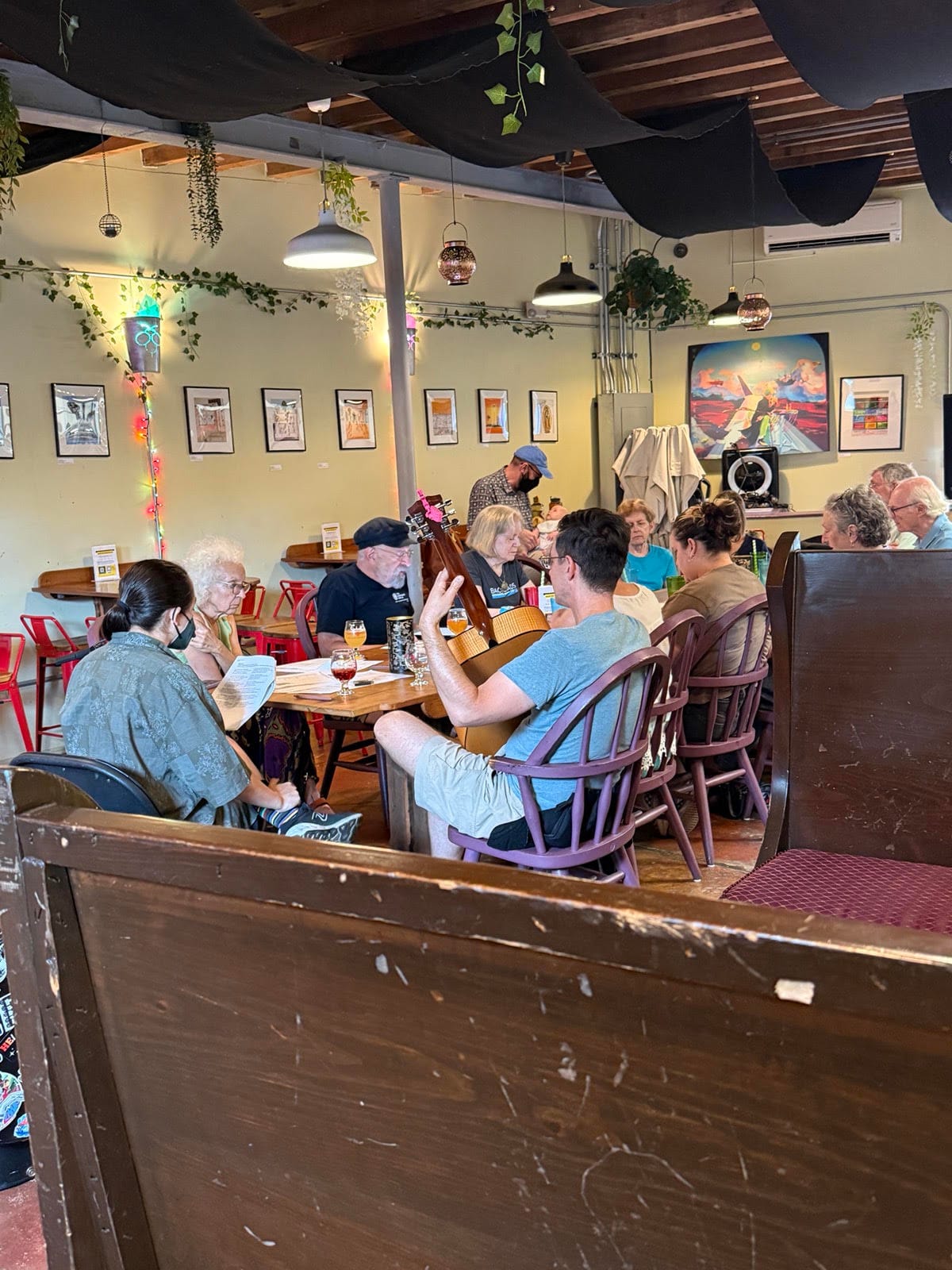
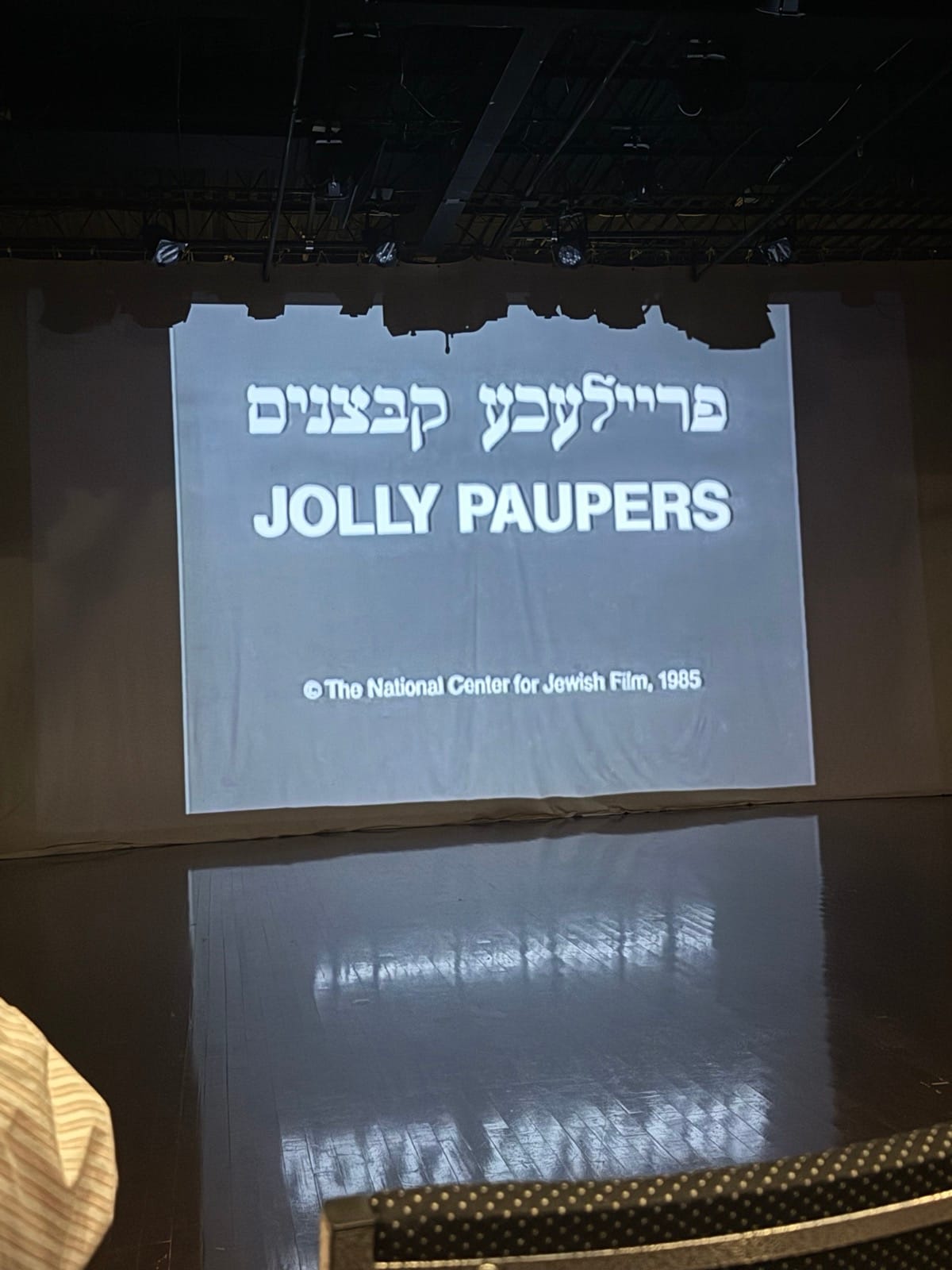
Left: A July zingeray event. Right: August 2025 Yiddish movie night and potluck. Photos courtesy Max Ewart.
All of these people, the ones who have been left behind by their communities and those searching for ones that align with their politics, deserve to have a space that they feel comfortable being their whole selves; culturally and politically. In the D.C. area, those places are becoming more and more difficult to find as institutions double and triple down on their Zionist stances, though it is not impossible. There are a number of religious institutions that have shifted left or were created for the sole purpose of creating a non or anti-Zionist religious community. As we build our new Jewish institutional spaces, it is essential that we make sure to include those who have often been left out of the conversation. The power that we gain from creating these new institutions must be rooted in the people who build it.
There is Beauty in the Labor of Creating Something New
The arduous work of creating something new can be daunting. Scheduling meetings that few people attend, setting up events, being consistent, building trust, and showing up are all never ending tasks. Burnout is common. But as you maintain consistency, you will start to see who else is consistent. You have conversations with those people and they begin to help out, lightening the load that you once had to shoulder with only a few other comrades. A few months, maybe a year later, and you have built something with lasting power, no longer reliant on the labor of only a few people.
Grace Lee Boggs, the legendary organizer for black liberation and other social justice movements refers to the Revolutionary Cadre Organization in her 1972 essay Organization Means Commitment. The task of building and maintaining a revolutionary cadre organization is not easy and requires hard work. We must be theoretically sound in our analysis, develop a program, be structurally sound, and willing to criticise ourselves. But in the process of doing this, you are rewarded with opportunities every now and then to take a step back and revel in what you are making and the beauty and joy that comes with it.
I recently brought my 11-week-old child to a regular DMV Bund Yiddish zingeray. She was able to hear the Yiddish in her ears, meet people I organize with and some of our older regulars. I get emotional thinking about the generations of people who have spoken and forgotten this language, died with it on their lips, the victims of antisemitism, Zionism, and assimilation. This is why we do what we do, to build the world we want our children and all who come after us to live in. Why wouldn’t we want to build that in our image?
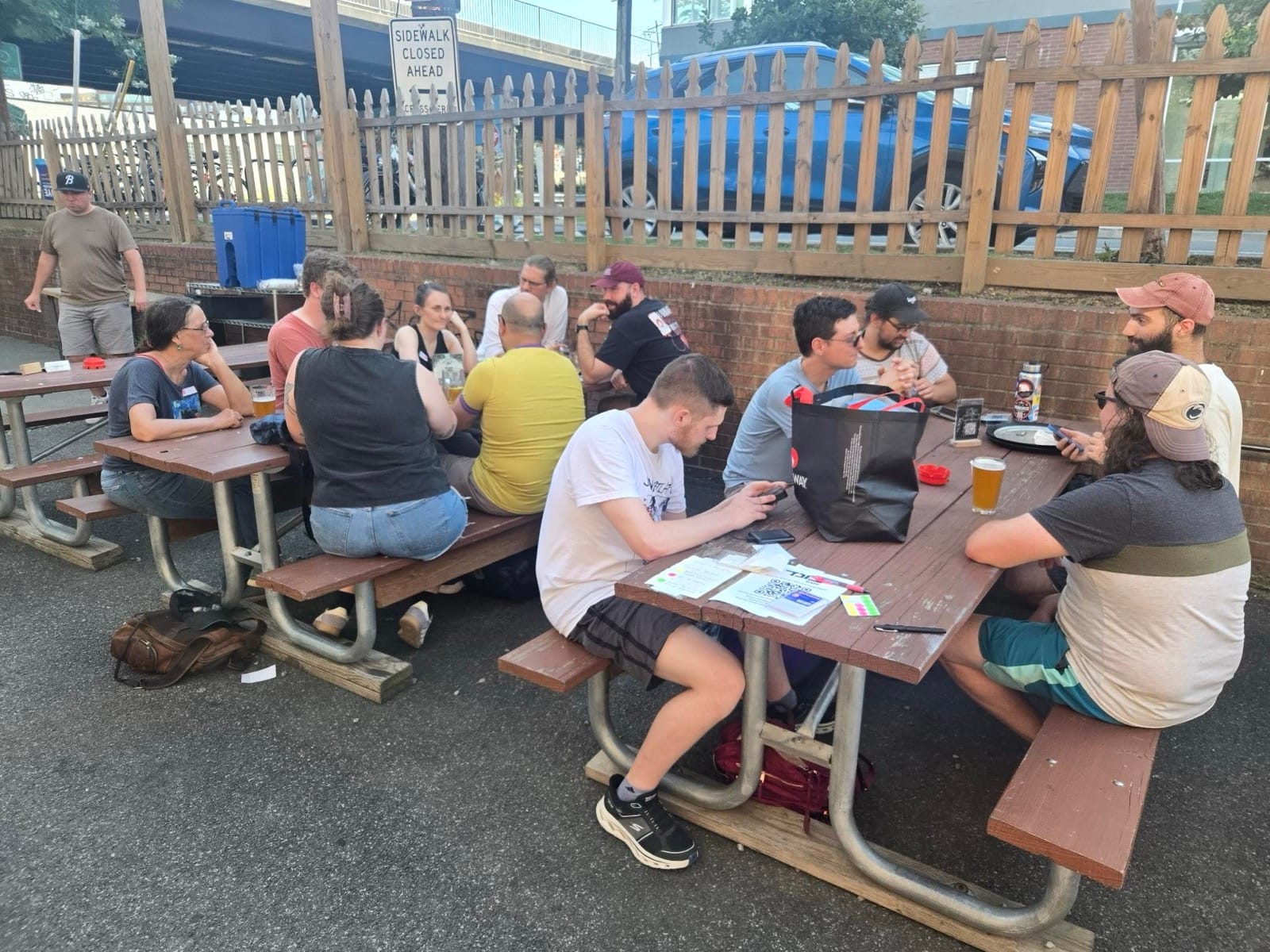
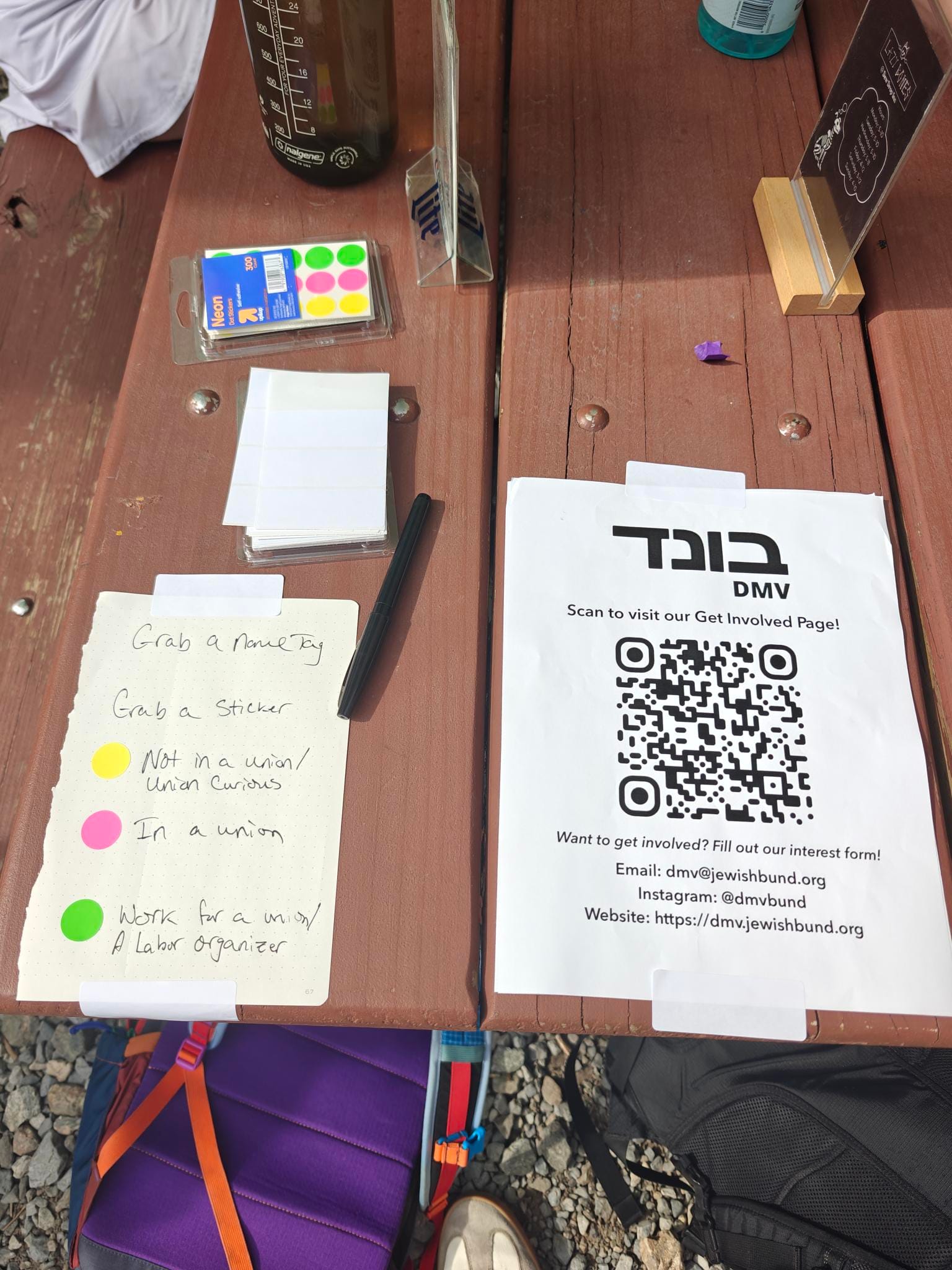
DMV Bund's Inaugural Workers' Happy Hour in June. Courtesy Max Ewart.
This isn’t to say that there is no value in participating in existing institutional spaces. I served as an elected Advisory Neighborhood Commissioner from 2021-2023, a hyperlocal elected position that represents around 2,000 people and whose opinions carry “great weight.” I’ve also chaired a Housing Justice Committee, and another member of the DMV Bund serves on a municipal advisory committee tasked with holding police accountable. While electoralism isn’t everyone’s jam, there is immense value in getting folks with radical politics elected at the local level. D.C. recently elected a slate of progressive candidates including Aparna Raj, a tenant organizer, to the D.C. Council, and Janeese Lewis George, a DSA member, to the mayoral seat. Members of the DMV Bund participated in the Jews for Janeese campaign, organized by Jews United for Justice, a local advocacy organization. To Mojsze’s point, many of these organizations claim to speak for us. But we carry more identities than just our Jewishness, and doikayt isn’t limited to just our Jewishness. This is not an all-or-nothing world, and we can do work to mitigate harm while working to create new institutions at the same time.
As we organize under the banner of the Bund, we must consider what makes the most sense for us locally. Our goal in the near term should be to do what we can to loosen the stranglehold Zionism has on the Jewish community. If that means organizing to take control of local Jewish institutions, do that. But that is not the case for everyone. In those instances we must build something beautiful and new.