Israel is a Dybbuk; or, an Ana B'Ko'akh That We May Liberate Stolen Brakhos
A plea to Zionists to recognize the oppression they are visiting upon their fellows — to exorcise their minds and our own of this terrible dybbuk.

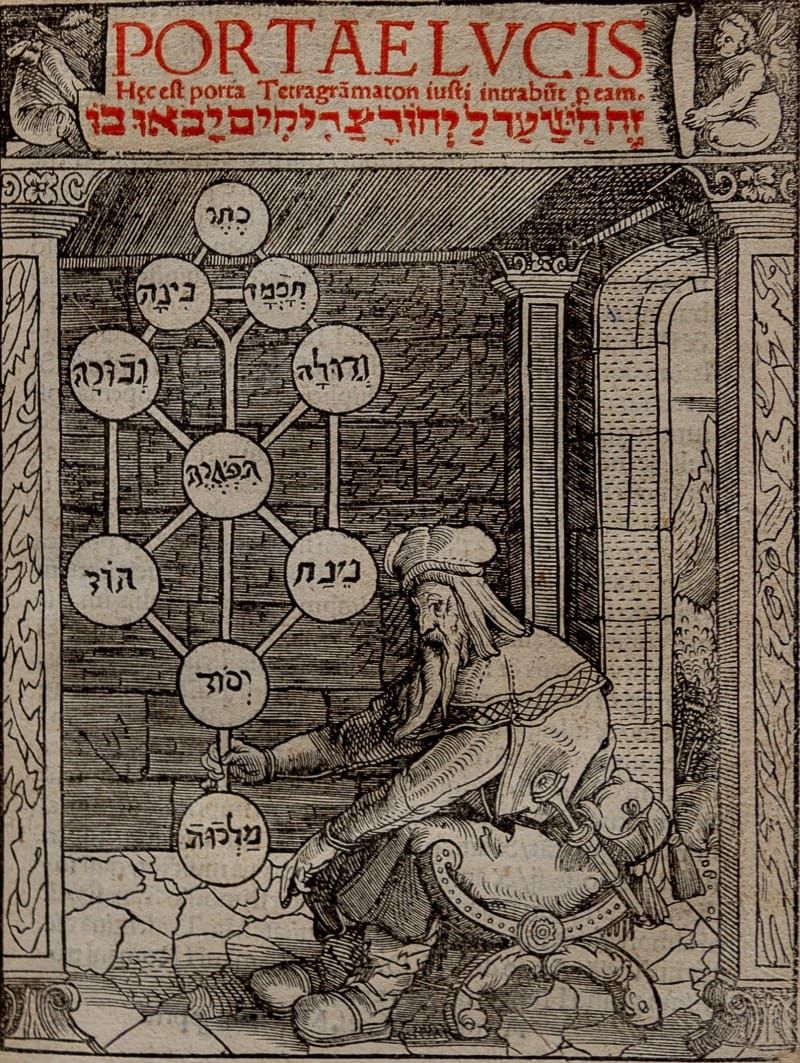
Hear us, Yisroel,
and answer us where upon when
and when upon where
tzedhaqa has gone.
Is it among the three and ten
and six hundred
mitzvahs?
Is it buried beneath sandy beaches?
In company to bloodied limbs
of soccer-playing children,
in five and sixty and
three hundred
sorrowful grains of sand,
eroding into the embracing Yam,
exfiltrating dismembered Khesed unto Ein Sof.
Hear us, Yisroel,
and answer us where upon when
and when upon where
have our tzadikim gone.
Are they pressed to the shadowed corners
of this labyrinth of chains, forged
in capital and title?
Are the shrewd formulae under Binah
only to be articulated by
the judging frown of a
wrath upon scarecrows,
Gevurah unrelenting,
retribution upon windmills
carved in bone and sinew with wailing winds
breathed in last by swollen mothers beneath a bursting star?
Hear us, Yisroel,
and answer us here and now
and also before and ahead
whether this is tzedek.
Is holy Malkuth to arise from a Yesod built of raked flesh and scarred minds?
Procedural Netzakh, processed victory filtering away Hod amongst fellows?
A sabra man sat upon a golden throne of broken backs and stolen
homes,
receiving upon his head a coveted Keter
wrought of pilfered sanctimony, reforged history, and holy conversion
to a new Judaism, cleansed of Khokhmah. Liberated from
the terror of knowing the cruel alchemies
needed to turn taurine gold
to a slathering mask,
occluding beauty,
from eyes behind and eyes beyond,
Tiferet beheld by none under one, and one under none.
Hear us, Yisroel,
we are so tired of
these masked pharaohs,
among us and around us,
above us and before us,
offering dewy tears
to quench thirst
in a desert
of their own
weave.
Oh, Yisroel,
cast out the honeyed braying of a dybbuk
wearing the ripped and cracked faces
of our forebears' blessed
memories.
Tikkun, Yisroel,
olam,
Yisroel.
Author's discussion
This poem invokes a few different cultural elements of Judaism, but is primarily centered around aspects of medieval Jewish exorcism practices. The Jewish practice of performing exorcisms is perhaps as old as Judaism itself, and even the early Christian philosopher, Origen of Alexandria, referred to Jewish exorcists as being exceptional at curing demonic possession. Throughout the medieval period, as exorcisms and other folk practices fell into disfavor among Jews in Spain, France, and Italy, they continued to flourish in what would one day become Germany, the mystical traditions continuing to thrive and develop as Jews migrated further eastward. Exorcisms often utilized prayers as well as various rituals from the Kabbalah.
The idea of an Ana B’Ko’akh — a medieval Talmudic poem often sung by Jews today across denominations at Shabbat — being used to ward off a dybbuk, a possessing spirit in Jewish folklore, is based on the utilization of Kabbalah ritual in exorcisms. The refrain, “Hear us, Yisroel,” on the other hand, is based on the sh’ma prayer, blending the recitation of traditional prayers with ritualistic chants from Jewish mysticism.
Ana B’Ko’akh is an acrostic of the 42 letters of God’s name. I don’t literally follow the pattern of the Ana B’Ko’akh, but rather I like to imagine that the complete invoking of each of the ten sefirot — “emanations” of the unitary and unknowable God, in the Kabbalistic tradition, which also form the basis of moral reality — is analogous to invoking each of the letters of God’s name. The opening refrain of Ana B’Ko’akh, loosely translated, beseeches God to give us the power to liberate the oppressed. I felt it was very appropriate for a plea to Zionists to recognize the oppression they are visiting upon their fellows and likewise the propaganda that has been pulled over their eyes by the Zionist politic — to exorcise their minds and our own of this terrible dybbuk.
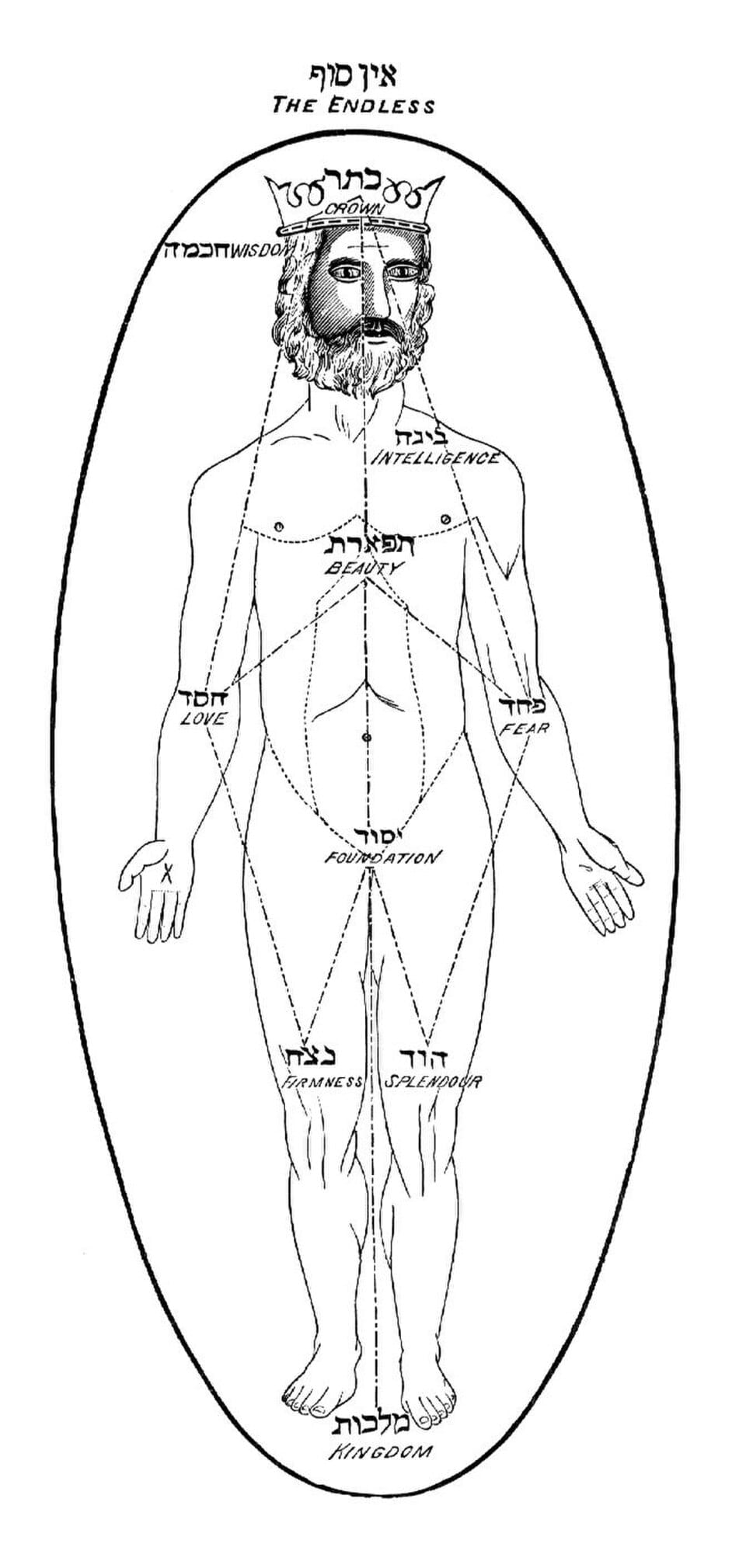
Each of the 10 standard sefirot are recited in the poem, which is another allusion to Jewish exorcism practice and mysticism. There are many traditions around the sefirot, some contradictory, such as mapping them to the human body or framing them simultaneously as universal and deeply internal. Some traditions “utilize contradiction [when dialectically engaging with the sefirot] in order to present” the theological cosmology of their preference, while others — such as Chabad, which is named after the combination or mediation of the sefirot Khokhmah, Bineh, and Daat — infer emergent, three-part additional sefirot from the confluence of the “standard” 10. Ultimately, the sefirot are understood to be qualities or aspects of god and the divine or spiritual world in general, and many mystic and folk traditions invoke them in whole or in part, in various formulations and mappings. I used them in their most barebones and basic formulation for this poem. Loosely, each sefira translates as follows:
Keter is crown, and is not typically closely associated with anything in particular, being the unknowable from which all other sefirot flow;
Khokhmah is wisdom, inherited and internalized understanding;
Binah is intellectual understanding, the consciously directed calculus of a human mind;
Khesed is kindness and mercy;
Gevurah is wrath and retribution, and also discipline and boundaries;
Tiferet is harmonic beauty;
Netzakh is victory and perseverance;
Hod is humility, empathy, submission, and allyship;
Yesod is earthly foundation; and
Malkhut is divine kingdom, where the sefirot are instrumentalized in the material world.
Dybbukim are believed to be angry spirits with unfinished business. However, when they possess a victim, they don’t necessarily attempt to resolve their unfinished business, but rather lash out in an exercise of malice, wrath, and destruction.
Effectively, the trauma suffered by a dybbuk in its life causes it to inflict more trauma in its cursed existence as a dybbuk. I can think of few better metaphors for what Zionism has done to my beloved Jewish peoples. And as a result, the purpose of the exorcism is not to castigate the possessed, who are ultimately victims of the dybbuk as well, but to open their eyes to the horror their possessed minds have wrought and facilitated. I wanted to emphasize that tikkun, repair, can be made if the possessed would just rip themselves free of the dybbuk of Zionism Thus, the final words of the poem are a call for tikkun olam — repair of the world.
Of course, Zionism and Israel are a twin dybbuk to capitalism, a theory of economics that places the role of capital, the power to dictate allocation of resources and labor, as generating more capital for its possessors. This is identical to the fascist worship of power for the sake of power itself. This is why you will see sprinkled through the lines of my poem references to various anti-capitalist revolutionary klezmer, in particular In Zaltzikyn Yam, the Yiddish poem written by S. Ansky in 1901 and dedicated to the Jewish Labor Bund.
Finally, I reference the numbers 613 and 365. There are 613 mitzvos in total, and of those 613, there are 365 negative mitzvos (e.g., don’t eat treyf). I also want to make a final note about the spelling of Hebrew words. It is one of my deep pet peeves to see anglicization of non-European words so wildly revise them. I know, there are lots of historical reasons for this in various contexts, but it’s my poem so I get to do what I want. There is no deeper meaning to the less anglicized spelling than my own neurotic idiosyncrasies. But I promise I won’t scold you for pronouncing the sefirot as “Hessed” or “Hochmah.” Who am I to dictate how you engage with Hebrew? Some sort of Zionist?
Special thanks to Ian Weiner for additional editing and consultation on this piece.