Re-Inventing the Jewish Workers' Bund: Yiddishkayt Socialism and the Politics of U.S. Post-Memory
In a time in which politicized nostalgia is everywhere, Molly Crabapple's "Here Where We Live Is Our Country" disrupts a narrative of a past that works only to secure a dystopian present.
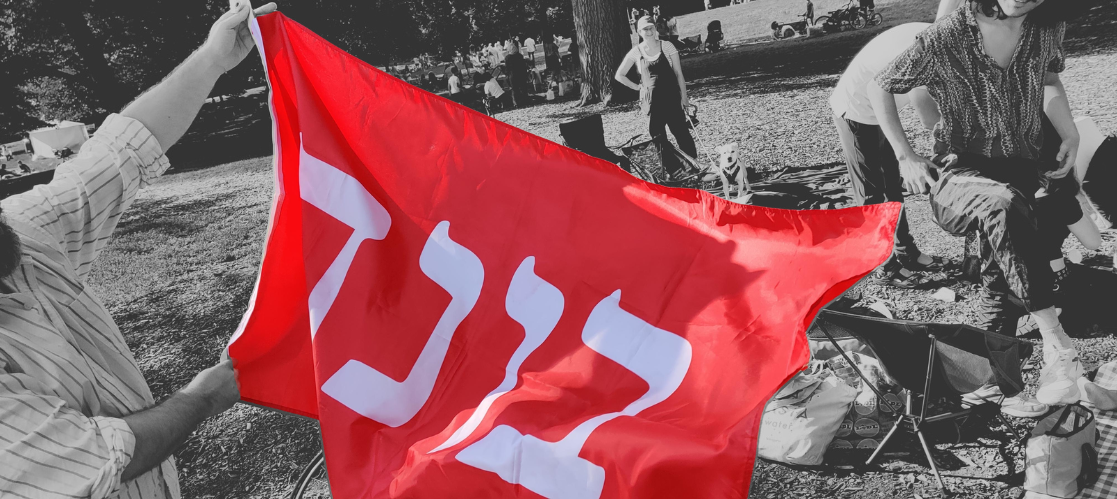
The Jewish Labor Bund seems to be having a moment. Molly Crabapple's Here Where We Live is Our Country: The Story of the Jewish Bund is a runaway bestseller. The book has topped reading lists of progressive shuls, Jewish Voice for Peace chapters, and IfNotNow groups. Neo-Bundish organizations have sprung up from San Francisco to Philadelphia to Chicago. In one sense, the rise of neo-Bundism is straightforward: we are in a moment of left-wing and anti-Zionist upsurge, and the Bund was, for a time, the most powerful socialist organization in Eastern Europe, led by anti-Zionist Jewish radicals. Crabapple's book is of course not the first book or representation of the Bund in U.S. culture, even if it is perhaps the most colorfully written, narratively rich and, the most popular. Nor of course, is this the beginning of Bundism in the United States, even if the actual Bund as an organization never had much of a presence on these shores. Yet there is a distinct moment in which the Bund, as a project of post-memory, begins, when the Bund and Bundism are no longer just historical movements, but become a means through which to narrate the present: Bund memory marks a conjuncture, one could say, that marks the era in all of its contradictions.
To be clear, there has never been a moment in which the Jewish Labor Bund was entirely forgotten — there were Warsaw Ghetto Uprising memorials going back to the late 1940s, and academic studies began to appear in the late 1950s. Of course, the Bund had an office in New York City post-World War II, and continues to have an ongoing presence in Australia. Yet the Bund began to capture a radical Jewish imagination in the U.S. in earnest in the 1970s with two organizations: the Chutzpah Collective in Chicago, and the Brooklyn Bridge Collective in New York City. These small Jewish socialist collectives — numbering perhaps in the dozens of full-time activist members yet within far wider networks of support — emerged out of the crack-up of Students for a Democratic Society (SDS) in 1969 and the ashes of the New Left more generally. Most of the members were themselves SDS activists, participants in the pro-Cuba Venceramos Brigades, organizers of anti-war marches and allies of the Black Panther Party and the Committee to Free Angela Davis. Yet as the Vietnam War wound down and the New Left fractured in different directions — some into liberal politics, others "into industry" and union organizing and still others into underground militancy — these Jewish members took a page from the Young Lords and Panthers and sought to create revolutionary identitarian organizations that were both internationalist and yet attuned to their communities’ own particular needs.
To create radical Jewish nationalist groups in the early 1970s is not as outlandish as it may sound. It was, as one Brooklyn Bridge column claimed, an era of revolutionary nationalisms, from Vietnam to Algeria, from the Young Lords in Harlem and the Panthers in Oakland. It was also the era of radical identity politics, with the Combahee River Collective's manifesto calling for an organization that represented Black, working class women and arguing for their unique, and particular, standpoint on radicalism. For American Jews, the emergence of the U.S. institutional "Zionist consensus" was interpreted by some to be exactly this Jewish answer to Black power. On the radical right, Meir Kahane and his black-bereted Jewish Defense League waged war against the "Uncle Jakes" who were too assimilated or too internationalist to support Zionism. While not quite so flamboyant, formerly liberal Jewish institutions took the occasion to purge their ranks of national dissenters and anti-Zionist skeptics still lingering on staff.
Of course, the Jewish nationalist turn to Zionism was far different from the Panthers and Lords. Not only was Israel constructed through ethnic cleansing of Palestine's indigenous occupants, it was on the side of the United States against pan-Arab anti-colonial uprisings. The lightning victory of the 6-Day War was greeted with jubilation in the U.S. press and Congress: Zionism was not a threat to Jewish assimilation, but rather its new articulation. Zionism was promoted by mainstream publications, openly and directly: IDF soldiers were grinning on the cover of Time and Life magazines; Israel was every politician's favorite story of a little country that could (defeat communism and anti-colonialism). While Zionists were long a presence in the U.S. institutional Jewish world — on the center-right with the American Jewish Committee and on the center left with the Jewish Labor Committee — most Jewish institutions and especially Jewish leftists were anti- or more often "non-Zionists" up until the late 1960s. The rise of American identity politics, white backlash, and growing Jewish institutional incorporation into the state all converged in this moment to turn Jewish liberal institutions into Zionist institutions.
The rise of Zionism in the U.S. also coincided with the end of America's articulations of Bundism. The late 1960s witnessed the declension of the U.S. yiddishkayt left, as much by force as by assimilation. U.S. yiddishkayt socialism, which had preceded the Bund in Eastern Europe by two decades even if it in other ways grew in tandem, transformed both the Jewish labor movement and also the labor movement itself. Once even greater in size than the Jewish Bund of Eastern Europe, the socialist Arbeter Ring and communist Jewish People's Fraternal Order (JPFO) each had many tens of thousands of members, their own newspapers, clubs, aligned labor unions, summer camps and schools. The Yidishe Kulture movement also importantly challenged racist and eugenicist ideas held by most labor leaders in the U.S. that immigrants should assimilate and whiten, or else face expulsion and even extinction. It is not an overstatement to suggest that for several decades, the yiddishkayt labor movement and its aligned organizations and newspapers were among the most politically sophisticated in the labor movement on questions of class and identity: they understood anti-racism and cultural celebration were not outside of working class concerns, but given the racial nature of class formation in the U.S., central to them.
Yet by the 1950s, their influence began to unravel: the JPFO in particular was targeted by the state for its association with the Communist Party. It was banned at the peak of the Red Scare, its assets seized and its members and leaders threatened with arrest and deportation. The JPFO, the largest of the "ethnic" communist organizations, was literally disappeared as a social formation. Its last living vestige, Camp Kinderland, is but a reminder of the wide network of Yiddishe shules, summer camps, and organizing drives that the organization used to sponsor. The Workers' Circle did not suffer the same fate, but the twin pressures of urban renewal — the literal bulldozing of Jewish neighborhoods in New York, Chicago and Los Angeles — combined with members' upward mobility and the organizations' own fade into anti-communist liberalism meant that by the 1970s, its force as an organization had greatly diminished. The very organizations that might have, decades earlier, provided a counter-weight to Zionist nationalism were either destroyed by the state or, aside from a few active chapters, had lapsed into senescence.
The Chutzpah of It: Neo-Bundism and a New Jewish Left
The emergence of the Brooklyn Bridge Collective and Chutzpah were responses to these twin conjunctures: the fall of American Yiddish socialism and the rise of Zionism in the American Jewish community. In one sense, these organizations were practical efforts by Jewish radicals to continue their New Left politics in a new moment: if "identity" was to be new terrain of struggle, then they would meet the moment in history on those terms. "We wanted to be Jews on the left and the left among Jews," Chutzpah co-founder Myron Perlman wrote in an inaugural issue of Chutzpah. They were, you could say, the left-wing version of Jewish Renewal, Rabbi Waskow's famous statement that Jewish radicals were to become "radical Jews." Yet there were also attempts to re-make a Jewish left in a moment in which older models of Jewish left organizing, from Yiddish schools to labor unions, were foreclosed.
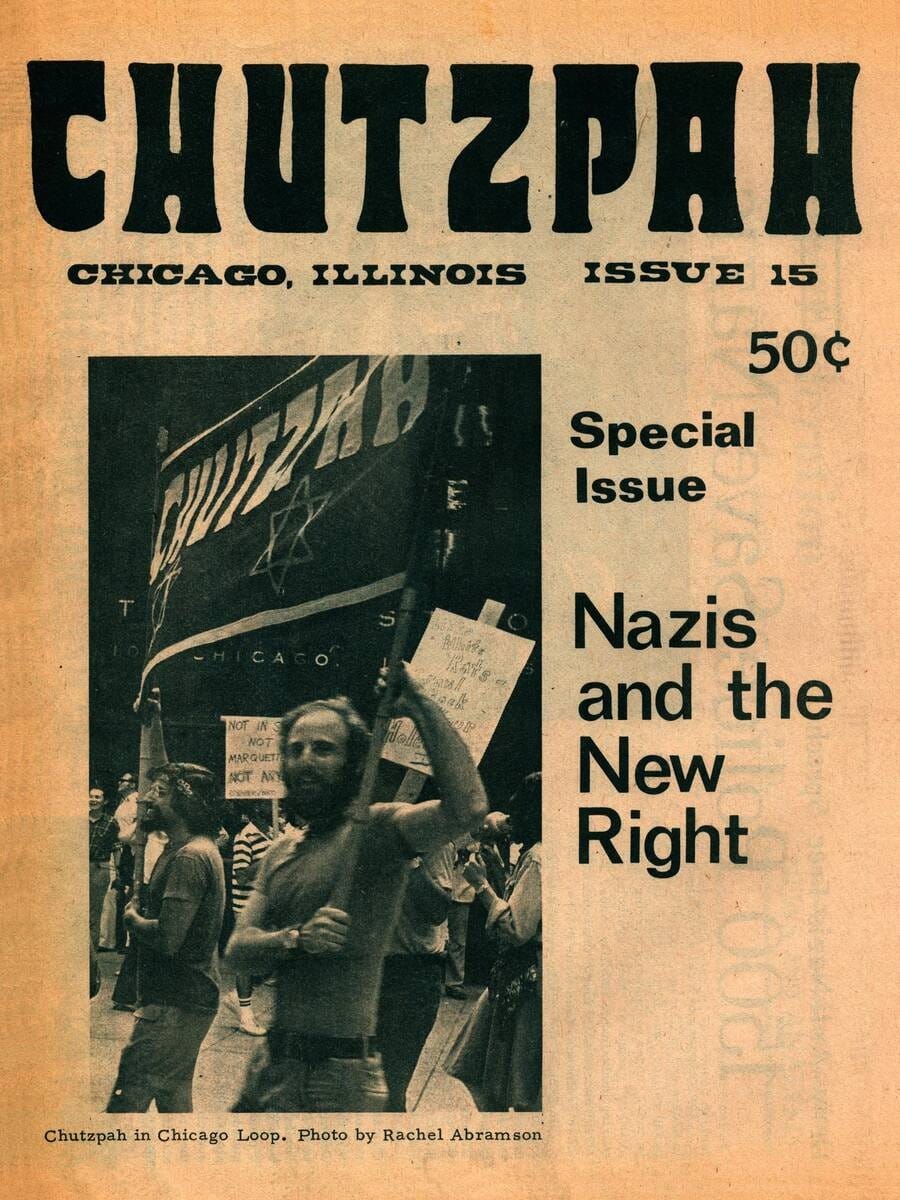
While Brooklyn Bridge and Chutzpah organized protests and mutual aid, perhaps their most important endeavor were their newspapers, which were a mix of movement reportage, theoretical arguments about Jewish identity, and more than anything else, memory production: works on Jewish left movements in the past.
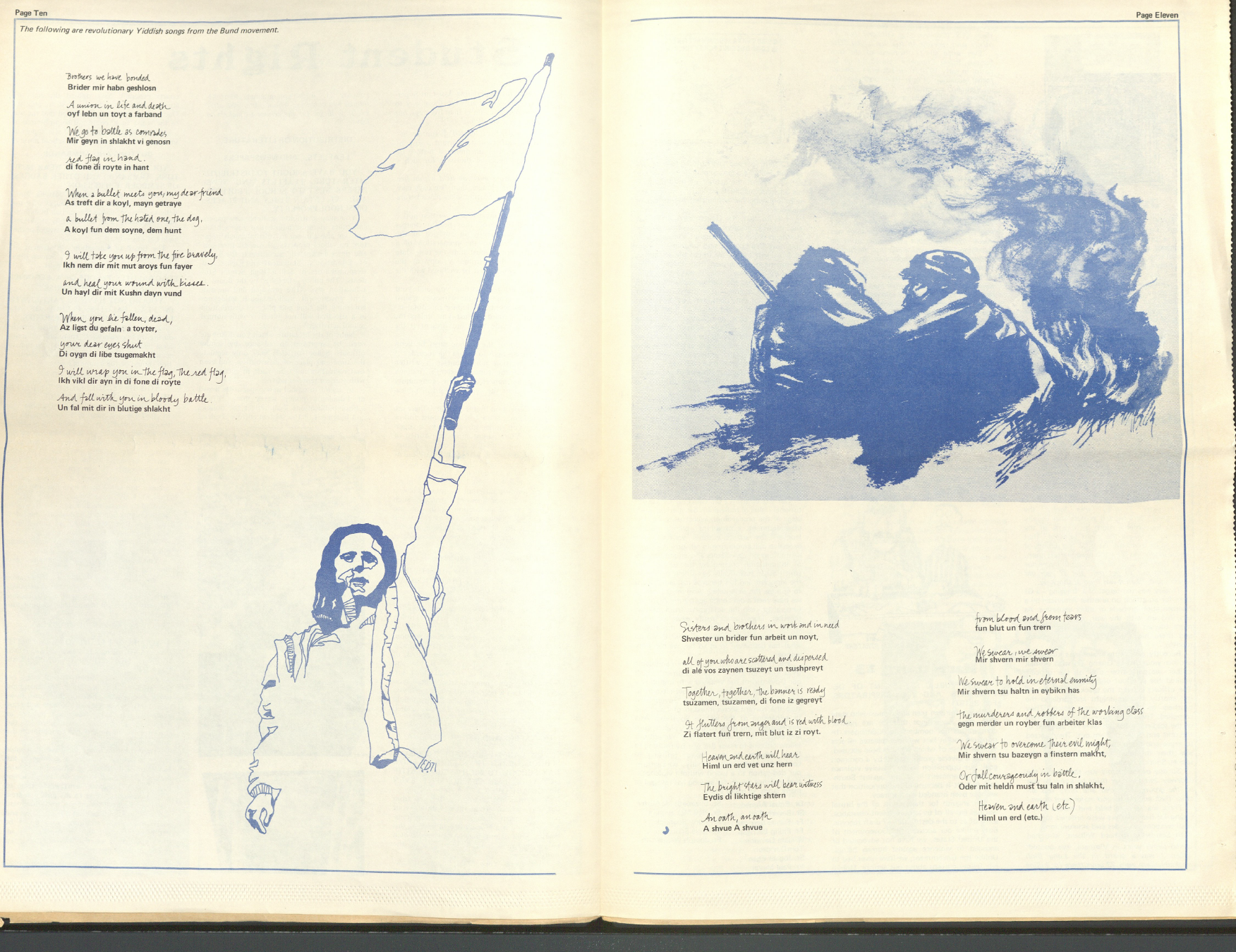
Brooklyn Bridge and Chutzpah both ran stories about the Bund in their early 1971 issues. Their stories curiously began the same, with a declaration of memory and forgetting: "Most Jews know something of their Biblical past, and a little about Zionism … unfortunately, few know anything about … groups like the General Jewish Workers' Union in Russia and Poland, or the Bund as it came to be called," as Myron Perlman wrote for Chutzpah. The Brooklyn Bridge put it even more bluntly: "It is not surprising most people, even most Jewish people, know nothing about the Bund." Both articles trace the outlines of the Bund's history, its origins in the late 19th century, struggles with the Bolsheviks over its autonomy and finally its end in the Holocaust. Yet the focus for both essays was on the Bund's modernity, that they were a "new type of organization in the Jewish community, based on national feelings and class oppression rather than religion," and represented a "new era for the modern Jew."
Both articles stressed that the Bund was a "nationalist organization," and yet also "internationalist." A "nation without a state" as Brooklyn Bridge put it, or "national without nationalism" as Chutzpah framed it. Both also stressed that the Bund was democratic, rooted in community, and offered a new "revolutionary lifestyle," a "counterculture" of radical and Jewish daily life. It should be noted as well that the articles about the Bund were accompanied in Chutzpah with partisan songs, stories of anti-fascist resistance, and in Brooklyn Bridge, articles about other Jewish nationalist groups, including the Israeli Black Panther Party and the Jewish Defense League. Brooklyn Bridge's "Revolutionary Jewish Nationalism," as one article suggested, was a rejection of the narrow nationalism of the JDL and an embrace of the Black Panthers, in Israel and the United States. In the same issue, Brooklyn Bridge declares a break with "American assimilation" and a statement that their strongest allies will be our "Black, Latin, Asian and Indian sisters and brothers" who are "fighting for their self-determination."
Bund as Post-Memory
The Bund is memory, but as a way to narrate the present. Rather than "ideology," as Aleida Assmann writes, "memory" becomes the modality through which solidarities are articulated. In other words, one’s politics are less a question of what one believes or what politics one aligns with, but what one claims as past. The peculiarity of this memory work is that it arrives at precisely the moment such politics cannot be lived in the United States. Up until the Red Scare and even for several years after, one could really talk of "revolutionary Yiddishland" in New York City, Los Angeles, and Chicago, insofar as one could live an entire lifeworld within one of two or three socialist yiddishkayt communities. The Bund is remembered at precisely the moment that, like Zionism, Jewishness is less a material relationship embedded in a particular place, but a portable identity one can articulate anywhere. The inaugural issue of Brooklyn Bridge very literally if also ironically brought this point home: "we are coming home" the cover announced, "to Brooklyn." While a sarcastic wink to Zionism, it also articulated home as a place that is not our country, but one we are trying to return to.
Historian Enzo Traverso remarks that Marxism and memory are often thought to be "separate continents." Marxism is imagined to be a positivistic account of historical events and a scientific approach to social transformation and revolution, and memory is subjective, cyclical, sentimental. Yosef Hayim Yerushalmi contrasted Jewish "memory" as being "mythic" and "cyclical," leaving objective historians such as himself often at odds with the folkways and oral traditions of the culture about which he writes. Literary critic Frederic Jameson also contrasts "nostalgia" with "history," the former suggesting a flat, affective plane of a timeless present, the latter the ongoing struggle between classes that force social transformation. One feels nostalgic for places that are gone; history demands we confront with an iron gaze the realities of the present. In this sense, if we were being radical historical materialists, we might say that remembering the Bund is such an act of nostalgia, substituting the real conditions of material reality — class — for a mystical and mystified identity construction. While the wealth of Jews is often grotesquely overstated (and indeed American Jews are not the wealthiest ethnic group in the U.S.), most American Jews are no longer sweatshop workers on the Lower East Side. With twice the average college graduate rate and a median income one-third higher than the American average, American Jews are by and large middle-class, the majority of whom descend from European ancestors. Remembering Jewish alterity, according to this linear progression of history, would be an act of fantasy or worse, disavowal of Jewish whiteness.
Yet it was just this faith in the movement history that prompted Walter Benjamin, in his final essay, to pose whether it was the historian’s job not to predict the conditions of success, but rather, chronicle defeats, and transcribe the names that would otherwise be lost. For Benjamin, the act of the historian was not to say "how it was," or even how it is, but rather to cut across the grain of the present with memory of past movements. History is less about the city of the future, and rather the graves torn up by the bulldozers, whether in defeat or that most terrible form of loss, progress. For Benjamin, revolutions are nourished with the image of "enslaved ancestors" rather than "liberated grandchildren." This suggests in a sense a different idea of history and revolution: revolutions may be conservative, even backward-facing, looking to stop the advance of progress rather than master it.
In this sense, memory, or what scholar Marianne Hirsch refers to as "post-memory," the identification with an historical event one has not experienced, is not only a means to de-naturalize the present, it is also the inevitable language of a left that no longer can or perhaps no longer wishes to articulate the straight lines of history, the inevitable teleology of revolution. Indeed, it is not an accident that memory of the Bund is not articulated in the height of radical struggle in the late 1960s, but rather as this movement fractured and gave way to both a right-wing backlash, the rise of neoliberalism, and of course, Zionism. Bund memory is part of the affective structure of an era of loss: we cannot win socialism, but we can remember past defeats. Insofar as it is part of "left-wing melancholy," in Traverso's phrase, it is also a counter-memory, a refusal to surrender to the dictates of the present. It may serve at once as a mystification, and also, a utopian horizon of the past to speak against the dystopian horizon of a Zionist present. That these are contradictions is also part of the historical conjuncture.
Where We Want to Live is Our Country
Since Brooklyn Bridge and Chutzpah published their retrospectives on the Bund and their odes to revolutionary Yiddish culture, there have been several other studies of Bund, notably Alain Brossat and Sylvie Klingberg's Revolutionary Yiddishland, published in French in the early 1980s, but not arriving into English until Verso published a translation in 2016. There have also been several admirable academic studies by historians Jack Jacobs and David Slucki, chronicling the Bund's interwar years in Poland as well the afterlife of the Bund post-Holocaust. While all of them have been well-received — and the translation of Brossat/Klingberg's history became a touchstone for the antifascist protests of 2016 and 2017 — Crabapple's book has broken through not only to be a bestseller, but to land her book reviews and speaking engagements far outside of the usual beat of the Jewish left, including the New York Times, The Guardian, NPR, Democracy Now!, Marc Lamont Hill's podcast and elsewhere. In no small part, this is a response to our new historical conjuncture, in which Israel's accelerated genocide of Palestine has left not only progressive Jews but many former supporters of Israel wondering if there might have been a different path than a settler-colonial nation in the Middle East.
As much of the success of the book responds to the crisis of the present, Here Where We Live speaks to the affective and cultural articulation of the present in ways nearly a dozen other recent books on Jewish anti-Zionism do not. What is striking about the book is its immediacy. As Anna Kornbluh notes, culture in late capitalism is marked by its lack of mediation. TikTok videos, live-streams, reality shows, true crime, Fortnite, live shooter games, the iPhone capture of police brutality, sex tapes, and even genocide, mass culture of the present places the viewer in the action: there is little space for critical thought or remove, one is simply there, wholly in the present, an actor in the drama one witnesses. Such immediate culture may create cross-class, cross-race cultures of feeling, in which wide swaths of the globe may identify in an instant; they also may create affective cultures of insularity and distrust, for those who feel differently. Feeling is a state of belonging in and of itself. When one opens Crabapple's book, one is struck by its very literal and visceral presence: Crabapple is a character in the story, and the Bund in many ways, is now.
"Bund memory is part of the affective structure of an era of loss: we cannot win socialism, but we can remember past defeats. Insofar as it is part of "left-wing melancholy," in Traverso's phrase, it is also a counter-memory, a refusal to surrender to the dictates of the present."
As the book opens, the author identifies the early 20th century Bundists as not just revolutionary antecedents, but people with whom she shares a "kinship," a trans-historical and transnational identification: "like them, I knew the floor of a police cell, the boredom of a leftist meeting, the electric charge of passing a pamphlet to a stranger." She "sauntered the same streets" with Bundists in Brooklyn, lived in a "squalid tenement in Williamsburg," had, like Bundists such as Vladimir Medem, a "stint in Exileland" in Istanbul as a journalist, and like Medem, recognizes "something in [his] awkward groping for an identity" that recalls her own struggles with belonging. Often Crabapple says she can literally see the people she writes about "squint as she translates a Marxist pamphlet into Yiddish" or mark people as objects of contemporary desire, such as Polish Bundist with slicked back hair, "a glamorous ideal, a real butch." The immediacy goes historically both ways, into the past, and from the past into the present: "how many girls like Pati" — a young Bundist — "have fallen for cold, ironic boys like Arkady Kremer … New York's angry radicals, the mean Derrida quoting grad students, the pouty anarchists fresh out of lockup, the supposedly brilliant writers who preferred video games to writing..." And of the early Bund's attempts to create an organization in Vilna, she remarks that they failed to go into factories but rather created reading groups for "hipsters."
In ways reminiscent of the Brooklyn Bridge Collective and Chutzpah, Crabapple frequently compares the Bund to the Black Panther Party and to speeches by Fred Hampton. For Brooklyn Bridge as for Crabapple, the comparison serves as a means to narrate questions about identity, race, class, and colonialism that were very much a feature of the early 1970s as they are of the present. With the rise of socialist politics from Democratic Socialists of America (DSA) to more sectarian organizations such as Party of Socialist Liberation (PSL) and Tempest, questions of "class" and "race," whether workers of color should join with white comrades, how much attention should be paid to demands that benefit all workers, or demands to end forms of structural inequality between workers, are as present as they were during the 1970s break-up of the New Left. As she writes of Vladimir Medem, one of the chief theorists of the Bund:
Class came first for socialists like Medem. His sympathies lay with Polish factory workers, not Jewish industrial barons. 'Solidarity of the entire nation means giving up class struggle, [and the] spiritual and material enslavement of the proletariat,' he wrote. When, decades later, the Black Panther Party chairman Fred Hampton said, 'We say we're not going to fight capitalism with black capitalism, but we're going to fight it with socialism,' Medem would have cheered. But class war alone would not eliminate the racism Jews faced in the tsarist empire, nor the self-contempt it bred, which had made assimilation seem like the price of acceptance.
Later she writes of the Bund, "their methods remind me of those of America's Black Panther Party, another group of young radicals who carried guns and started free breakfast programs and asserted their people's beauty in a country that wanted them dead." Crabapple likewise compares the self-defense squads to the Algerian anti-colonial fighters, for whom "picking up a gun turned from object of history, to subject."
In doing so, the book makes a distinction between the Bundish concept of doikayt and contemporary theorists of diasporism such as Judith Butler or Daniel Boyarin, who articulate the diaspora as less a country but an ethic of collaboration, co-habitation, and regard for the other. Diaspora for Boyarin and Butler is not a place, but a social relationship. For other diasporists such as Shaul Magid, diaspora is a spiritual relationship to the mashiach. For Crabapple and her Bundists, doikayt is not such progressive cosmopolitanism, however dialectically related to the socialist internationalism and Jewish identity. Eastern Europe was "home," not merely a metaphor of belonging or an imagined community of Yiddish speakers. "The Bund believed that Jews belonged in eastern Europe. 'We are not strangers and we are not guests,' one local Bund committee wrote, 'the richness of the land is soaked through with our blood.’" While this contrasts with Zionists, for whom Jerusalem was home, no matter who else may be living there, it is nevertheless a kind of national belonging, a nationalism, that evokes images of blood, land and armed self-defense. Narrating the discourse of doikayt, Crabapple describes a photo of Bundists, in black, with guns and stern, resolute faces standing over their dead comrades, killed by Christians. To be clear, the Bund was an organization of socialists and internationalists, yet their sense of belonging and rootedness — and their nationalism — was not mere metaphor.
This sense of belonging extends as well to the book's portrait of the Bolsheviks. While it is no secret that the Bund and the Bolsheviks sparred, to put it mildly, from the 1903 Russian Socialist Congress until the Soviet Union eventually in effect banned the Bund as an organization in the 1920s, the text represents the struggle in surprisingly embodied terms. Vladimir Lenin, a "man of few scruples" who flew into "debilitating rages" and who has "small crafty eyes," a "devilish smile" and who "bared his teeth" like an animal, is presented not merely as an opponent to the Bund, but a kind of cartoon villain. Trotsky comes off little better, described as having a "mordant mouth," and his chosen nom du guerre — Trotsky for Bronstein — compared as an attempt to "pass," akin to "Jews under a surgeon's knife, to awake on Sixty-ninth street with money and a hip nose." Trotsky, most of all, is discussed as an opportunist, someone who was "always one to seize a moment," and "wasted no time" during the 1905 Revolution to "transform himself into a star." Trotsky, even more than Lenin, is portrayed as Enzo Traverso once described him, a "comrade Shylock," an eternal outsider who mistook the left for a place where he could leave "the cage" of the Pale of Settlement. There is more than a whiff of old-fashioned anticommunism here: to be a Communist is to be too Jewish, and not Jewish all.
"If the conditions of the Pale of Settlement demanded a Bund, even if the values remain the same in a new socialist Yiddishkayt movement, what does organizing in 21st century America require?"
While I do not fault Crabapple for choosing sides between the Bund and the Bolsheviks — it is the story of the Bund, after all — the representation of the Bolsheviks reveals one of the critical tensions in the immediacy promised by the cultures of memory. If the Bundists are "home" in Europe, then the Bolsheviks are interlopers, attempting to deny them their right — literally and figuratively — to represent Jews in the Pale. Yet, even as Crabapple’s book is a partisan of the Bund, even she admits the question is complicated: indeed, far more radical Jews joined the Bolsheviks during the October Revolution than joined the Bund, in no small part for the Bund's disastrous decision to back Kerensky and continue the war against Germany. And even if one can agree that the Bolshevik Revolution turned out badly for the Yiddishists, the story is perhaps more complicated for Jews as a whole. While Stalin was an antisemite and persecuted not only the Bund but Jewish communists with particular fervor, it was after all state power — and not Yiddish culture — that stopped the Nazis and allowed 3 million Jews to survive east of Ukraine after the war. The Bolshevik Revolution attracted Jews in the Pale as the only force that could — and often did — punish pogromists. The Red Army imprisoned pogrom agitators and sometimes even shot them on the spot, even as, at the same time, the Revolution unleashed a wave of antisemitic violence by the Whites and far less frequently, by members of the Red Guards. Crabapple gestures to this complexity when she depicts the Red Army pouring over the border to Poland and stopping a fascist pogrom, executing the far-right Polish pogromist on the spot: "The Red Army's arrival didn't just halt Tyminski's pogrom. It promised protection from the Nazi advance." One can see why the attraction of socialist state power and the promise of equality is not an easy question — nor one that has an immediate correlative in contemporary American Jewish life.
The Radical Disruptions of Bundist Memory
The politics of immediacy and memory, however, are far more disruptive, radical, and generative when it comes to both Zionism and especially the Holocaust. The book is unsparing in its contempt for Zionism, not least because David Ben-Gurion and Ze'ev Jabotinsky "pranced on Polish stages, giving speeches that supported the pogromists demand for Jews to leave," as Crabapple describes. Jabotinsky further sided with the Polish government in the early 1930s to expel Jews from Poland, and offered to "evacuate" them to Palestine, a "fine distinction the Bund did not appreciate." To bring the point home, the Zionists are not merely colonialists; they are a “parade of Jewish fascists.” The most militant of the Zionists, Betar, the militia organized by Ze’ev Jabotinsky’s, may have merely been a grotesque spectacle of brown-shirted Jewish youth in Poland; in Mandate Palestine, they trained to shoot guns, raided Yiddish cultural events, destroyed businesses of Jews who hired Palestinian workers, and menaced Palestinians.
Perhaps the most moving section on Palestine was Crabapple's portrait of Musa al-Husayni, President of the Palestine Arab Congress and mayor of Jerusalem, who demanded freedom from British rule and also extended the hand of citizenship and friendship to Palestine's growing Jewish population. Al-Husayni "explained that the Palestine Arab Congress aspired to a democracy that represented Christians, Jews and Muslims … we are not fighting against Jews, but only for our freedom." Al-Husayni, despite or perhaps because of his sincere desire for Palestine to be a democratic state for all its people, was gunned down on the street by the British during a demonstration for Palestinian freedom.
The most compelling and radical section of the book is, in a way, the territory most frequently covered by mainstream Jewish history: the Holocaust. Of all the Zionist myths of course, it is the Shoah that lay at the center, both as the act that united the world's Jews in their need for a state, and also, as a violent redemption for the supposed passivity of Jewish victims. In one of the most gripping scenes (in a section that is both arresting and impossible to put down) Leon Feiner, a Bundist and the first to document the crimes of the Holocaust while it was still ongoing, offers his "message" to the "Jewish leaders of the West," many of whom such as the AJC president Joseph Proskauer, refused to openly oppose Roosevelt's barring of Jewish refugees to the United States:
Tell them there are moments when we hate them all...because they are safe 'there' and do not rescue us. Because they don't do enough...let the Jewish leaders, then, do something that will force the other world to believe us...We are all dying here, let them die too...let them crowd the offices of Churchill and others, let them proclaim a fast before the doors of the mightiest and not retreat until they believe us, until they take some action to rescue those of our people who are still alive.
For those who would argue the Bund "failed" while Zionists succeeded, this turns the tables on whose failure the Holocaust really was. Of course, the Western powers that banned Jewish refugees are the most to blame, yet it was neither Zionism that ended the Holocaust, nor was it Zionists who put their lives on the line to pressure Western states to act. There was a Jewish failure, and it was not the failure of arms but rather the failure to have courage even in democracies in which the stakes were quite low. "Death is not glorious...." the book concludes of the Shoah, "there was no grand moral, just dissolution … survivors tell me how much they hate sentimental portrayals of the Holocaust." The most sentimental of course, is that the Holocaust is settled memory, even for Jews. This form of post-memory is radical precisely because the Holocaust has been so mythologized.
This is the paradox of memory, and of Crabapple's arresting and evocative book. The book is, as it calls itself, a "story," "the" story of the Bund, and it reads much like that — a counter-memory to the immediacy of Zionism's over-produced post-memories. This is why the most radical parts of the text are those that intervene in the memory-making of American mainstream Jewish life, that posit the Holocaust as the story of undifferentiated Jewish victims, and Zionism the heroic creation of a state from the ashes of the Warsaw Ghetto. As Crabapple herself writes at the end, the symbol of the Warsaw Ghetto Uprising remains unsettled and overdetermined: Zionists declare the fighters as "proto-Zionists," Polish nationalists declare the uprising as part of the "legend of Fighting Poland," and in Palestine, as sign of resistance to an on-going genocide, named it the "Warsaw Ghetto Intifadah."
Memory is a presentist discourse, and the genius of Crabapple's book in a way is to own its presentism completely: she, and thus her readers, are present actors in a drama that is still ongoing. In the sections that dramatize the Holocaust and Zionism, with the rise of neo-fascism and the crimes of the Israeli state, it does feel like the events of the early 20th century are indeed repeating, with of course differences, and similarities. We are living in a post-memory world, with violent actors for whom these post-memories are not ghosts. Yet for the narrative that does not translate — the revolutionaries striding down the streets of Yiddishland with their leather jackets, sixguns and armbands during inter-left struggles for power after World War I — one wonders how well memory may or may not be a guide to the present. Our own socialist moment, in which race, Jewishness, and state power, all look quite different, may require a more dialectical articulation of memory and Marxism.
Which Direction, the Past?
We are living in a time in which politicized nostalgia is everywhere, most palpably on the right: Make American Great Again is, if nothing else, a vehicle for American memory, offered up in the form of trad wives, AI slop of all-white small towns, Cracker Barrel sententiousness, and Yellowstone ranchers on TV. As Thomas Frank noted recently in Harpers, “Nostalgia is today a structural feature of our modern world, the emptiness and vapidity at the heart of our culture…endless remakes and extensions of Eighties movie franchises, an ongoing pastiche of old architectural styles, the umpteenth return of preppy fashion, those Nirvana T-shirts you see everywhere…”
What makes Crabapple’s Bund memory different — and other Jewish memory works such as Caroline Luce’s writing about the California Yiddish left or histories of the JPFO — is they cut across the grain of the present, disrupting a narrative of a past that works only to secure a dystopian present. For all of the stories of Jewish upward mobility and the very literal settling of the “Jewish question” in the land of Canaan, the rise of neo-Nazi antisemitism, the re-proletarianization of the educated middle class (including Jewish middle class), and the presence of Jewish anti-Zionist activists on the streets speaks to long suppressed memories suddenly, like hastily buried corpses, rising to the present.
To take a page from the Chutzpah Collective, which is clearly a precursor not only to Crabapple’s book but to organizations such as IfNotNow and Jewish Voice for Peace, their own organizing was flexible, historically informed and yet keen to the contradictions of the present. One example I like to cite is their Warsaw Ghetto Uprising Coalition, organized to face the growing threat of 1970s white nationalists active in Chicago. When white nationalists threatened Jewish neighborhoods, Chutzpah took the lead often against the wishes of the ADL, which hoped the problem would go away so they could continue fund-raising for Israel. Chutzpah replaced “Hatikvah,” Israel’s national anthem, with Yiddish partisan songs and reprinted Bund anti-Nazi fliers. Yet when Chutzpah worked in coalition with South Side activists, they worked in coalition, with a young Harold Washington and the remnants of the Black Panthers taking the lead. In more comic and literary fashion, one could point to Adam Mansbach’s novel The Golem of Brooklyn, when a young Jewish schoolteacher resurrects a golem from the Vilna ghetto and watches with very real consternation as it rampages against neo-Nazis in the South. One can also think of JVP dropping a banner in Grand Central Station that read, “Never Again for Anyone,” a memory, and also a refracting present.
Obviously were there a pat formula we wouldn’t need novels or histories; these are questions that must be answered by writers and activists, in the times they live and in the conditions, as famously said, not of their choosing. Returning to Walter Benjamin, he notes in “Author as Producer” that a writer should not only concern themselves with the “attitude” of a work toward history, but also “the position within it” — not only what a work says, but where it is located in history, how it may speak to relations of power, where it finds itself within those relations. Quoting his close friend and confidant Bertolt Brecht, Benjamin went on to write that a work should not only demand one feel but also to think about the reader or viewer’s place in the “process of production.” In other words, if the conditions of the Pale of Settlement demanded a Bund, even if the values remain the same in a new socialist Yiddishkayt movement, what does organizing in 21st century America require? Even the Bund’s contemporaries in the Arbeter Ring and JPFO understood, with their Yiddish schools and socialist federations, that the United States was not Russia and this granted them more freedom, but also — especially for the JPFO — the necessity of organizing with workers of color. If there is one thing that Jewish diasporic history suggests, it is that dislocation and diaspora are hybrid. Transnationalism is, in Stuart Hall’s words, creole and polyglot, attuned to place and also placelessness. If there are no prescriptions, we can at least think of ways to make it new.